Wood Duck
The Leap of Faith: The Wood Duck
St. George Consulting — Living River Series
Introduction
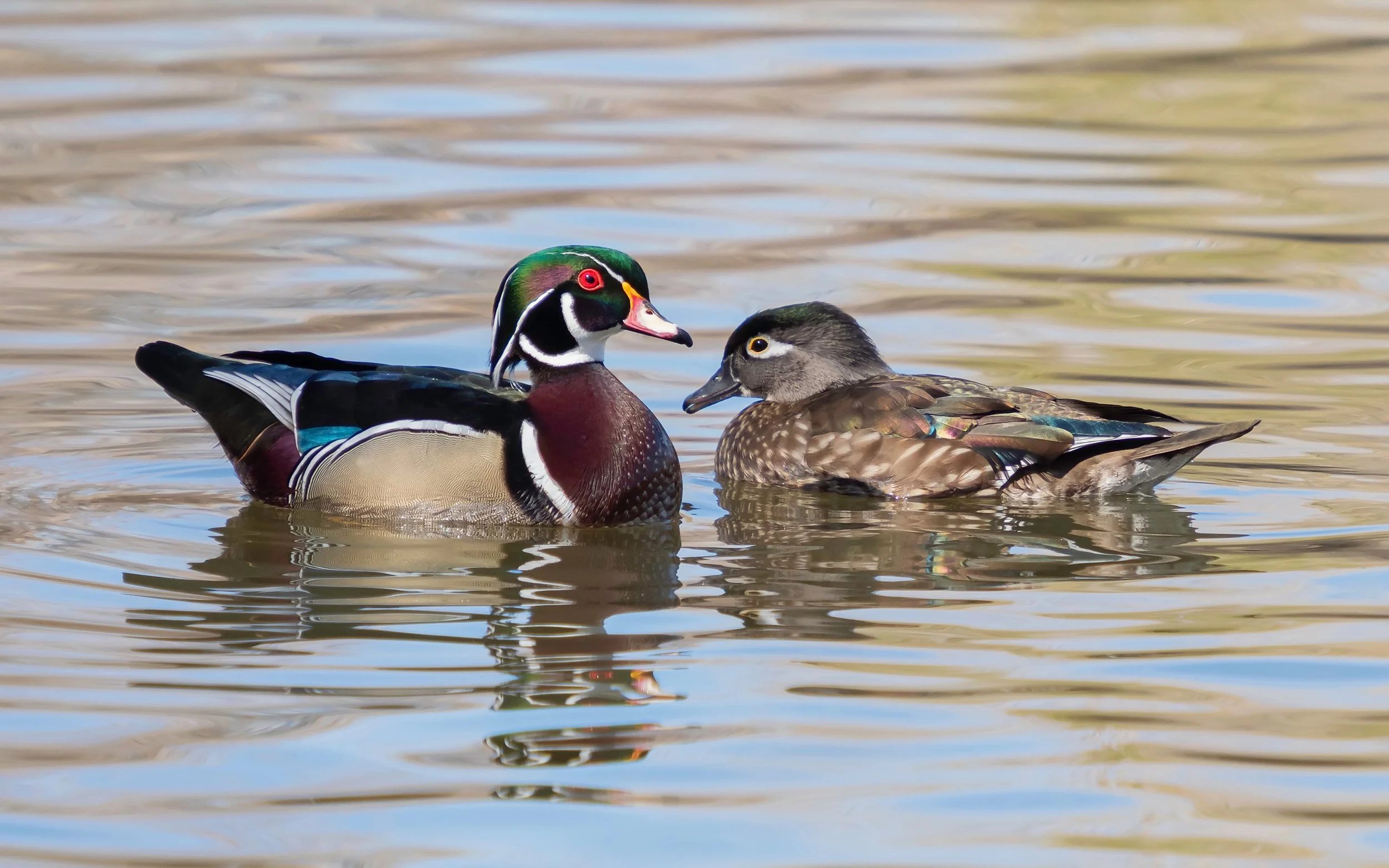
It is a reasonable argument that the male wood duck (Aix sponsa) is the most beautiful bird in North America. An iridescent green and purple crested head traced with white lines, a chestnut breast, warm tan flanks, a vivid red eye and red-tipped bill — the description sounds overdone until you see one gliding out of the shadowed edge of a beaver pond into a shaft of morning light, and then it seems barely adequate. Wood ducks are birds of the forested wetland, and the swampy backwaters, flooded woodland edges, and quiet pond margins of the St. George watershed are precisely the habitat they have shaped their lives around. They are here every summer, raising families in hollow trees, and their presence is one of the quieter joys the watershed extends to those paying attention.
Natural History
Wood ducks are medium-sized, compact ducks with a distinctive large head and a squared-off tail they hold cocked upward in flight. The male's plumage in breeding season is so elaborate it appears almost artificial. The female is subtler but striking in her own right — soft gray-brown with a bold white teardrop ring around the eye that makes her instantly identifiable, even in poor light.
They are cavity nesters, dependent on large hollow trees near water, and this dependence shaped both their near-extinction and their recovery. By 1900, a combination of unrestricted market hunting and the wholesale clearing of the old forests that provided nesting cavities had pushed wood ducks toward collapse. They were considered one of the most endangered waterfowl in North America. The Migratory Bird Treaty Act of 1918 halted the hunting, and the subsequent explosion of nest box programs — wooden boxes designed to mimic natural cavities, mounted on posts over water — did the rest. It is one of the most complete wildlife recoveries on record, driven almost entirely by habitat provision and harvest management.
Wood ducks eat a broad diet: acorns, wild grapes, berries, seeds of aquatic plants, aquatic insects, beetles, and invertebrates. The acorn is the centerpiece of their autumn diet, and their consumption and occasional dropping of acorns makes them modest but real dispersers of oak trees throughout the forested wetland landscape.
Role in the St. George River Watershed
Few species in this series are as thoroughly embedded in the watershed's physical structure as the wood duck. Their preferred habitat — flooded woodland, beaver-created ponds, slow backwaters edged with old trees — is exactly the landscape that American beavers (another subject in this series) build and maintain. Wherever beavers have raised the water table and killed standing timber, wood ducks find nesting cavities, protective cover, and calm water for raising ducklings. The relationship is not direct — wood ducks and beavers don't interact — but the beaver reshapes the landscape in precisely the ways that most benefit the duck.
Raccoons are the primary predator of wood duck nests and eggs, which is why nest boxes mounted on smooth metal poles in the middle of water are so effective — raccoons can't reach them. Mink are a serious threat to broods in and near the water, and snapping turtles take ducklings from below — another connection in the network of species this series has explored. Barred owls take ducklings at night, and large largemouth bass are a documented predator of very young ducklings in weedy ponds.
As consumers of aquatic invertebrates, wood ducks connect to the dragonfly, damselfly, and aquatic beetle communities of the watershed's wetlands. As acorn eaters and occasional seed droppers, they participate in the slow dispersal of oak and other hardwood mast across the wetland landscape.
The great blue heron shares the same forested wetland habitat, and the two species often occupy the same beaver ponds simultaneously — the heron hunting the shallows while the wood duck feeds along the vegetated margins, their ecological needs different enough that they rarely interfere with each other.
Seasonal Notes
Wood ducks arrive in the St. George watershed in April, among the earlier returning waterfowl. Nesting begins almost immediately, with eggs laid through April and May. Ducklings appear in late May and June and grow rapidly, becoming capable of flight in roughly 60 days. By September and October, families have dispersed and birds begin moving south, though some linger into November in mild autumns. The richly colored males are most visible in April and early May before they molt into a drab eclipse plumage through summer, making them considerably harder to identify until fall feathers return.
Fun Fact
Within 24 hours of hatching, wood ducklings must make one of the most dramatic leaps in the animal kingdom. The female calls from the ground below the nest cavity — which may be 50 feet or more above the forest floor — and the ducklings, one by one, climb to the entrance and jump. They have no flight feathers. They are covered in down. They tumble through branches, bounce off roots, and land on the ground or in the water below, almost always unhurt. Their tiny bodies are so light and their down so shock-absorbing that the fall that would kill an adult bird is merely an inconvenience to a day-old duckling. They shake themselves off and follow their mother to the water.
Want to Learn More?
- Cornell Lab of Ornithology — Wood Duck — Species account with field marks, calls, range maps, and the full recovery story.
- Maine Audubon — Wood Duck Nest Boxes — How nest box programs work and how you can participate in Maine.
- Maine IF&W — Waterfowl — Wood duck management and population monitoring in Maine.
- Wood Duck Society — Dedicated to wood duck conservation and nest box programs; practical resources for landowners.
The Living River blog series is published by St. George Consulting in support of the Georges River Land Trust and the Maine Council of Trout Unlimited. To explore the important work these organizations are doing to conserve and restore Maine's landscapes, visit georgesriver.org and tumaine.org.