Flowering Shad
First Bloom, First Fruit: The Shadbush
St. George Consulting — Living River Series
Introduction
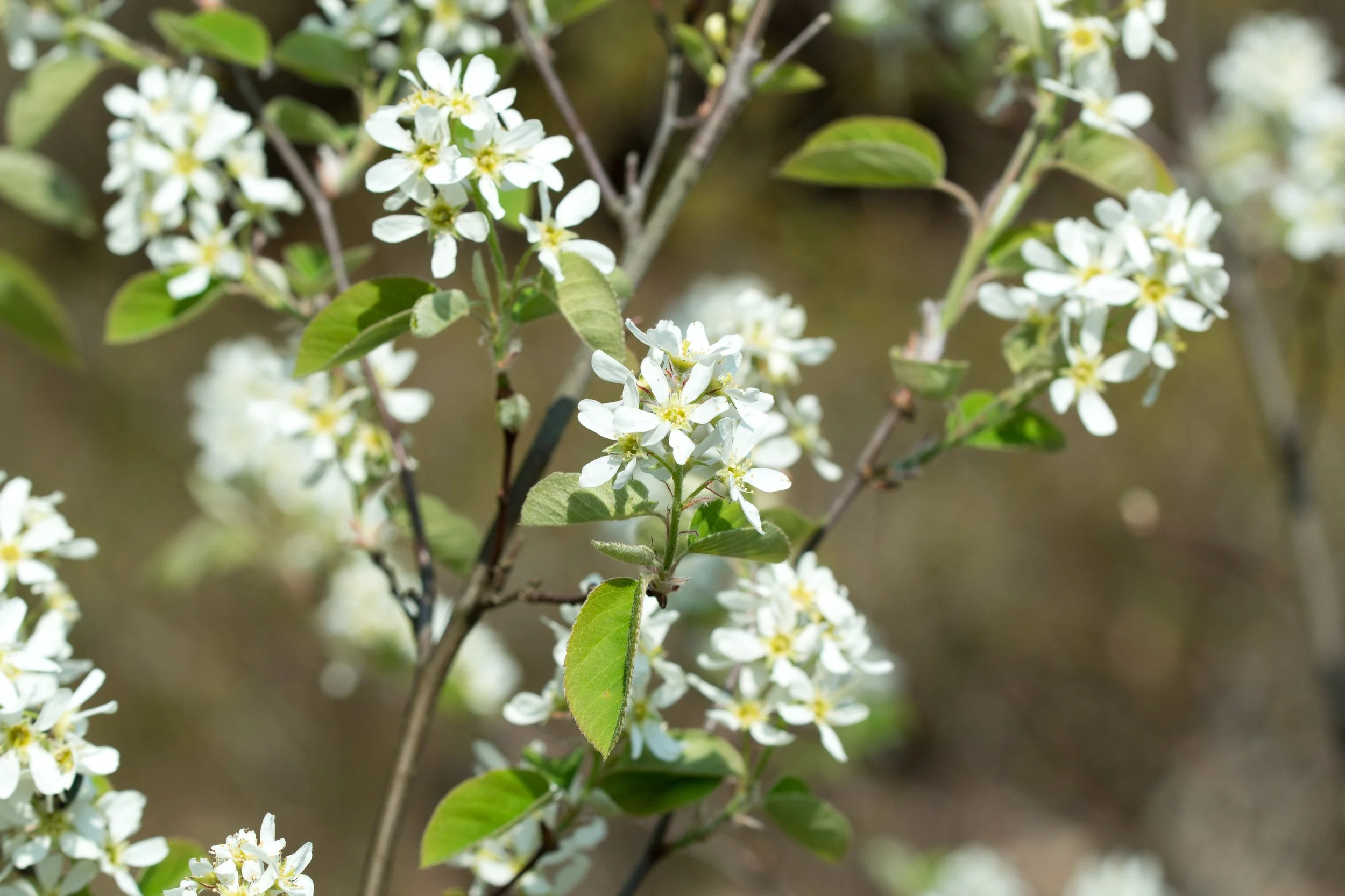
Every spring, before the leaves have opened and while the hillsides are still brown and bare, something remarkable happens along the edges of the St. George watershed. A small tree lights up in white — clusters of delicate, star-shaped blossoms catching the April light like scattered snow. This is Amelanchier, known here in Maine as shadbush or shadblow, and its bloom is one of the earliest and most welcome signs that winter has finally loosened its grip.
If you know where to look, shadbush is everywhere: rocky slopes, stream edges, forest margins, old fields growing back to shrub. It is easy to overlook in summer, but in April it stops you in your tracks.
Natural History
Several species of Amelanchier grow in Maine — A. canadensis, A. laevis, and others — and they are notoriously difficult to tell apart. In practice, most of us call them all shadbush and leave taxonomy to the botanists. What they share matters more than what separates them: white five-petaled flowers in early spring, small reddish-purple berries ripening by June, and a remarkable ability to thrive in the rocky, thin-soiled edges that define much of our coastal landscape.
Shadbush grows as a large shrub or small tree, typically 6 to 20 feet tall, often multi-stemmed and spreading. The leaves emerge slightly reddish and unfurl as the flowers fade. By midsummer the plant is unremarkable — a bit of green in the understory — but in June the berries arrive: small, sweet, and dark purple, clustered along the branches like tiny blueberries.
The name "shadbush" comes from a beautiful piece of ecological timing. The trees bloom just as the alewives and American shad begin running upstream to spawn — a reminder that in a living watershed, the calendar of one species is tied to the calendar of another.
Wabanaki Uses
For Wabanaki peoples, shadbush berries were an important and eagerly anticipated food. The sweet, early-ripening fruit was eaten fresh and also dried for winter use — pressed into cakes or mixed with dried meat and fat to make pemmican, a high-calorie food that sustained people through travel and lean seasons. The berries were sometimes dried over fire or in the sun and stored for months, retaining both nutrition and sweetness long after fresh fruit had disappeared.
The timing of the shadbush bloom and fruit was itself a form of knowledge — a signal woven into the seasonal calendar that told people when certain fish were running and when specific activities along the river were most productive. In Wabanaki understanding, the plant world and the animal world were in continuous conversation, and shadbush was one of its most reliable translators.
Role in the St. George River Watershed
In the watershed, shadbush punches well above its modest size. Its early bloom — often the first significant nectar source of the year — is a lifeline for native bees, queen bumblebees emerging hungry from hibernation, and early butterflies. In a landscape where few other plants are flowering, shadbush feeds the pollinators that will go on to serve the entire spring and summer growing season.
By June, the berries fuel a wave of hungry birds. Cedar waxwings descend in flocks. Baltimore orioles, rose-breasted grosbeaks, catbirds, and thrushes all seek out the fruit. The berries ripen and vanish quickly — often stripped within days — which means the window is narrow but the feast is real. White-tailed deer and black bears eat the fruit as well, and the dense, multi-stemmed structure of older shadbush provides good nesting cover for smaller songbirds.
Seasonal Notes
May is the moment — white flowers against bare gray branches, often visible from a distance. June and July bring the berries, ripening from pink to deep purple and disappearing fast. Summer is quiet; look for the smooth, oval leaves in the forest understory. Fall brings a quiet reward: shadbush foliage turns shades of orange, red, and gold — modest but warm, a small piece of the larger autumn display.
Fun Fact
Shadbush berries were historically sold in markets as "Juneberries" — a name still used in the Midwest, where Amelanchier species are native to open prairies. The fruit has a flavor reminiscent of blueberry with a hint of almond, from the seeds inside. Indigenous peoples across the continent prized these berries, and they are increasingly showing up at farmers' markets and specialty food producers who have rediscovered what the birds never forgot.
Want to Learn More?
- Native Plant Trust: Go Botany — Amelanchier — Species identification, range maps, and habitat notes for New England.
- USDA Plants Database — Amelanchier canadensis — Taxonomy, range, and ecological data.
- Maine Audubon — Planting for Birds: Native Shrubs — Guidance on native shrubs that support birds through the seasons.
- Abbe Museum — Wabanaki Cultural Connections — Resources on Wabanaki history, knowledge, and relationship with the natural world.
The Living River blog series is published by St. George Consulting in support of the Georges River Land Trust and the Maine Council of Trout Unlimited. To explore the important work these organizations are doing to conserve and restore Maine's landscapes, visit georgesriver.org and tumaine.org.