The Living River introduces one species each week from the St. George River watershed — its life, its role, and its place in the long human story of this land. Posts appear below in the order they were published, grouped by month. New to the series? Start with the introduction.
May · The River at Peak
The series begins. The river hits its peak. Everything is moving.
- The River's Silver Messenger: The AlewifeA keystone fish that delivers marine nutrients deep into the forest. Published May 12.
- The River's Black Diver: Double-crested CormorantA prehistoric-looking bird that arrives with the alewife run. Published May 14.
- First Bloom, First Fruit: The ShadbushWhite flowers against bare gray branches — and a name tied to the fish running below. Published May 19.
- The Leap of Faith: The Wood DuckDucklings that jump 50 feet on their first day of life — and shake it off. Published May 26.
June · Long Days, Quiet Water
The water is warm, the days are long, and the river is full of secrets.
- FiddleheadsThe St. George River's Springtime Scrollwork
- Older Than the AtlanticThe Sea Lamprey of the St. George
- The MayflyBorn in the River, Gone in a Day
- Sun, Shell, and Stillwater: The Painted TurtleA living artifact basking on Maine's logs for millions of years.
- Before the Dinosaurs: Horsetail on the Banks of the St. George350 Million Years at the Water's Edge
July · Look Closer Than You Usually Do
Summer on the quiet water. Look closer than you usually do.
- Life in the Fast Lane: The Blacknose DaceA small native fish that monitors water quality for free, every day.
- The Stream's Silver Currency: The Common ShinerLoose schools that scatter like thrown coins in clean water.
- Ancient and Unhurried: The Snapping TurtleOlder than the people who share their shoreline.
- Architects of the Streambed: CaddisfliesLarvae that build tiny houses out of sand and pebbles.
- Jewels at the Water's Edge: DamselfliesMetallic blue-green ebony jewelwings along a shaded reach.
- Spinning in Circles and Loving It: The Whirligig BeetleTwo pairs of eyes — one for above water, one for below.
- Walking on Water: The Water StriderA creature that lives on the film between air and water.
- A Floating World: Water Lilies of the St. George WatershedNative lilies that shelter turtles, frogs, and bass.
- Bronze and Beautiful: The Smallmouth BassThe river's most celebrated sport fish — and an introduced predator.
August · The Hidden and the Slow
Late summer — the hidden, the slow, the overlooked.
- The Moss That Built the Bog: SphagnumAn ancient moss that makes the very bogs it lives in.
- The Marsh's General Store: The CattailA wetland plant the Wabanaki used in every season.
- Hidden Gems of the River Bottom: Freshwater MusselsThree threatened species filtering the river quietly for a century.
- The Quiet Workhorse Beneath the Surface: Common WaterweedUnderwater meadows that oxygenate the watershed's slow water.
- Upside Down and Dangerous: BackswimmersAn apex invertebrate predator with a sting like a bee.
- The Rowboat of the Pond: Water BoatmenPound-for-pound the loudest animals on Earth.
- More Than a Nuisance: The MosquitoA pollinator of orchids and essential food for bats.
September · The Year Begins to Turn
The year begins to turn. Pay attention.
- The Long Way Home: The American EelA fish that began life in the middle of the Atlantic Ocean.
- The Ancient Fisherman: The Great Blue HeronThe river's most visible large predator, hunting on patience alone.
- The Engineer Next Door: The American BeaverThe animal that reshapes the watershed more than any other.
- Thorns, Berries, and Centuries of Story: HawthornsSmall, thorny trees that feed cedar waxwings and robins in fall.
- The Apex Ambusher: The Northern PikeA formidable invasive — and a species to understand honestly.
October · Autumn comes to the river
The year completes itself in cold water and brilliant color.
- The Jewel of Cold Water: Wild Brook TroutOctober spawning colors — the most spectacular sight on any tributary.
- A Beloved Stranger: The Brown TroutA European guest now thriving in the lower river.
- A Glacier's Gift: The Landlocked Salmon of Lake St. GeorgeAtlantic salmon that never got the memo about going to sea.
- Wax, Warblers, and Good Fortune: The Northern BayberryA winter-candle tradition.
Living River Series
Welcome to the Living River: An Introduction to the St. George River Watershed
St. George Consulting — Living River Series
A Land Acknowledgement
The lands and waters of the St. George River watershed are the unceded territory of the Wawenock people, one of the Wabanaki nations whose deep roots in this landscape stretch back thousands of years. The Wawenock lived, fished, hunted, gathered, and built their communities along these rivers and shores long before European names were placed on maps. We offer this acknowledgement with respect for their enduring presence and their ongoing relationship with this land.
A Landscape Born of Ice
The St. George River watershed looks the way it does today because of events that began roughly 20,000 years ago, when a continental ice sheet more than a mile thick covered all of what is now Maine. That glacier scoured the bedrock, rounded the hills, deepened the lake basins, and deposited the jumbled mix of clay, sand, and gravel that underlies our soils today.
By around 14,000 years ago, the ice had begun its long retreat northward. As it melted, the land — compressed for millennia under unimaginable weight — sat low, and the sea flooded far inland. Marine clays were deposited across what are now valley fields and farmland throughout the watershed. Over thousands of years, the land slowly rebounded, streams carved their channels, and forests advanced northward behind the retreating ice: first tundra, then spruce and fir, then gradually the mixed hardwood-softwood forest we know today.
The St. George River itself rises near Montville in the hills of Waldo County and flows roughly 50 miles south through a chain of lakes and wetlands — including Lake St. George, Seven Tree Pond, and Crawford Pond — before reaching its tidal estuary at Thomaston and opening to the sea on the storied St. George Peninsula. Its watershed drains approximately 350 square miles of forest, farmland, wetland, and village, emptying ultimately into the Gulf of Maine.
Thousands of Years of Human Life
The first people arrived in what is now Maine not long after the glaciers withdrew — perhaps 12,000 to 13,000 years ago — following the retreating ice edge into a landscape of tundra, meltwater lakes, and abundant game. These Paleo-Indian peoples were the ancestors of the Wabanaki nations, and their descendants have maintained a continuous relationship with this landscape ever since.
Over thousands of years, that relationship deepened and elaborated. The Archaic and Woodland periods saw increasingly settled patterns of life along the river: seasonal camps at fish runs, shellfish harvests along the coast, burial sites, trade networks, and a rich material and ceremonial culture tied closely to the rhythms of the watershed. Salmon, eels, and alewives ran the river in numbers difficult to imagine today. The forests provided deer, moose, beaver, and bear. The marsh edges gave cattail, berries, and medicinal plants. The Wawenock people knew this place in a completeness that no map has ever captured.
European contact came in 1605, when English captain George Weymouth sailed his vessel into the river mouth and, in a moment that darkened what might have been a peaceful encounter, seized five Wawenock people and took them back to England. The river has carried his name ever since. English settlement followed fitfully through the 1700s — interrupted by wars and conflict with Wabanaki peoples defending their territory — and by the early 19th century the watershed had been transformed: forests cleared, mills built at every fall, and the distinctive lime industry of Knox County underway, fueled by the region's abundant limestone bedrock.
The Watershed Today
The St. George River watershed today is home to roughly 35,000 people living in a collection of towns that reflect the full range of Maine's Midcoast character. From the farming communities of the upper watershed — Montville, Liberty, Searsmont, Appleton, and Washington — to the mill and village towns of the middle river — Union and Warren — to the working waterfront communities of the lower watershed and peninsula — Thomaston, Cushing, South Thomaston, and St. George — the watershed is a landscape of remarkable variety. It is farmed and fished, hiked and paddled, painted and written about. It is, in the fullest sense, a living place.
The Georges River Land Trust
Since its founding, the Georges River Land Trust has worked to ensure this landscape remains wild, connected, and accessible for the people and wildlife that depend on it. The Land Trust's mission states it plainly:
"Conserve and care for the diverse ecosystems and wildlife habitats of the St. George River watershed, expand access to nature for all people, and collaborate with partners through education and the arts to inspire lasting kinship with the natural world."
Through conservation easements, land acquisition, stewardship, and community partnership, the Land Trust protects the working farms, forested ridges, wetland corridors, and riverside habitats that make this watershed what it is. Every acre protected is a decision made on behalf of the brook trout in the headwaters, the osprey on the river bend, and the children who haven't yet had the chance to discover this place.
The Maine Council of Trout Unlimited
Trout Unlimited Maine is the state council of Trout Unlimited, America's oldest and largest cold-water conservation organization. In Maine, TU chapters work to protect and restore the brook trout streams, landlocked salmon lakes, and wild Atlantic salmon rivers that define the state's watersheds. Their work includes stream habitat improvement, dam removal advocacy, riparian buffer protection, and water quality monitoring — often in direct partnership with land trusts, state agencies, and tribal communities. Maine holds the largest remaining wild brook trout population in the eastern United States, and TU Maine's mission is to keep it that way. Learn more at tumaine.org.
An Invitation
This blog series — The Living River — is an invitation to meet your neighbors. Not the ones on your street, but the ones in the marsh, under the ice, in the canopy overhead, and in the leaf litter at your feet: the beaver and the otter, the trout lily and the cattail, the whirligig beetle and the American eel. Each week we'll introduce one species from the St. George River watershed — its life, its role, its story, and its place in the long human relationship with this land.
The watershed is not a backdrop. It is a community, ancient and intricate, and we are part of it. We hope these stories remind you of that — and send you outside to look.
Want to Learn More?
- Georges River Land Trust — Conservation news, protected lands, events, and ways to get involved.
- Maine Geological Survey — Glacial History — An accessible overview of how Maine's landscape was shaped by glaciation.
- Wabanaki Confederacy and History — Abbe Museum — A leading institution for Wabanaki art, history, and culture, located in Bar Harbor.
- Maine Memory Network — St. George River History — Digitized historic photographs, documents, and maps from communities throughout the watershed.
- Native Plant Trust: Go Botany — An essential field companion for identifying the plants you'll encounter along the river.
The Living River blog series is published by St. George Consulting in support of the Georges River Land Trust and the Maine Council of Trout Unlimited. To explore the important work these organizations are doing to conserve and restore Maine's landscapes, visit georgesriver.org and tumaine.org.
Northern Pike
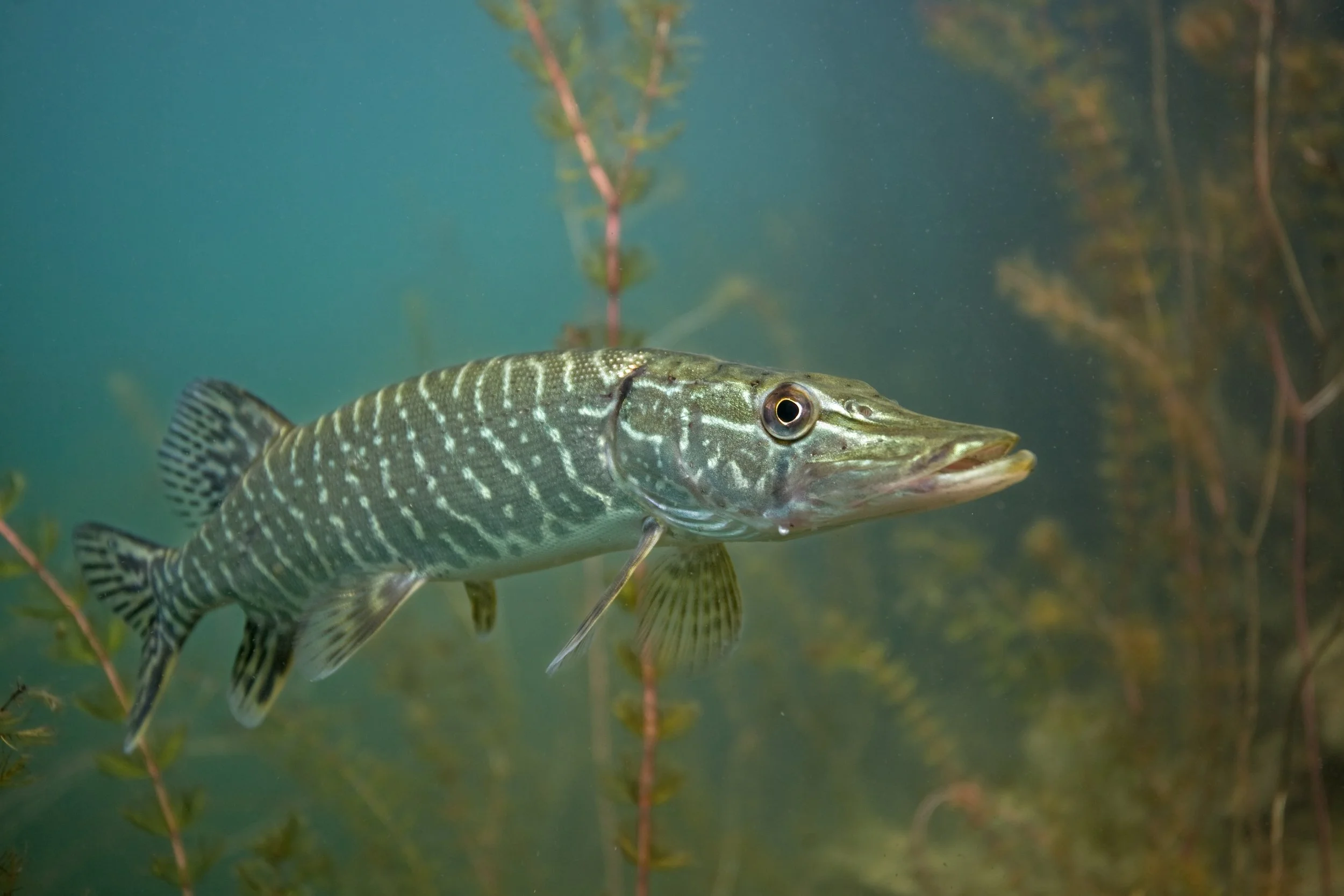
There is no mistaking a northern pike (Esox lucius). Long, torpedo-shaped, and patterned in olive and gold like something that belongs in a deeper, older world, the pike is one of the most formidable freshwater predators on the continent. It is also, in the St. George watershed, a complicated presen
The Apex Ambusher: The Northern Pike
Georges River Land Trust — Living River Species Series
Introduction
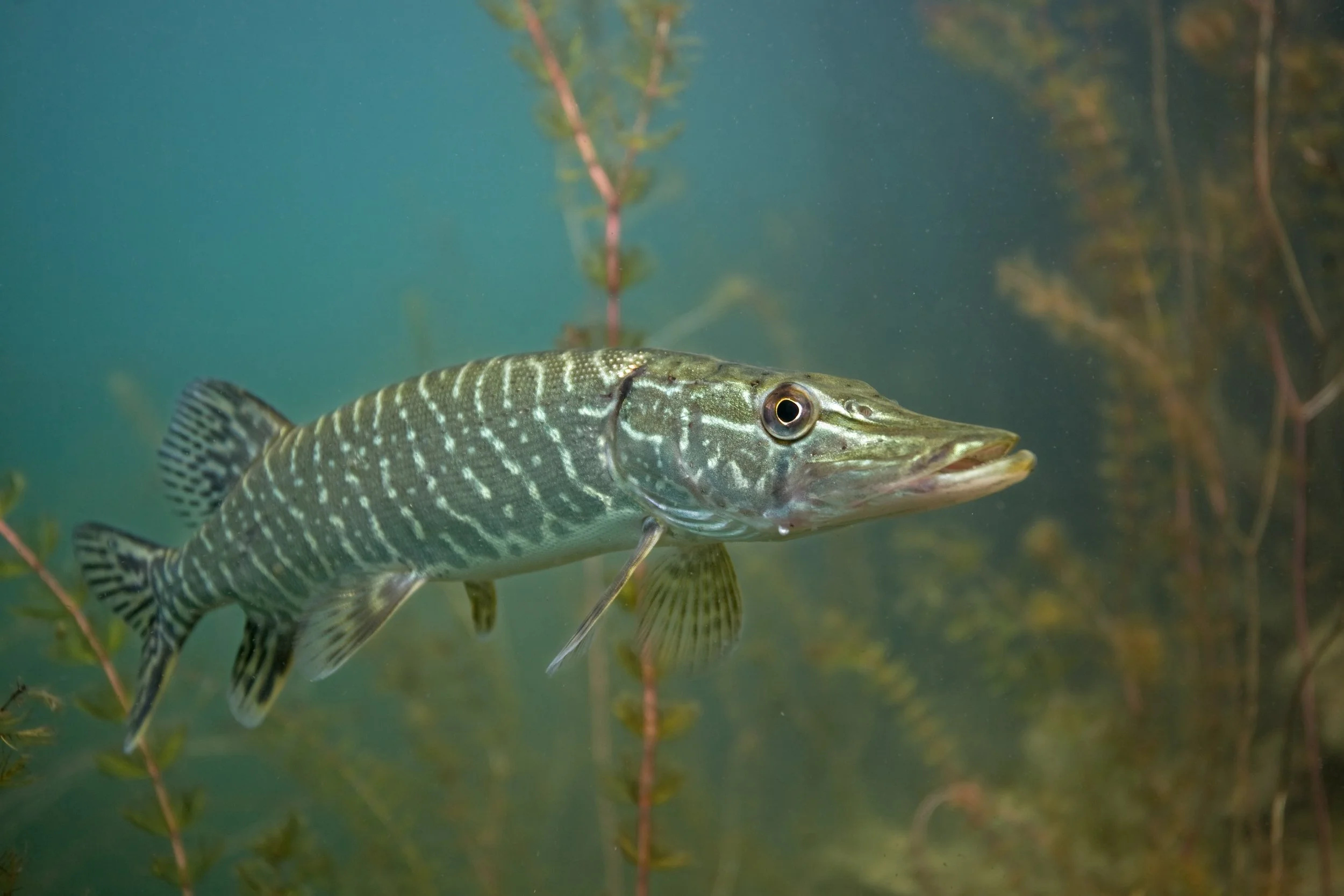
There is no mistaking a northern pike (Esox lucius). Long, torpedo-shaped, and patterned in olive and gold like something that belongs in a deeper, older world, the pike is one of the most formidable freshwater predators on the continent. It is also, in the St. George watershed, a complicated presence — a species whose power and ecological significance deserve respect, and whose spread into waters where it does not belong deserves honest attention. Understanding the pike means holding both of those things at once.
Natural History
Northern pike are built for one thing: ambush. They lie motionless among aquatic vegetation, nearly invisible, and then accelerate with startling speed to seize prey in a mouthful of backward-angled teeth designed to grip and not release. They will eat fish, frogs, ducklings, small muskrats — nearly anything that crosses their path and fits in their mouth. Large pike have been reliably documented taking prey half their own length.
They are among the largest freshwater fish in the Northeast. Adults commonly reach 24 to 36 inches; exceptional individuals can exceed four feet and weigh more than 20 pounds. Females grow larger and live longer than males, sometimes reaching 25 years of age. Their preferred habitat is the weedy, shallow margin of lakes and slow rivers — exactly the productive, vegetated edges that support so much other life in the watershed.
Spawning occurs in very early spring, often in March or April, when pike push into flooded vegetation along lake shores and stream margins while ice may still be retreating. Females scatter thousands of adhesive eggs among the vegetation and depart, leaving the eggs and eventual fry entirely to chance.
Identification Tips
A pike's body is long and torpedo-shaped, with a flattened, duck-bill snout full of sharp backward-pointing teeth. The color runs dark olive-green to gray, marked with light, bean-shaped or oval spots arranged in rows along the sides — the reverse of the chain pickerel's dark chain-link markings on a lighter background, a useful way to separate the two at a glance. Pike also have a fully scaled cheek but only the upper half of the gill cover (operculum) scaled, a technical but reliable mark for ruling out muskellunge or pickerel. The dorsal and anal fins sit far back on the body, close to the tail, giving pike their distinctive ambush-predator silhouette. Any fish over two feet long with this profile lurking in a weedy cove is almost certainly a pike — few other St. George fish approach that size.
Role in the St. George River Watershed
Here is where the pike's story in this watershed requires some care.
Northern pike are native to Maine — but only in the northern and eastern portions of the state, primarily the St. John River drainage. In the lakes and ponds of Midcoast Maine, including the St. George watershed, pike are an introduced species, almost certainly the result of illegal bucket stocking by anglers attracted to their reputation as hard-fighting sport fish. Maine IF&W has documented their spread into numerous southern and coastal Maine waters over recent decades, and the ecological consequences are serious.
As apex predators with enormous appetites, pike can rapidly reorganize the fish communities they enter. Brook trout, landlocked salmon, and yellow perch — species native to the St. George system — are highly vulnerable to pike predation, particularly juveniles. In waters where pike establish themselves, populations of these native fish often decline sharply. The carefully managed salmon fishery in Lake St. George is among the resources that benefit most directly from limiting pike's spread.
At the same time, in ecosystems where they are ecologically appropriate, pike play a meaningful role in controlling populations of smaller fish and maintaining balance. Great blue herons, ospreys, river otters, and mink will take juvenile pike; humans are the primary check on adult populations. The aquatic vegetation the pike depends on — water lilies, pondweeds, emergent sedges — is the same productive habitat that supports dragonflies, painted turtles, and waterfowl. The pike is a creature of these rich, weedy edges, even where it does not belong.
Wabanaki people across the pike's native range in northern and central North America depended on them as an important food source, particularly in late winter and early spring when few other fish were available. Pike were taken through the ice using spears and lines, and their size made them valuable. In northern Maine, Penobscot people knew them well and incorporated them into the seasonal cycle of fishing that structured life along the rivers and lakes.
Seasonal Notes
Pike are most active in early spring, spawning in March and April in shallow, weedy areas. Summer finds them in deeper, cooler water during the hottest weeks, moving back to vegetated shallows in morning and evening. Fall brings renewed activity as water temperatures drop and the fish feed aggressively before winter. They remain active under the ice throughout winter, making them one of the more productive ice-fishing targets — and a reason Maine IF&W encourages harvest of pike in waters where they are invasive.
Fun Fact
Pike have been documented in fossil records dating back more than 60 million years — making the genus Esox one of the most ancient lineages of freshwater fish in the Northern Hemisphere. The pike you see in a Maine lake is, in a real sense, a very old design that evolution has seen little reason to improve.
Want to Learn More?
- Maine IF&W — Invasive Aquatic Species — Maine's guidance on pike as an introduced species and what anglers can do.
- Maine IF&W — Northern Pike — Species biology and management information specific to Maine.
- Lake St. George State Park — One of the St. George watershed's most important recreational and ecological resources.
- Stop Aquatic Hitchhikers — Maine — The broader context of invasive aquatic species in Maine and how the public can help.
The Living River blog series is published by St. George Consulting in support of the Georges River Land Trust and the Maine Council of Trout Unlimited. To explore the important work these organizations are doing to conserve and restore Maine's landscapes, visit georgesriver.org and tumaine.org.
Hawthornes
Few plants in the Maine landscape are as quietly generous — or as easily overlooked — as the hawthorns. Tucked along old stone walls, at the edges of fields, and threading through the shrubby corridors of streambanks, these thorny small trees have been feeding wildlife, sheltering birds, and sustain
Thorns, Berries, and Centuries of Story: Meet the Hawthorns
Georges River Land Trust — Living River Species Series
Introduction
Few plants in the Maine landscape are as quietly generous — or as easily overlooked — as the hawthorns. Tucked along old stone walls, at the edges of fields, and threading through the shrubby corridors of streambanks, these thorny small trees have been feeding wildlife, sheltering birds, and sustaining human communities for as long as people have lived in this watershed. They bloom like a celebration in May and blaze with red berries come fall. They're worth a much closer look — just watch out for the thorns.
Natural History
Hawthorns (Crataegus spp.) belong to the rose family, Rosaceae, which makes them cousins to apples, cherries, and wild roses. The genus is notoriously sprawling — there are hundreds of species worldwide, and botanists have been arguing about how to sort them for generations. In Midcoast Maine, you're most likely to encounter native species like fireberry hawthorn (C. chrysocarpa) and fanleaf hawthorn (C. macrosperma), along with the introduced common hawthorn (C. monogyna) that arrived with European settlers.
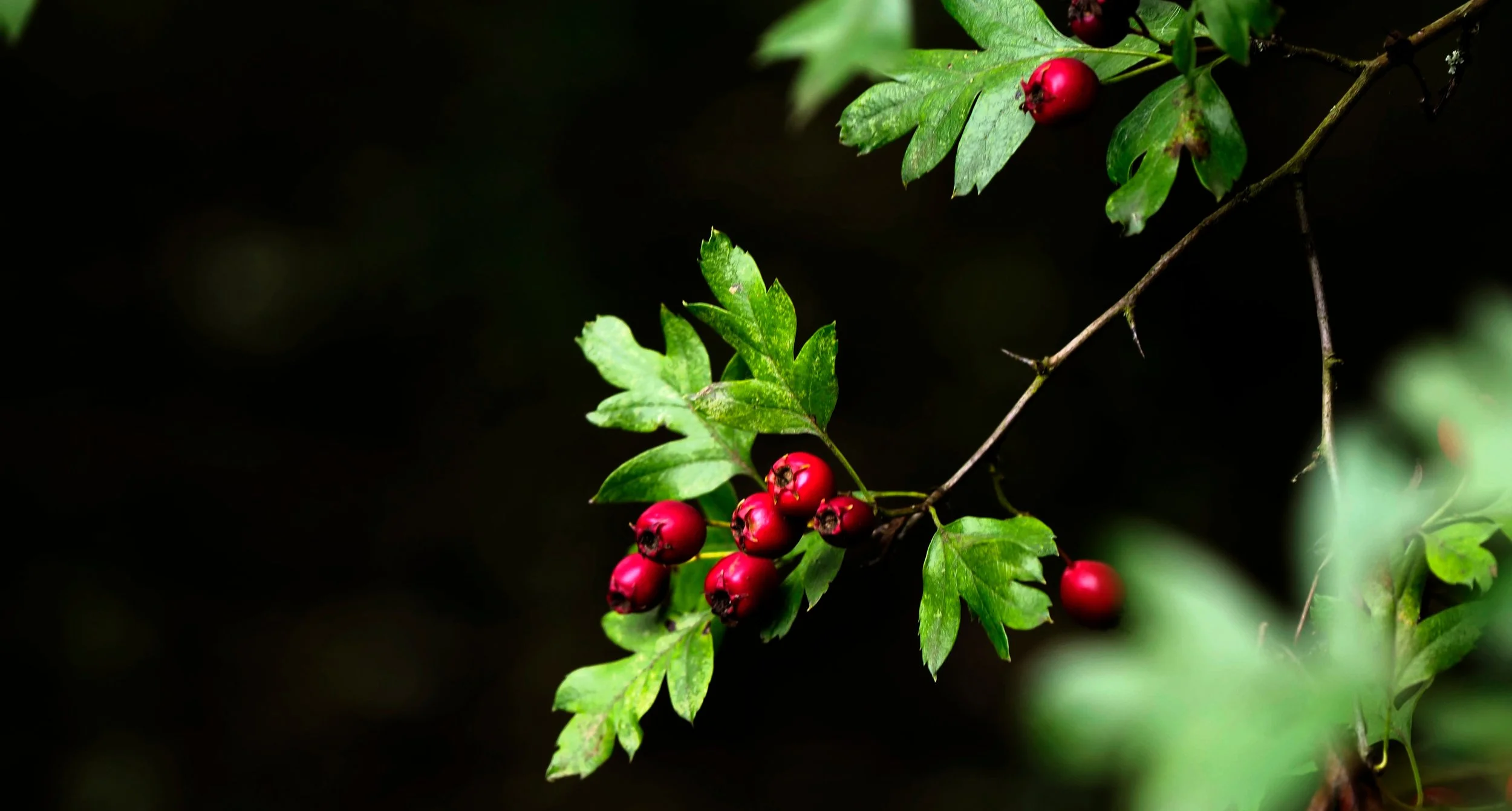
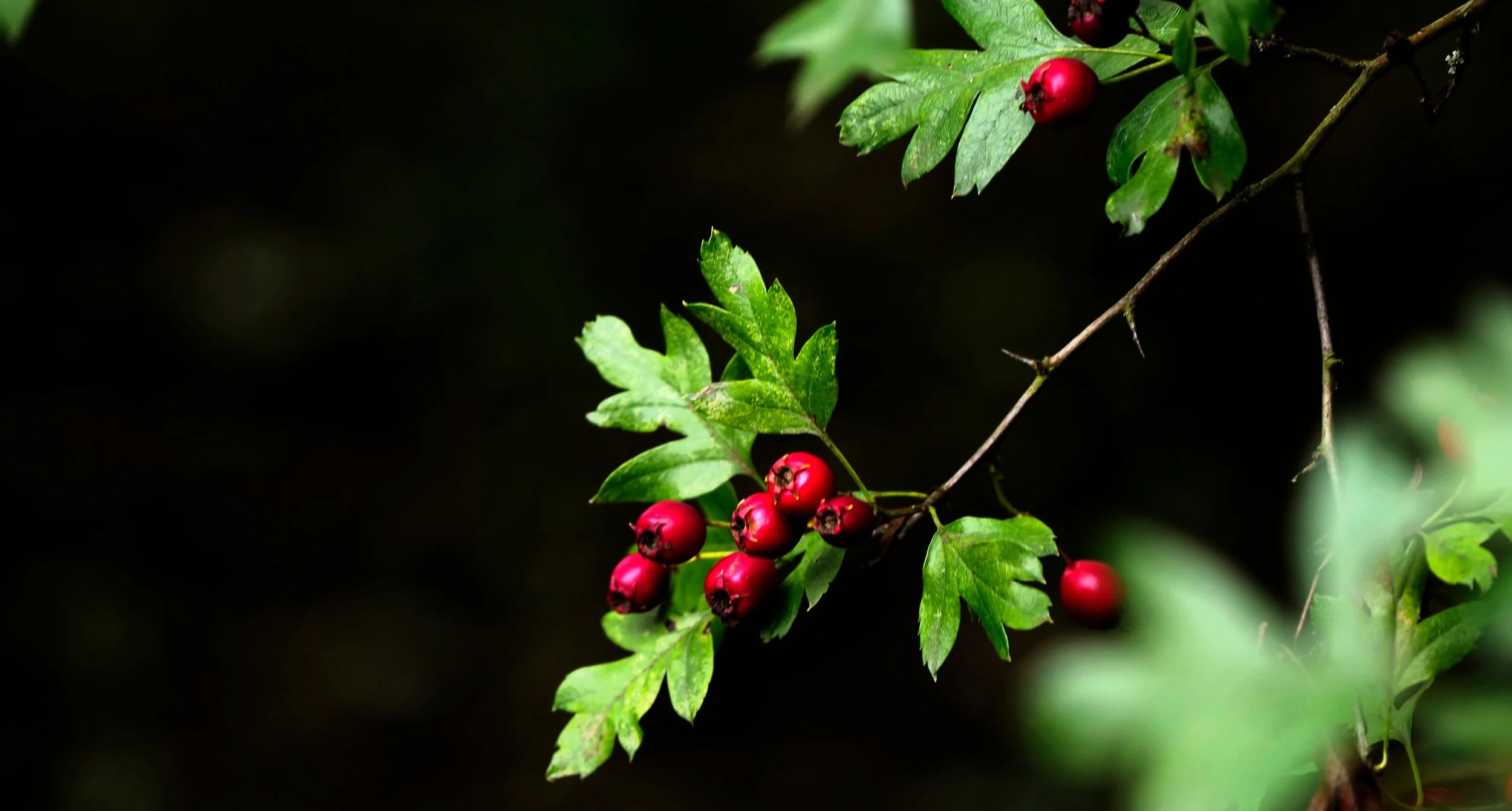
What hawthorns share across all their variety: clusters of white five-petaled flowers in late spring; dense, twisting branches armed with stiff, sharp thorns (technically modified stems); and small, apple-like fruits called haws that ripen to red, orange, or deep burgundy by late summer and persist well into winter.
The thorns are not just formidable — they're functional. Dense hawthorn thickets are among the safest nesting spots in the landscape. The tangle of spines keeps raccoons, crows, and other nest predators at bay, making hawthorns a favorite of songbirds like gray catbirds, brown thrashers, cedar waxwings, and several warbler species.
Identification Tips
Hawthorns are identified by their combination of stiff, sharp thorns growing directly from the branches, clusters of white five-petaled flowers in May, and small apple-like fruits called haws that ripen red, orange, or burgundy by fall. Leaves vary by species but are typically toothed or lobed, alternating along thorny, zigzagging twigs, and the bark is gray and scaly on older wood. Because Crataegus is a notoriously difficult genus to sort to exact species, focus on the reliable combination of thorns, rose-family flowers, and persistent haws rather than trying to pin down an exact species — that combination is not shared by any other tree or shrub in the watershed. Dense, thorny thickets found along old stone walls, field edges, and streambanks are a strong habitat clue, since hawthorns favor these open, semi-disturbed margins over deep forest.
Wabanaki Uses
For the Wabanaki peoples — including the Penobscot, Passamaquoddy, and Abenaki nations whose homelands encompass this watershed — hawthorns were both food and medicine. The haws were eaten fresh in fall and dried for winter use, sometimes incorporated into pemmican-style preparations mixed with fat and dried meat. They are starchy and mildly sweet, something like a dry rose hip crossed with a small crabapple.
Medicinally, hawthorn berries, leaves, and flowers were used to support heart health and digestion — uses that modern herbalists and researchers have since validated. Hawthorn is now one of the most studied plants in cardiovascular herbal medicine. The thorns themselves had practical applications too, serving as needles, awls, and fish hooks. The hard, close-grained wood was shaped into tool handles and small implements.
Role in the St. George River Watershed
Along the St. George River and the wetland edges, old fields, and upland margins of its watershed, hawthorns are ecological anchors. Their dense structure provides year-round shelter — nesting cover in summer, thermal refuge in winter — and their haws are a critical late-season food source for wildlife when other fruits are exhausted.
American robins, cedar waxwings, ruffed grouse, wild turkeys, white-tailed deer, foxes, and black bears all rely on haws in fall and early winter. In lean years, a hawthorn thicket heavy with fruit can make a measurable difference for overwintering wildlife.
Hawthorns also play a subtle but important role in forest succession. Their thorny thickets protect young tree seedlings from deer browse, acting as a nursery for the next generation of forest. In that sense, they're not just inhabitants of the landscape — they help build it.
Seasonal Notes
Hawthorns are a plant to watch all year in Midcoast Maine. In May, their white flower clusters are among the showiest blooms of the season, fragrant and buzzing with native bees and early butterflies. Through summer, the developing haws are easy to spot — small green clusters that slowly swell and deepen in color. By September and October, a fruiting hawthorn is a wildlife magnet, with flocks of waxwings and robins working the branches. In winter, persistent clusters of dried haws stand out against snow, still providing nutrition for birds on the hardest days of the year.
Fun Fact
The word hawthorn is old English — haw simply meant "hedge," and these trees were planted throughout medieval England as living fences. They were so central to the rural landscape that May Day celebrations (held when hawthorns bloom) became synonymous with the tree itself. In some parts of Britain, hawthorns are still called mayflowers — the same name the Pilgrims gave their ship, perhaps in homage to the blossoming hedgerows they left behind.
Want to Learn More?
- USDA Plants Database — Crataegus spp. — Range maps, taxonomy, and ecological data for North American hawthorns.
- Native Plant Trust: Go Botany — Crataegus — Excellent identification tool for New England hawthorn species, with photos and keys.
- Wabanaki Medicine and Moons Educators Guide — Maine Dept. of Education — A rich overview of traditional Wabanaki plant and medicine knowledge, produced in partnership with tribal educators.
- University of Maine Cooperative Extension: Native Shrubs for Wildlife — Guidance on native woody plants and their value for Maine wildlife.
The Living River blog series is published by St. George Consulting in support of the Georges River Land Trust and the Maine Council of Trout Unlimited. To explore the important work these organizations are doing to conserve and restore Maine's landscapes, visit georgesriver.org and tumaine.org.
Beaver
No wild animal reshapes the landscape of the St. George River watershed quite like the American beaver (Castor canadensis). Where a beaver colony moves in, a stream becomes a pond, a pond becomes a wetland, and a wetland becomes one of the richest habitats in the entire watershed — alive with ducks,
The Engineer Next Door: The American Beaver
Georges River Land Trust — Living River Species Series
Introduction
No wild animal reshapes the landscape of the St. George River watershed quite like the American beaver (Castor canadensis). Where a beaver colony moves in, a stream becomes a pond, a pond becomes a wetland, and a wetland becomes one of the richest habitats in the entire watershed — alive with ducks, herons, frogs, dragonflies, otters, and dozens of other species that had nowhere to live before a family of large rodents decided to build a dam. The beaver is what ecologists call a keystone species: remove it, and the whole arch of the ecosystem it supports comes down. Leave it alone, and it does more for the health of a river than almost anything else.
Natural History
The American beaver is the largest rodent in North America, with adults typically weighing between 35 and 60 pounds and occasionally exceeding 70. They are built for a life divided between land and water: dense, waterproof fur; a broad, flat tail that acts as a rudder while swimming and a prop while sitting upright to gnaw; large webbed hind feet; and front paws nimble enough to manipulate sticks and pack mud with surprising precision. They can stay submerged for up to 15 minutes and swim at speeds that make them nearly uncatchable in the water, even by otters.
Their most recognizable feature is the teeth. A beaver's incisors are bright orange — the color comes from iron compounds in the enamel, which make the cutting edge exceptionally hard. The back of each tooth is softer and wears away faster, creating a self-sharpening chisel that never stops growing throughout the animal's life. A beaver can fell a 5-inch-diameter tree in minutes and will tackle much larger ones when motivated.
Despite all that wood-cutting, beavers don't eat wood — they eat the soft inner bark and cambium layer beneath it, along with aquatic plants, grasses, and leaves. Aspen, alder, birch, and willow are favorites. In fall, they cut and cache branches underwater near the lodge entrance, creating a submerged food supply they can access all winter without ever leaving the water.
Beavers mate for life and live in family groups — a breeding pair, the current year's kits (usually two to four, born in May or June), and often the yearlings from the previous litter who stay on to help raise the new arrivals. The family maintains a lodge of sticks and mud with underwater entrances, rendering it nearly impenetrable to predators.
Identification Tips
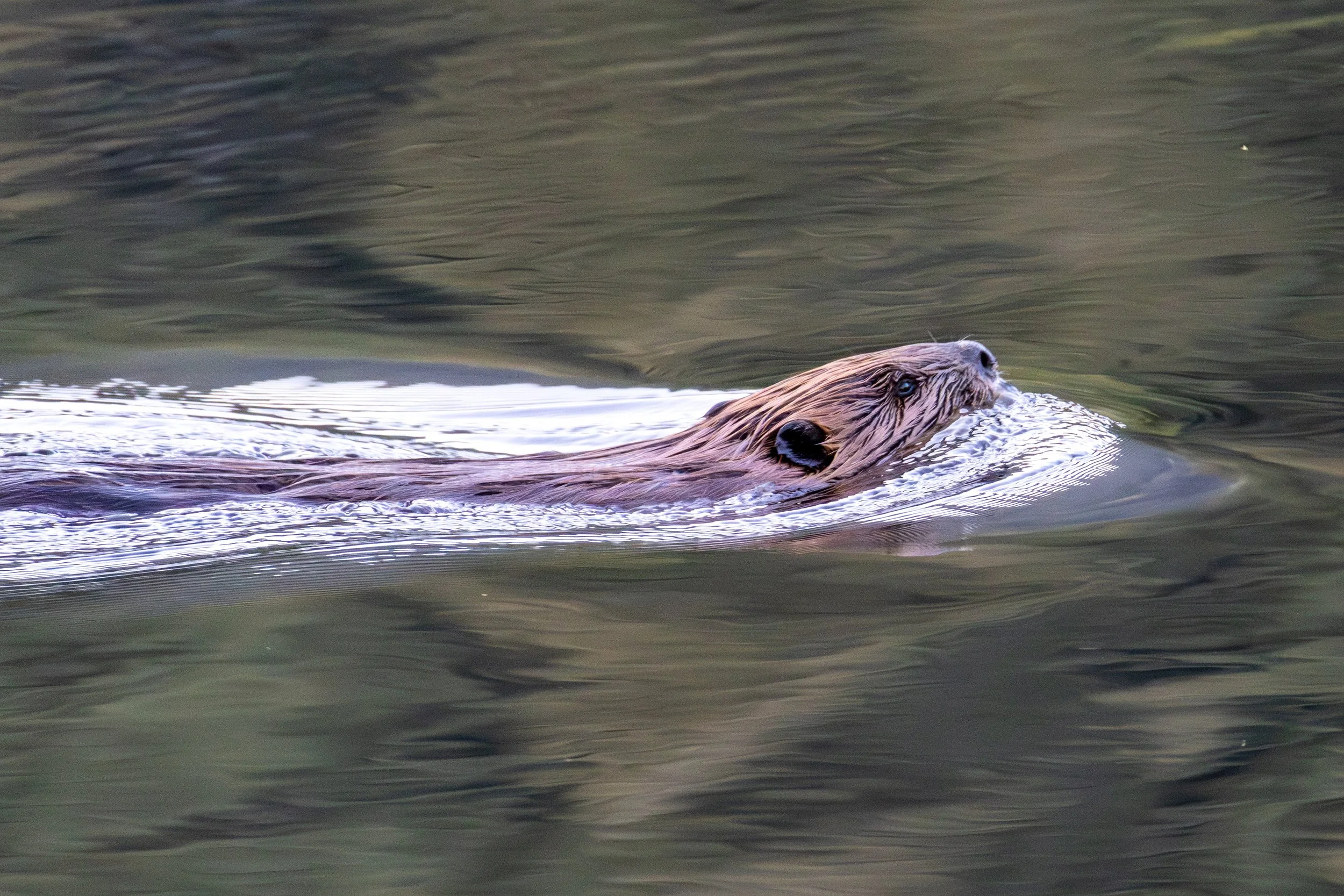
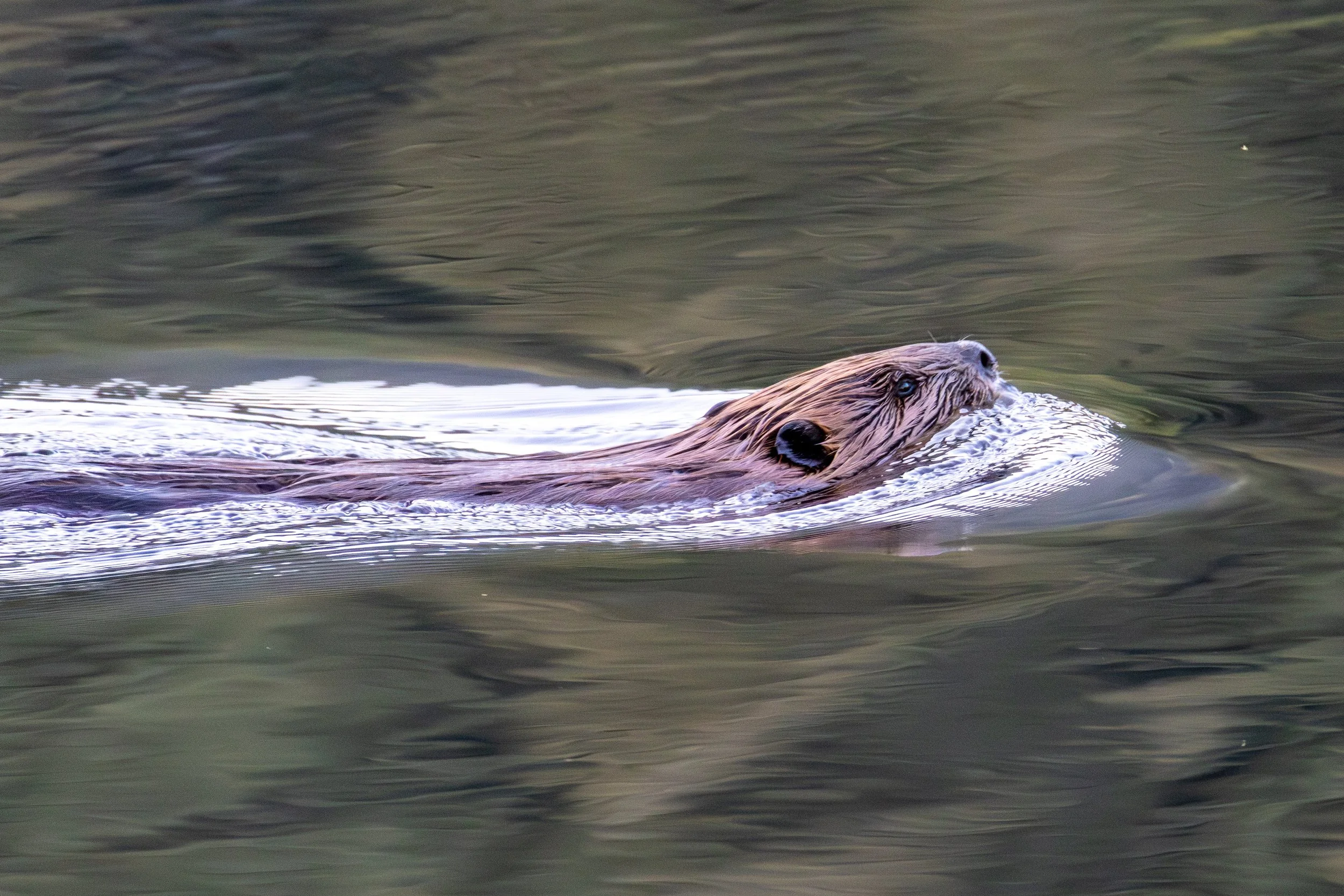
American beavers are large, thickset rodents easily told apart from muskrats by size and tail: a beaver's tail is broad, flat, and paddle-shaped, while a muskrat's is thin, ratlike, and whips side to side when swimming. Adult beavers commonly weigh 35 to 60 pounds, dwarfing a muskrat's two to four. Fur is a rich chestnut to blackish-brown, dense and glossy when dry. Look for bright orange incisors, visible when a beaver is feeding or grooming, and for the unmistakable signs of their presence on the landscape — dams, lodges of piled sticks and mud, conical-cut stumps with visible tooth marks, and cached branches poking above a pond's surface near the lodge. A beaver swimming low in the water with only the head and back visible, and a loud tail-slap on the surface when startled, are both reliable field cues.
Role in the St. George River Watershed
Beaver activity is woven throughout the St. George watershed, and its effects are overwhelmingly positive for biodiversity and watershed function. When beavers dam a stream, the resulting pond slows water flow, raising the water table in surrounding soils and creating wetland habitat that the landscape would otherwise lack. Beaver wetlands trap sediment, filter nutrients, and reduce the flashiness of streams during heavy rain — natural flood control built one stick at a time.
The habitat complexity a beaver pond creates is remarkable. Open water, emergent marsh, shrubby edges, and standing dead timber (drowned trees killed by flooding) provide niches for wood ducks, great blue herons, river otters, mink, painted turtles, wood frogs, countless invertebrates, and cavity-nesting birds like woodpeckers that depend on the snags. When a beaver colony eventually abandons a site, the drained pond becomes a rich, flat meadow — "beaver meadows" that are among the most botanically diverse spots in the northeastern forest.
For a land trust focused on watershed health, active beaver colonies are, in a very real sense, partners.
Seasonal Notes
Beavers are active year-round in Maine and do not hibernate. Fall is their busiest season — through September and October, colonies work intensively to reinforce dams and lodges and build up their underwater food cache before freeze-up. This is when fresh gnawing stumps and new dam work are easiest to spot. Winter finds them moving beneath the ice between lodge and food pile, rarely visible but very much present. Spring brings kits and, often, new dam construction as families expand. Summer evenings — the hour before dark along a quiet beaver pond — are among the best times to watch them working the surface in the fading light.
Fun Fact
By the early 1800s, the American beaver had been almost completely wiped out from Maine and much of New England, trapped to near-extinction for the European fur trade. At the peak of the fur trade era, millions of beaver pelts were shipped across the Atlantic each year, primarily to be felted into fashionable hats. The recovery of beaver populations over the past century — driven by trapping regulations, reintroduction programs, and the regrowth of eastern forests — is one of the great conservation success stories of North America. The wetlands being created in the St. George watershed right now are in many ways a second chance, centuries in the making.
Want to Learn More?
- Maine IF&W — American Beaver — Species biology, habitat management, and coexistence resources from Maine's wildlife agency.
- Rethink the Myth: Beavers as Restoration Tools — National Wildlife Federation — An accessible look at how beaver reintroduction is being used for watershed restoration across the country.
- Beaver Institute — A nonprofit dedicated to beaver coexistence, with practical resources for managing beaver activity near roads and culverts.
- Maine Audubon — Wetlands and Wildlife — Broader context on the role of wetlands in Maine's landscape and the wildlife that depends on them.
The Living River blog series is published by St. George Consulting in support of the Georges River Land Trust and the Maine Council of Trout Unlimited. To explore the important work these organizations are doing to conserve and restore Maine's landscapes, visit georgesriver.org and tumaine.org.
Great Blue Heron
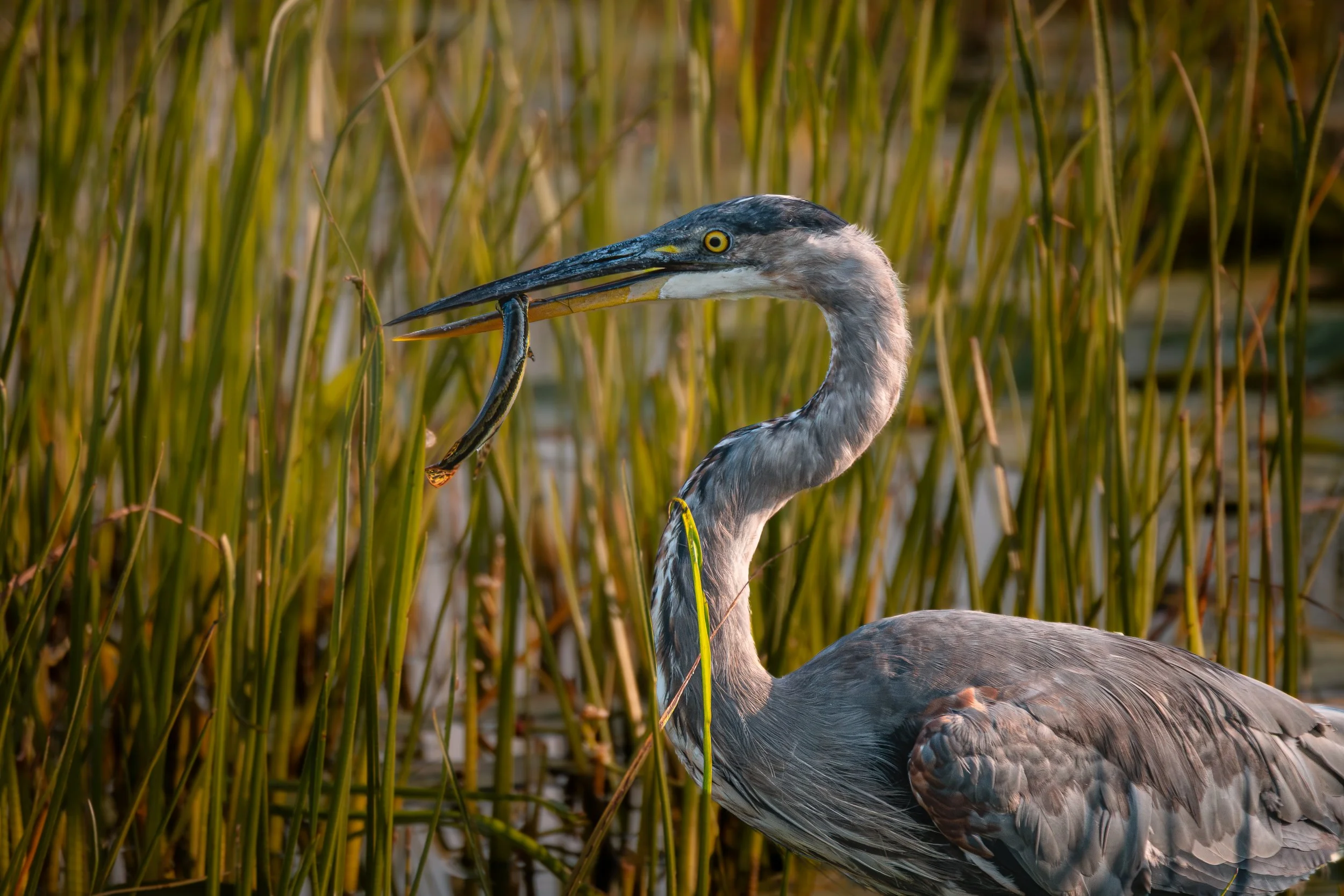
The Ancient Fisherman: Great Blue Heron of the St. George
Georges River Land Trust — Living River Species Series
A Stillness That Commands Attention
Standing motionless at the river's edge, blue-gray as weathered slate, the great blue heron looks like something out of the prehistoric record. There's a reason people routinely mistake it for a pterodactyl in flight — something about the slow, deliberate wingbeats and the folded neck suggests a creature from a much older world.
Once you start looking for them, you'll find great blue herons everywhere — wading the shallows at Sennebec Pond, standing sentinel along the tidal stretches near Thomaston, or lifting heavily from a marshy cove with that low, prehistoric kraaank that carries surprisingly far.
Natural History: Patient, Powerful, Precise
The great blue heron (Ardea herodias) is the largest heron in North America. Standing up to four and a half feet tall with a wingspan approaching six feet, it is an imposing presence — though much of that size is feathers and hollow bones, and it weighs only about five and a half pounds.
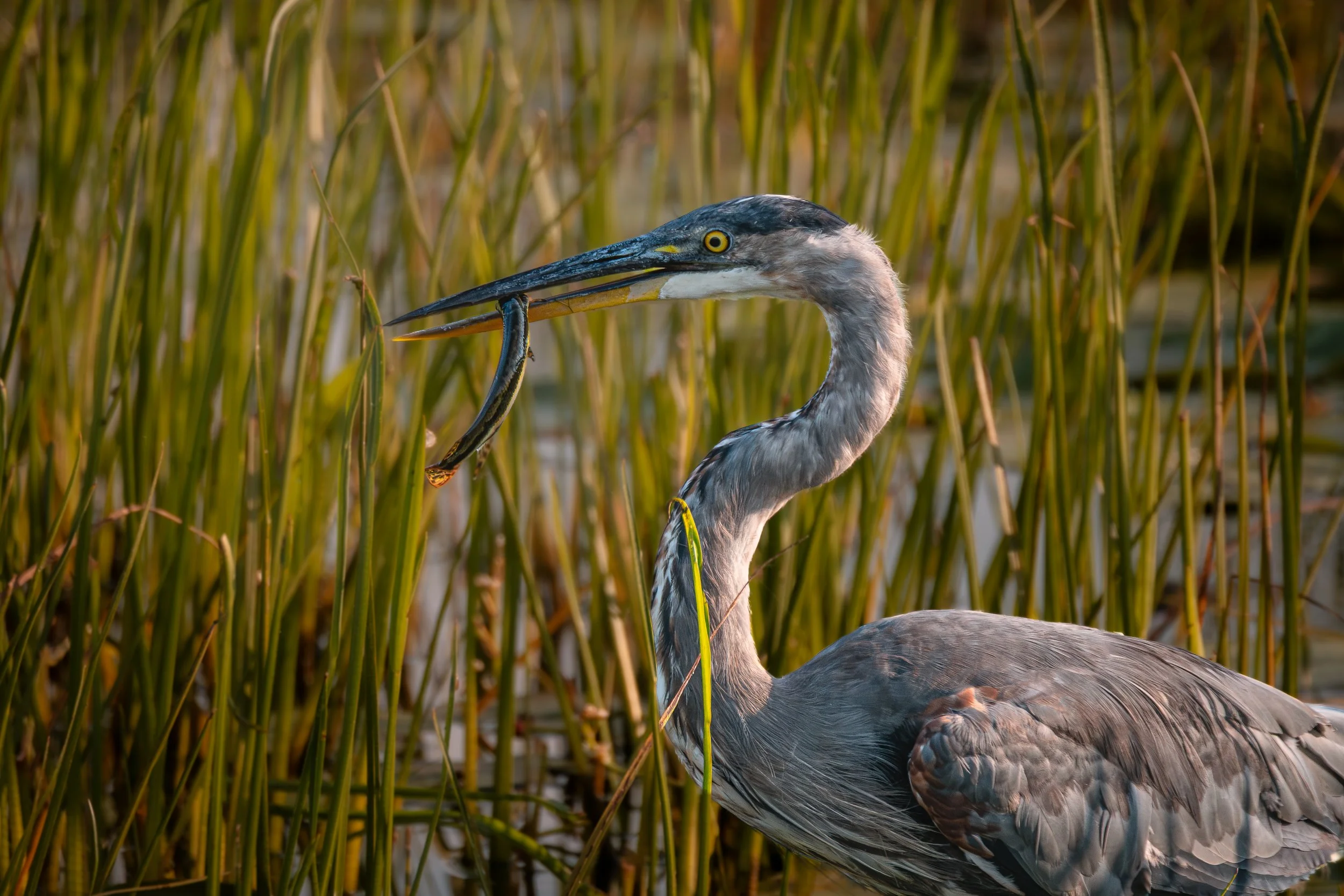
Its hunting strategy is a study in patience. A heron will stand absolutely motionless for long minutes, or wade forward so slowly the water barely ripples, waiting for prey to come within range. Then, in a fraction of a second, that long neck uncoils like a spring and the dagger bill strikes. The S-curve of the neck isn't just elegance — it's a coiled mechanism, loaded and ready.
Their diet is broad: fish are the mainstay, but great blue herons will also take frogs, snakes, crayfish, voles, and large insects. Essentially, if it fits in the bill and lives near water, a heron has tried it.
Nesting is a communal affair. Great blue herons gather in colonies called rookeries or heronries — sometimes dozens or even hundreds of pairs together, building bulky stick-platform nests high in tall trees. These sites can be active for generations. Both parents incubate the eggs and feed the chicks, which grow with surprising speed.
Identification Tips
A great blue heron's slate-blue-gray body, long yellow bill, and S-curved neck make it hard to confuse with anything else in the watershed except possibly a great egret, which is entirely white. In flight, check the neck: herons tuck their necks into a tight S-curve against the body, while similarly large, long-legged birds like sandhill cranes fly with necks fully extended — a reliable rule for identifying any large bird overhead. Look also for long, trailing plumes on the head, neck, and back during breeding season, and the slow, deep, almost labored wingbeats that distinguish heron flight from the more urgent wingbeats of most waterfowl. Standing herons are often mistaken for statues; a slow, deliberate wade forward, or a lightning-fast neck strike, are the tells that it's alive and hunting.
Role in the St. George River Watershed
Great blue herons are top-of-the-food-chain predators in the riparian world. They help regulate fish and amphibian populations and serve as a living gauge of ecosystem health — a heron hunting productively in a stretch of river tells you something good about the water quality and the abundance of life beneath the surface.
They are also an umbrella species: protecting the habitats herons need — undisturbed wetlands, clean rivers, forested uplands near water for nesting — benefits a whole community of other wildlife at the same time. Beaver flowages, wooded shorelines, and shallow marshy coves throughout the St. George watershed are heron country, and keeping those places intact matters.
Maine has seen a concerning 31% decline in nesting pairs since 2009, enough that the great blue heron is now listed as a Species of Special Concern in the state. Disturbance at rookeries — even well-meaning human visits during nesting season — can cause entire colonies to abandon their nests. Giving these birds space when they need it most is one of the simplest things we can do for them.
Seasonal Notes
Great blue herons are year-round residents in the St. George watershed, though their numbers swell in summer with breeding birds and thin in the coldest months when ice forces them to find open water. A few hardy individuals winter along the tidal portions of the lower river, where saltwater stays ice-free. By late February or March, nest-building activity picks up in the rookeries, and by April eggs are being incubated high in the trees — well before the leaves come in.
Summer and early fall offer the best watching, when young birds — slightly ragged, without the adult's elegant plumes — appear along the riverbanks, learning the patience their craft demands.
Fun Fact
A great blue heron's neck contains a specialized sixth vertebra that creates its distinctive S-curve — and acts like a spring-loaded launching mechanism for that lightning strike. When the bird flies, it folds that neck tightly against its body. Cranes, which look superficially similar in flight, hold their necks extended straight out. If you see a large, long-legged bird flying overhead and aren't sure what it is, check the neck: tucked in means heron.
Learn More
- All About Birds — Great Blue Heron (Cornell Lab of Ornithology)
- Maine Rivers — Great Blue Heron
- Great Blue Heron — Maine: An Encyclopedia
- Harpswell Heritage Land Trust — Nature Notes: Great Blue Heron
- Mass Audubon — Great Blue Herons
- Northern Woodlands — Gregarious Great Blue Herons
The Living River blog series is published by St. George Consulting in support of the Georges River Land Trust and the Maine Council of Trout Unlimited. To explore the important work these organizations are doing to conserve and restore Maine's landscapes, visit georgesriver.org and tumaine.org.
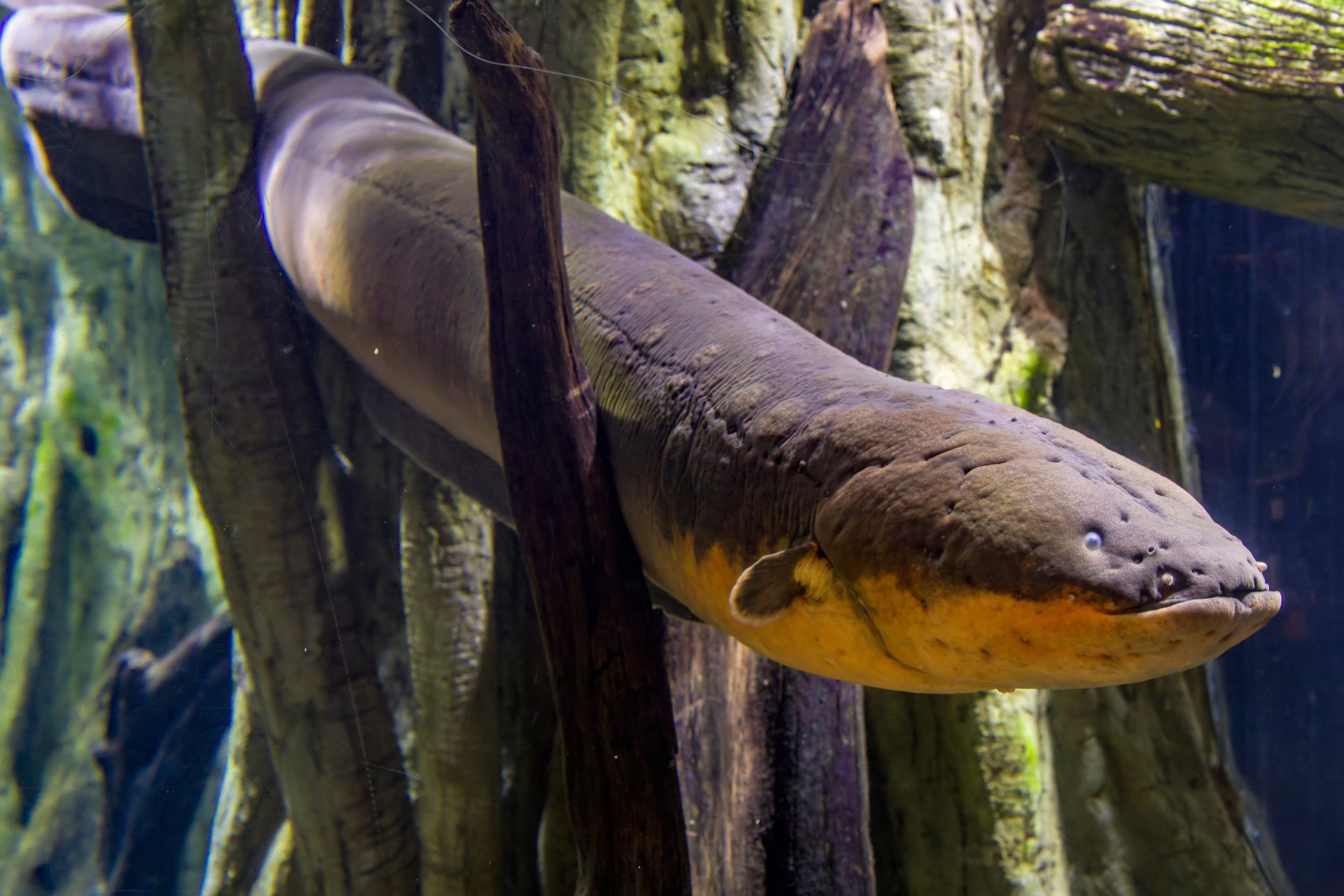
American Eel
There is a creature living in the St. George River right now that was born in the middle of the Atlantic Ocean, drifted thousands of miles on ocean currents as a transparent wisp of tissue, and then spent years — possibly decades — hunting in the dark beneath our riverbanks and lake bottoms. When it
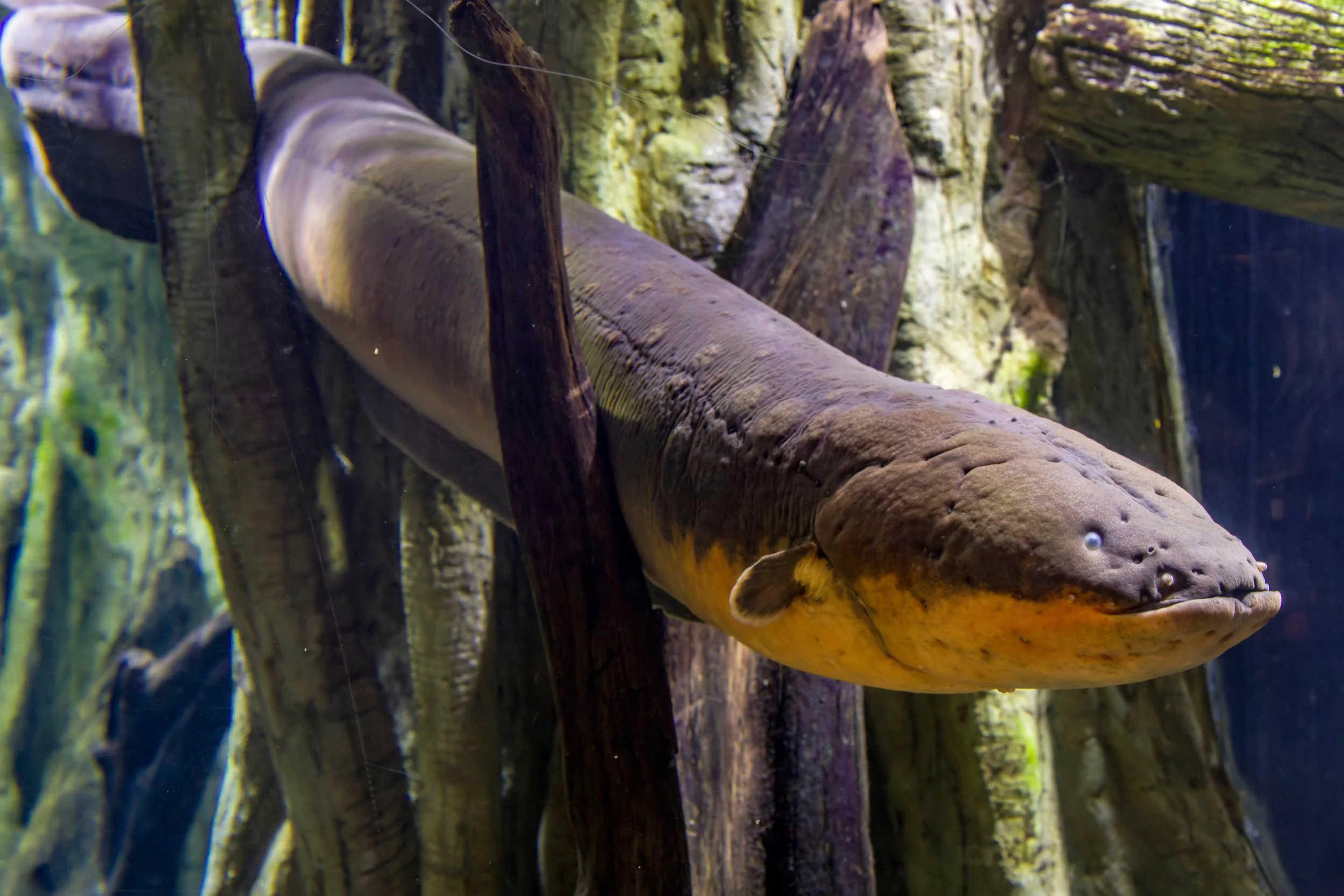
The Long Way Home: The Remarkable Life of the American Eel
Georges River Land Trust — Living River Species Series
Introduction
There is a creature living in the St. George River right now that was born in the middle of the Atlantic Ocean, drifted thousands of miles on ocean currents as a transparent wisp of tissue, and then spent years — possibly decades — hunting in the dark beneath our riverbanks and lake bottoms. When its time finally comes, it will transform once more, find the sea again, and disappear into the deep to spawn and die without ever returning. The American eel (Anguilla rostrata) lives one of the most extraordinary lives of any animal on earth, and it does most of it quietly, invisibly, right here in our watershed.
Natural History
The American eel is the only catadromous fish in eastern North America — meaning it lives in freshwater but migrates to the ocean to reproduce, the reverse of salmon and alewives. Every American eel alive today was born in the Sargasso Sea, a warm, still region of the Atlantic east of Bermuda. After hatching, the leaf-shaped larvae drift on the Gulf Stream for months, slowly transforming into transparent "glass eels" as they approach the coast.
In spring, these tiny eels — now called elvers — pour into tidal rivers by the millions, pushing upstream with single-minded determination. They can even wriggle overland through wet grass on rainy nights to reach isolated ponds and streams. Once settled, they darken into the familiar yellow-brown "yellow eel" phase and begin years of nocturnal hunting — insects, worms, crayfish, small fish, and just about anything else they can find.
Females can grow to nearly four feet and live for twenty years or more. When the time finally comes to spawn, they transform one last time into "silver eels" — their eyes enlarge, their bellies turn silver, their digestive systems shut down — and they head downriver in autumn to begin the long journey back to the Sargasso Sea. They never return. Remarkably, no one has ever witnessed American eels actually spawning. We know where they go only because that's where the tiniest larvae are found.
Identification Tips
American eels are unmistakable once you know to look: a long, smooth, snake-like body with no pelvic fins and a single continuous fin running from midback around the tail to the vent, unlike any other fish in the watershed. The skin is slick and scaleless to the touch, colored olive-brown to yellow-green above and pale yellow below during the long resident "yellow eel" stage, shifting to a silver-bellied, bronze-backed sheen just before the adult's final migration to sea. Elvers — the tiny, nearly transparent young stage — are best looked for at dusk in April and May, wriggling upstream at the edges of culverts, dams, and fish ladders. Adult eels are almost entirely nocturnal, so a daytime sighting usually means one has been disturbed from a burrow in the mud or under a rock.
Role in the St. George River Watershed
Eels are active at every level of the St. George River's food web. As predators, they keep populations of invertebrates and small fish in balance. As prey, they are critically important to ospreys, great blue herons, river otters, striped bass, and other species. Their bodies, rich in fat and protein, transfer energy from river bottom to sky.
American eels are in serious decline across their range, and dams are a leading cause. Even modest barriers block the upstream migration of elvers. Efforts to restore eel passage — including eel ladders and dam removals — are part of the ongoing work to restore the ecological health of the St. George River and its tributaries. A river with a healthy eel population is a river with its connections intact.
Wabanaki Uses
For the Wabanaki peoples — Penobscot, Passamaquoddy, Maliseet, and Abenaki nations — the American eel was a prized and reliable food source throughout the seasons. Eels were harvested by spearing, by basket traps and weirs set at falls and narrows, and through the ice in winter, when eels buried in river sediment could be located and dug out. They were eaten fresh, smoked over fires, and dried for storage, providing important fat and protein through the long Maine winters.
Eel skin, strong and supple, was used for bindings and small leather goods. Eel oil was valued medicinally for its warming and lubricating properties. The relationship between Wabanaki communities and the eel stretched across generations and seasons — one of the most consistent threads in the food culture of this region long before European contact.
Seasonal Notes
In April and May, watch for elver runs at river mouths and fish ladders — the tiny eels are nearly invisible but can form dense, writhing aggregations. Through summer, adult eels are largely nocturnal and rarely seen, though they're active throughout the watershed. In September and October, "silver eels" move downstream on dark, rainy nights during their final migration — one of the most dramatic and least-watched wildlife events of the Maine autumn.
Fun Fact
Despite centuries of study, no one has ever seen American eels reproduce in the wild. Scientists have pieced together their life cycle largely through inference — tracking larvae, tagging adults, and reasoning backward from what washes up where. The full story of what happens in the deep, still waters of the Sargasso Sea remains one of the genuine unsolved mysteries of North American natural history.
Want to Learn More?
- Atlantic States Marine Fisheries Commission — American Eel — Stock assessments, management information, and life history overview from the primary regulatory body.
- Maine DMR: American Eel — Maine-specific information on eel biology, elver fisheries, and conservation efforts.
- NOAA Fisheries — American Eel Species Profile — Federal species profile with range maps, status, and habitat information.
- Wabanaki Medicine and Moons Educators Guide — Maine Dept. of Education — Traditional Wabanaki knowledge of plants, animals, and seasonal relationships, produced in partnership with tribal educators.
The Living River blog series is published by St. George Consulting in support of the Georges River Land Trust and the Maine Council of Trout Unlimited. To explore the important work these organizations are doing to conserve and restore Maine's landscapes, visit georgesriver.org and tumaine.org.
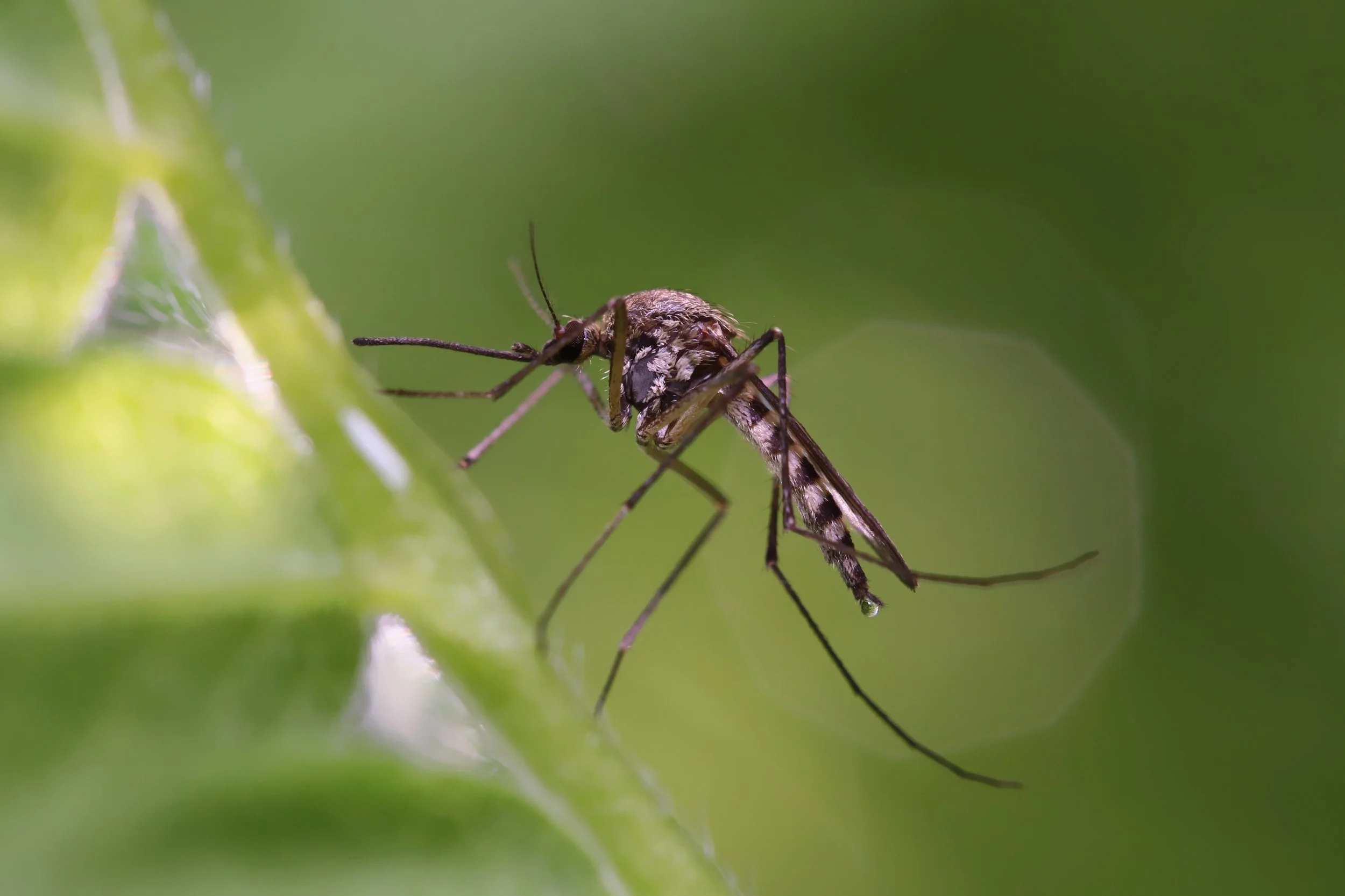
Mosquito
The mosquito needs no introduction to anyone who has stepped outside between May and September in the St. George watershed — and its reputation is harder to rehabilitate. But mosquitoes are pollinators of native orchids and food for bats in numbers that genuinely matter.
More Than a Nuisance: The Mosquito
Georges River Land Trust — Living River Species Series
Introduction
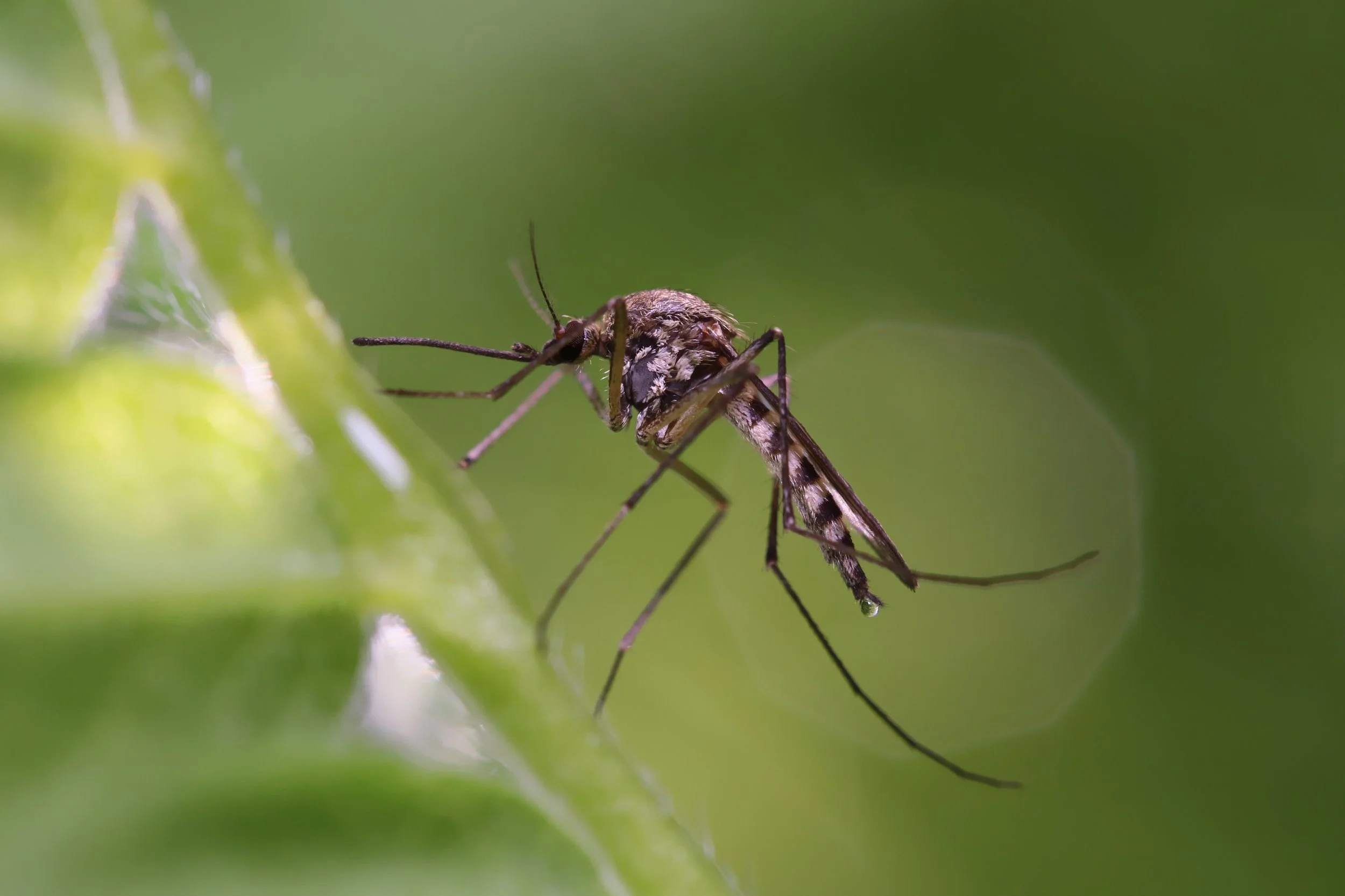
Last week we made the ecological case for the black fly — Maine's most notorious warm-season insect. This week we take on the other one. The mosquito (Family Culicidae) needs no introduction to anyone who has stepped outside between May and September in the St. George watershed, and its reputation is, if anything, harder to rehabilitate than the black fly's. Mosquitoes carry disease. They are genuinely a public health concern, and that should not be minimized. They are also pollinators of native orchids, food for bats and swallows in quantities that matter enormously, and aquatic processors of organic matter in the still-water habitats that support much of the watershed's biodiversity. The mosquito contains multitudes, and understanding them fully changes the relationship — if not the itch.
Natural History
Maine hosts approximately 50 mosquito species, and once again the essential biological fact is that only females bite. Males feed entirely on nectar and plant juices and are harmless. Females, like female black flies, require a blood meal to develop eggs — but females also feed on nectar for their own energy, visiting flowers throughout their lives. The blood and the bite are reproductive, not nutritional.
Mosquito larvae are strictly aquatic but occupy the opposite end of the water quality spectrum from black fly larvae. Where black flies require fast, cold, clean riffles, mosquito larvae thrive in still, warm, often stagnant water: vernal pools, roadside ditches, the water trapped in a hollow tree or an overturned bucket, the slow margins of ponds, the flooded woodland floor. Larvae hang from the surface film, breathing through a tube called a siphon, and filter algae, bacteria, and fine organic particles from the water below — the same filter-feeding strategy that midges and black flies use, adapted here for the quiet, nutrient-rich water of still environments.
Different species have adapted different seasonal strategies. Aedes species — the aggressive spring biters familiar to anyone who has walked through the woods in May — overwinter as eggs in dried vernal pool basins and leaf litter, hatching en masse when spring flooding arrives. Culex species breed through summer in stagnant water and are the primary vectors of West Nile virus and eastern equine encephalitis (EEE) in Maine, both of which are genuine health concerns worth monitoring through public health advisories. Knowing which mosquito is biting and when is more than academic trivia.
Identification Tips
Mosquitoes are small, slender flies with long, thin legs, narrow wings, and — the single most reliable field mark — an elongated, needle-like proboscis extending forward from the head, used by females to pierce skin. This distinguishes them at a glance from midges, which look superficially similar in flight but lack the piercing mouthpart and don't bite. Larvae hang just below the water's surface at a distinct angle, breathing through a siphon tube at the tail end, and move with a distinctive wriggling, S-shaped thrash when disturbed — different from the free-swimming midge larvae that share the same still water. The high-pitched whine near your ear, produced by rapid wingbeats, is often the first and most familiar identification cue of all.
Role in the St. George River Watershed
Strip mosquitoes from the watershed entirely — a thought experiment that some people entertain with pleasure — and the effects would ripple through the food web in ways that are difficult to fully predict.
Little brown bats are the watershed's most efficient mosquito consumers, and they matter enormously here. A single bat can consume more than 1,000 mosquitoes in a single night of foraging, and the bat populations roosting in the watershed's old buildings, hollow trees, and bridge crevices represent a combined nightly predation pressure on mosquitoes that no pesticide program could replicate. Tree swallows and barn swallows, nighthawks, and chimney swifts consume adults in large numbers during daylight and dusk hours. Dragonflies and damselflies — both covered in this series — catch them on the wing. Spiders in the vegetation around water's edges take them in webs. The adults are prey for so many species that their removal would cascade unpredictably upward through the food chain.
Mosquito larvae are food for backswimmers, predaceous diving beetles, dragonfly and damselfly nymphs, and small fish including minnows and juvenile perch — a connection we noted in last week's backswimmer post. In vernal pools, they share the water with wood frog and spring peeper tadpoles in the same weeks that tadpoles are developing — a crowded, predation-rich environment that mosquito larvae must survive to complete development.
The most surprising ecological role belongs to the males, and to females visiting flowers: mosquitoes are pollinators of native orchids. Several Maine native orchids — including bog orchids in the genus Platanthera, which grow in the watershed's wetter edges and sphagnum bogs — are pollinated primarily or exclusively by mosquitoes, which enter the flowers to feed on nectar and carry pollen between plants. These orchids and their mosquito pollinators have co-evolved over millions of years, a partnership so specific that removing one would jeopardize the other. The orchid that blooms at the sphagnum bog margin in July has mosquitoes to thank.
Seasonal Notes
Spring Aedes emerge in late April and May, often before the snow is fully gone, hatching from overwintered eggs in vernal pools and flooded woodland. They peak in May and early June and largely decline as pools dry and temperatures rise. Summer Culex and other species build through June and July, with peak activity at dusk and dawn on calm, humid evenings. Activity declines noticeably with the first frosts of September, though some species remain active into October in mild autumns. No mosquitoes overwinter as adults in Maine — the species that bite in May hatched from eggs that survived the winter, not from adults that did.
Fun Fact
The high-pitched whine of a mosquito is produced by its wingbeats — females beat their wings at a slightly different frequency than males, and the difference is detectable. Researchers studying mosquito courtship discovered that when a male and female fly near each other, they adjust their wingbeat frequencies to harmonize — tuning toward each other until their flight tones converge on a shared frequency. The insects are, in effect, finding each other in the air by listening for a match and then adjusting their pitch to meet it. A mosquito's whine, in other words, is not random noise — in the right context, it is a duet.
Want to Learn More?
- Maine CDC — Mosquito-Borne Disease — Current monitoring data, EEE and West Nile risk, and public health guidance specific to Maine.
- Maine Medical Entomology Laboratory — University of Maine research on mosquito species, distribution, and disease risk.
- Bug Guide — Culicidae — Photographic identification guide to North American mosquito species and life stages.
- iNaturalist — Mosquitoes — Regional sightings and community observations from New England naturalists.
The Living River blog series is published by St. George Consulting in support of the Georges River Land Trust and the Maine Council of Trout Unlimited. To explore the important work these organizations are doing to conserve and restore Maine's landscapes, visit georgesriver.org and tumaine.org.
Water Boatmen
Barely the size of a watermelon seed and shaped like a tiny hull, water boatmen are among the most numerous aquatic insects in the St. George watershed's ponds — and among the most astonishing animals in the world, though you would never guess it by looking at them. Males produce a mating call of nearly 100 decibels. For a two-millimeter insect, that is extraordinary.
The Rowboat of the Pond: Water Boatmen
Georges River Land Trust — Living River Species Series
Introduction
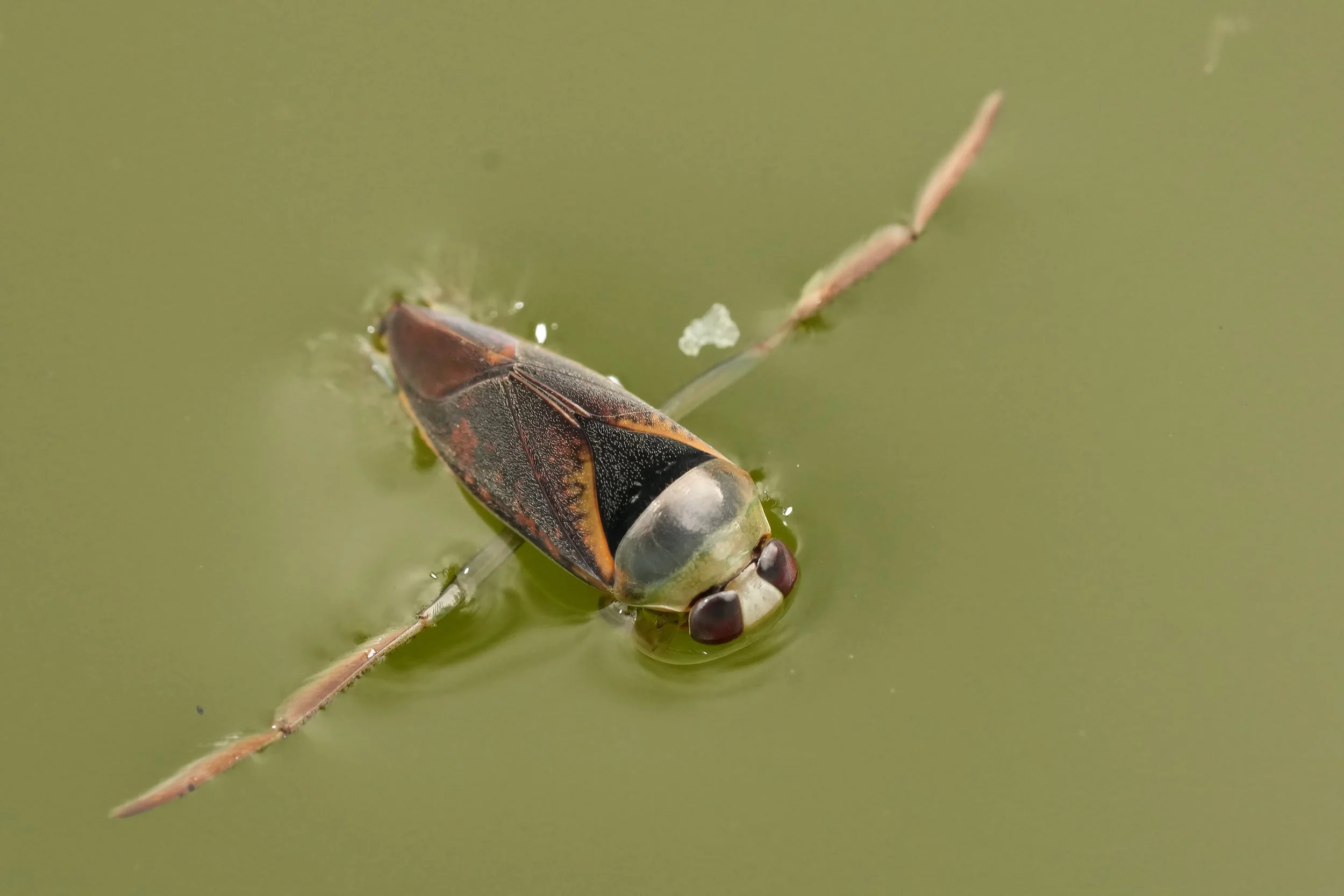
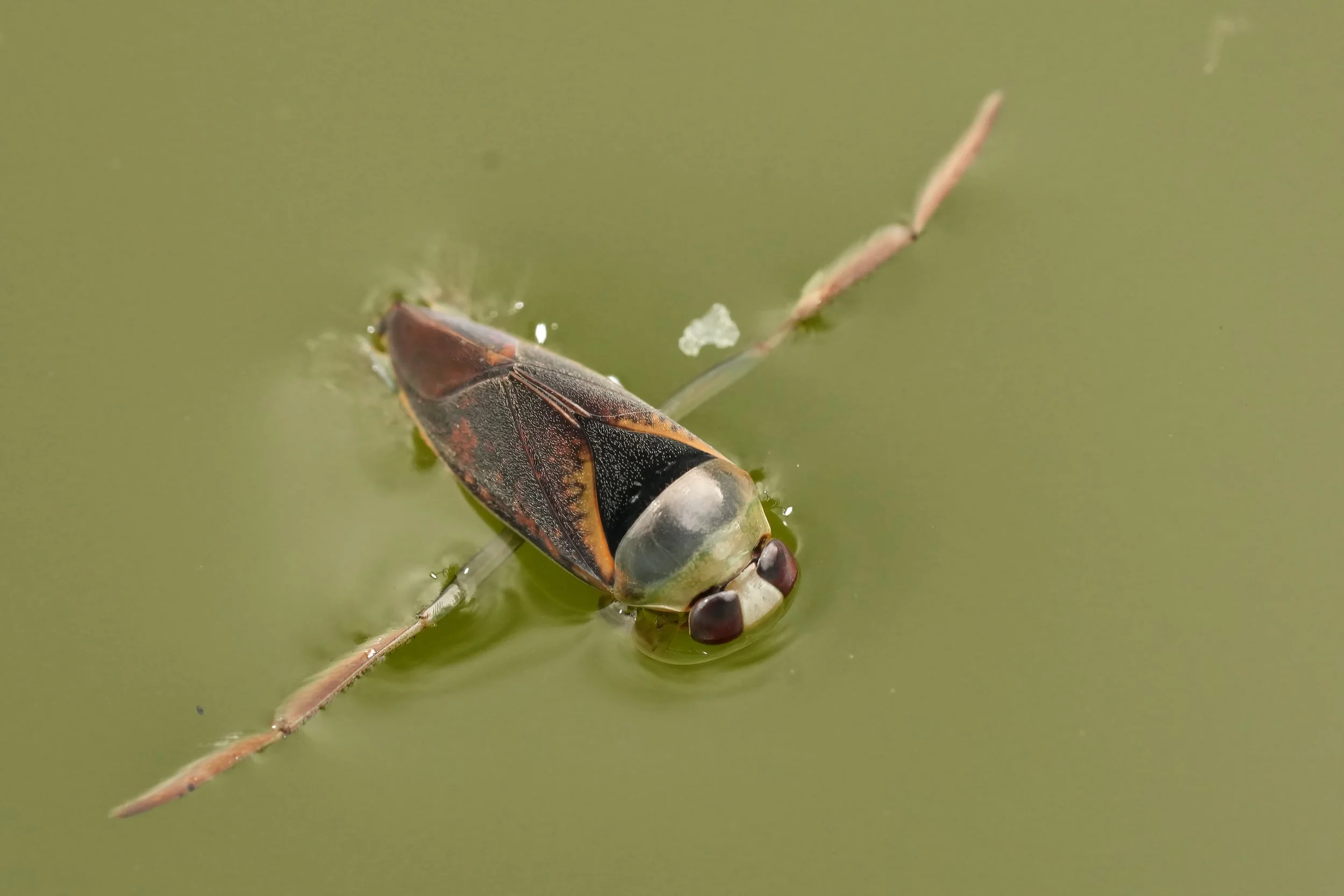
Last week we looked at the water strider, skating across the surface film of the St. George's still pools. This week we go beneath the surface, to an insect that is every bit as common, considerably more abundant, and almost entirely overlooked: the water boatman (Family Corixidae). Barely the size of a watermelon seed, shaped like a tiny hull, and rowing through the water column with a pair of flattened hind legs that work exactly like oars, water boatmen are among the most numerous aquatic insects in the watershed's ponds, lake shallows, and quiet river reaches. They are also, as it turns out, one of the most astonishing animals in the world — though you would never guess it by looking at them.
Natural History
Water boatmen are true bugs, members of the Order Hemiptera and close relatives of the water striders we featured last week, though their lives could hardly be more different. Where the strider walks on the surface and never gets wet, the water boatman lives entirely submerged — rowing through open water, clinging to aquatic vegetation, and grazing across the mud and algae of the pond bottom with a blunt, scraping mouthpart.
They breathe air, as all insects do, but they solve the underwater breathing problem with elegant simplicity: before diving, the water boatman traps a bubble of air beneath its wings or along the surface of its abdomen, carrying it down like a miniature scuba tank. The bubble not only provides oxygen but functions as a physical gill — as the oxygen in the bubble is consumed, dissolved oxygen from the surrounding water diffuses in to replace it, extending the dive significantly beyond what the original air supply alone would support. Eventually the bubble is exhausted and the insect must return to the surface to replenish it, a quick trip that takes only a moment before the boatman dives again.
Unlike most of their Hemipteran relatives — which are predators that inject digestive enzymes and suck out liquefied prey — water boatmen are primarily herbivores and detritivores. They scrape algae, diatoms, and decaying organic matter from submerged surfaces, and some species supplement this with small invertebrates and midge larvae. They are grazers of the underwater garden, moving through the same biofilm community that the blacknose dace browses from riffle rocks in fast water — here in the quieter, softer reaches of ponds and backwaters.
Water boatmen are capable fliers and disperse readily between water bodies, particularly at night. This flight ability makes them important early colonizers of new or restored wetlands — often among the first insects to arrive and establish populations in habitat that has been created or recovered.
Role in the St. George River Watershed
In a watershed full of ecologically important insects, water boatmen earn their place through sheer abundance and the breadth of species that depend on them.
As grazers of algae and aquatic biofilm, they help regulate the growth of algae in ponds and lake shallows, performing in slow, vegetated water the same function the blacknose dace performs on fast riffle rocks. By cropping algae before it can form dense mats, they contribute to the water clarity that benefits every other species in the system.
As prey, they are consumed by an impressive roster of the watershed's animals. Brook trout, yellow perch, and smallmouth bass eat them throughout the open-water season. Painted turtles pick them off submerged vegetation. Great blue herons and belted kingfishers take them in the shallows. And — in a connection that links directly to an earlier post in this series — buffleheads diving in the lower river and tidal reaches through winter consume water boatmen as a significant component of their diet. Water boatmen remain active beneath the ice through winter, one of the few aquatic insects that does not enter dormancy, which makes them a critical food source for any predator active in cold-water months.
Their flight dispersal between water bodies also carries ecological benefits beyond colonization. As they move from pond to pond across the watershed, they transport algae, bacteria, and microscopic invertebrates on their bodies and in the water clinging to them — passively connecting isolated water bodies and contributing to the biological continuity of the wetland landscape.
The aquatic vegetation of the watershed's ponds — water lilies, pondweeds, cattail roots, submerged sedges — provides both foraging substrate and shelter for water boatmen, creating a mutual dependency between the insect and the plant community it inhabits.
Seasonal Notes
Water boatmen are active year-round, including under ice in winter — one of their most ecologically distinctive traits. They are among the first insects visible in ponds each spring, sometimes active before ice has fully cleared. Mating and egg-laying occur in spring and early summer, with eggs attached to submerged vegetation. Population densities peak through summer in warm, shallow, well-vegetated water. On calm autumn evenings, adults take flight to disperse, and they are strongly attracted to artificial lights — a water boatman buzzing around a porch lamp near a pond is a common and largely unrecognized autumn encounter. Under winter ice, they can be observed with a flashlight through clear ice in shallow ponds, still rowing methodically through the cold water below.
Fun Fact
Water boatmen hold a remarkable distinction: they are among the loudest animals on Earth relative to their body size. Males produce a mating call by stridulating — rubbing a small body part across a ridged surface on the abdomen, much as a cricket rubs its legs together — generating sounds that have been recorded at nearly 100 decibels. For an insect roughly two millimeters long, this is a sound output so disproportionate to body size that researchers who first measured it assumed their equipment was malfunctioning. The song travels through water and is inaudible above the surface, but beneath it, the ponds and quiet backwaters of the watershed are considerably louder than they appear.
Want to Learn More?
- Bug Guide — Corixidae — Photographic identification guide to North American water boatman species and life stages.
- Maine DEP — Biological Monitoring — How Maine uses aquatic invertebrates to assess the health of freshwater systems.
- Xerces Society — Freshwater Invertebrates — Conservation context for aquatic insects and the wetland habitats they depend on.
- iNaturalist — Water Boatmen — Regional sightings and community photographs from New England naturalists.
The Living River blog series is published by St. George Consulting in support of the Georges River Land Trust and the Maine Council of Trout Unlimited. To explore the important work these organizations are doing to conserve and restore Maine's landscapes, visit georgesriver.org and tumaine.org.
Backswimmers
If you've spent any time peering into a pond in the St. George watershed, you've probably seen them — small, torpedo-shaped insects rowing through the water, pale undersides catching the light. They look like water boatmen. They are not. Backswimmers swim upside down, and they hunt. A word of practical advice: if you scoop one into your hand, release it promptly.
100%
Upside Down and Dangerous: Backswimmers
Georges River Land Trust — Living River Species Series
Introduction
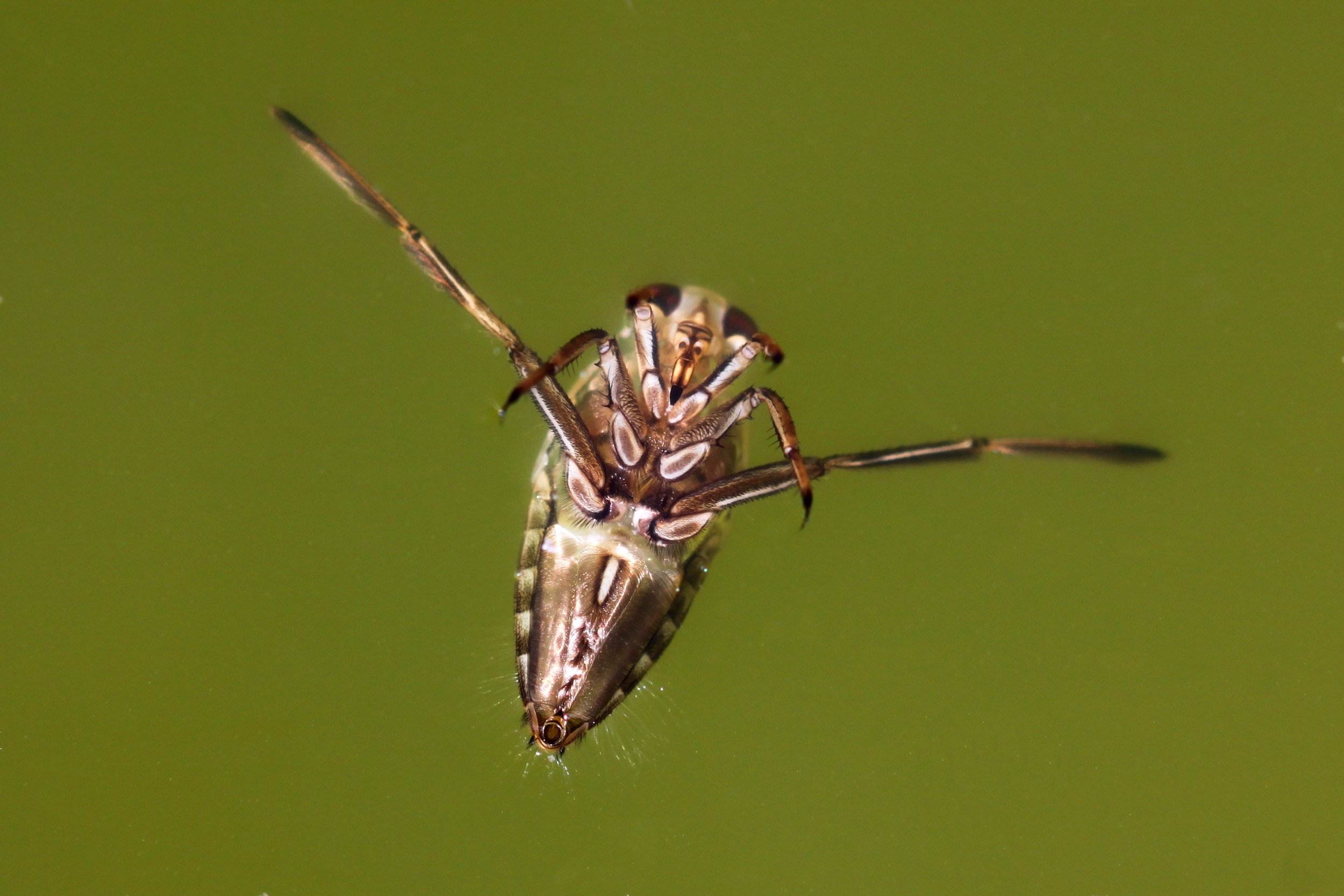
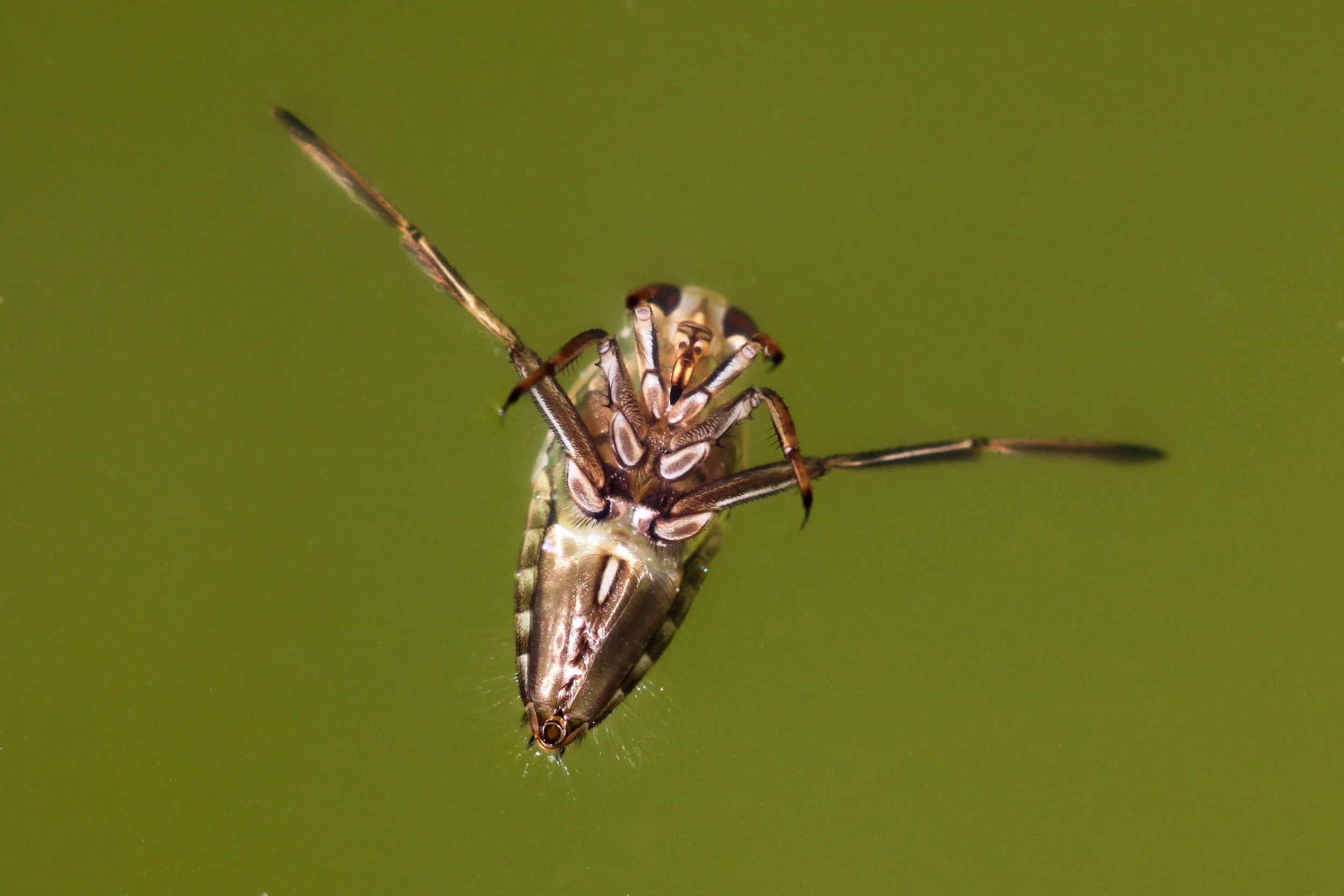
If you have spent any time peering into a pond or slow backwater of the St. George watershed, you have probably seen them without knowing what they were — small, torpedo-shaped insects rowing steadily through the water with long, oar-like hind legs, their pale undersides catching the light as they move. They look, at first glance, like water boatmen, which we wrote about last week. They are not. Backswimmers (Family Notonectidae) are doing something water boatmen never do: they are swimming upside down, and they are hunting. Where the water boatman is a peaceful grazer of algae and detritus, the backswimmer is an aggressive predator — one of the most effective ambush hunters in the watershed's quiet waters, and an animal that commands a certain respectful distance.
Natural History
Backswimmers are true bugs (Order Hemiptera), close relatives of both the water striders and water boatmen featured in the past two posts. The family name Notonectidae means "back swimmer" in Greek, which is precisely what they do: they cruise through the water inverted, belly up, using their long, fringed hind legs as synchronized oars. The keel-shaped back — which faces downward in the water — cuts through the resistance of the water column efficiently, and the pale, often silvery underside, now facing up, reflects the light in a way that can make them shimmer as they move.
Like water boatmen, backswimmers carry a bubble of air trapped against their body to breathe while submerged. But where the water boatman must work to stay on the bottom, the backswimmer faces the opposite problem: the buoyancy of its air bubble makes it naturally float upward. A backswimmer that stops swimming immediately begins to rise toward the surface — they must actively swim downward to remain submerged, which means hunting requires continuous effort. At rest, they hang just below the surface film, air bubble touching the water's surface for a breath, hind legs splayed, waiting.
They are piercing predators with a sharp, three-segmented rostrum capable of delivering a painful bite. Backswimmers will attack prey considerably larger than themselves — mosquito larvae, aquatic insect nymphs, small tadpoles, and even tiny fish fry are all fair game. The rostrum is driven in, digestive enzymes injected, and the liquefied contents drawn out, true-bug style. A word of practical advice: if you scoop pond water and find a backswimmer in your hand, release it promptly. Their bite has been compared to a bee sting and is genuinely uncomfortable — impressive for an insect less than half an inch long.
Role in the St. George River Watershed
Backswimmers are apex invertebrate predators in the pond and still-water communities of the watershed, and their position at the top of the aquatic invertebrate food web gives them an outsized ecological influence.
Their most publicly appreciated role is as predators of mosquito larvae. Mosquito larvae develop in exactly the warm, still, vegetated water that backswimmers favor, and a pond with a healthy backswimmer population is a pond with meaningful biological pressure on mosquito reproduction. This is natural pest control that operates quietly, continuously, and without any human intervention.
They also consume water boatmen — the very species we featured last week — along with midge larvae, mayfly nymphs, small caddisfly larvae, and other soft-bodied aquatic invertebrates. In doing so, they regulate the abundance of these mid-level consumers and keep the invertebrate community in balance. Their predation on tadpoles connects them directly to the watershed's amphibian community — wood frog and spring peeper tadpoles developing in warm pond margins are vulnerable to backswimmer attack, a pressure that likely influences where and how amphibians use pond habitat for breeding.
Backswimmers are in turn eaten by brook trout, yellow perch, and largemouth bass, which take them both in the water column and at the surface. Great blue herons and belted kingfishers pick them off in shallow margins. Diving ducks — including the buffleheads we wrote about earlier in the series — consume them through winter, as backswimmers remain active beneath the ice in the same months when other invertebrate prey becomes scarce.
Like water boatmen, backswimmers are capable fliers and disperse between water bodies at night, rapidly colonizing new or restored wetland habitat and knitting together the watershed's network of ponds and slow reaches into a connected ecological system.
Seasonal Notes
Backswimmers are active year-round, including under ice in winter — one of several aquatic true bugs that maintain activity through the coldest months, making them an important food source when the watershed's invertebrate diversity contracts sharply. They are visible in open water from April through November, with populations building through late spring and summer in warm, vegetated pond shallows. Mating occurs in spring, and eggs are inserted into aquatic plant tissue. On warm autumn nights, adults take flight to disperse — like water boatmen, they are attracted to artificial lights and occasionally found far from any water body. In winter, look for them through clear ice in shallow ponds, still rowing steadily upside down through the cold darkness below.
Fun Fact
Backswimmers navigate by using the brightness of the sky above the water surface as their primary reference for which way is up. Their compound eyes are divided into upper and lower halves with different sensitivities, and they orient themselves by swimming away from the brightest light source — which, in a natural setting, is always the sky above. This system works flawlessly in nature. Near artificial lights at night, however, the system fails: a bright lamp below or to the side of the pond registers as "up," and backswimmers will swim toward it, sometimes ending up stranded far from water. The same elegant navigation that has served them for millions of years becomes a liability in a world lit from unexpected directions.
Want to Learn More?
- Bug Guide — Notonectidae — Photographic identification guide to North American backswimmer species and life stages.
- Maine DEP — Biological Monitoring — How Maine uses aquatic invertebrates to assess freshwater ecosystem health.
- Xerces Society — Freshwater Invertebrates — Conservation context for aquatic insects and the pond and wetland habitats they depend on.
- iNaturalist — Backswimmers — Regional sightings and community photographs from New England naturalists.
The Living River blog series is published by St. George Consulting in support of the Georges River Land Trust and the Maine Council of Trout Unlimited. To explore the important work these organizations are doing to conserve and restore Maine's landscapes, visit georgesriver.org and tumaine.org.
Common Waterweed
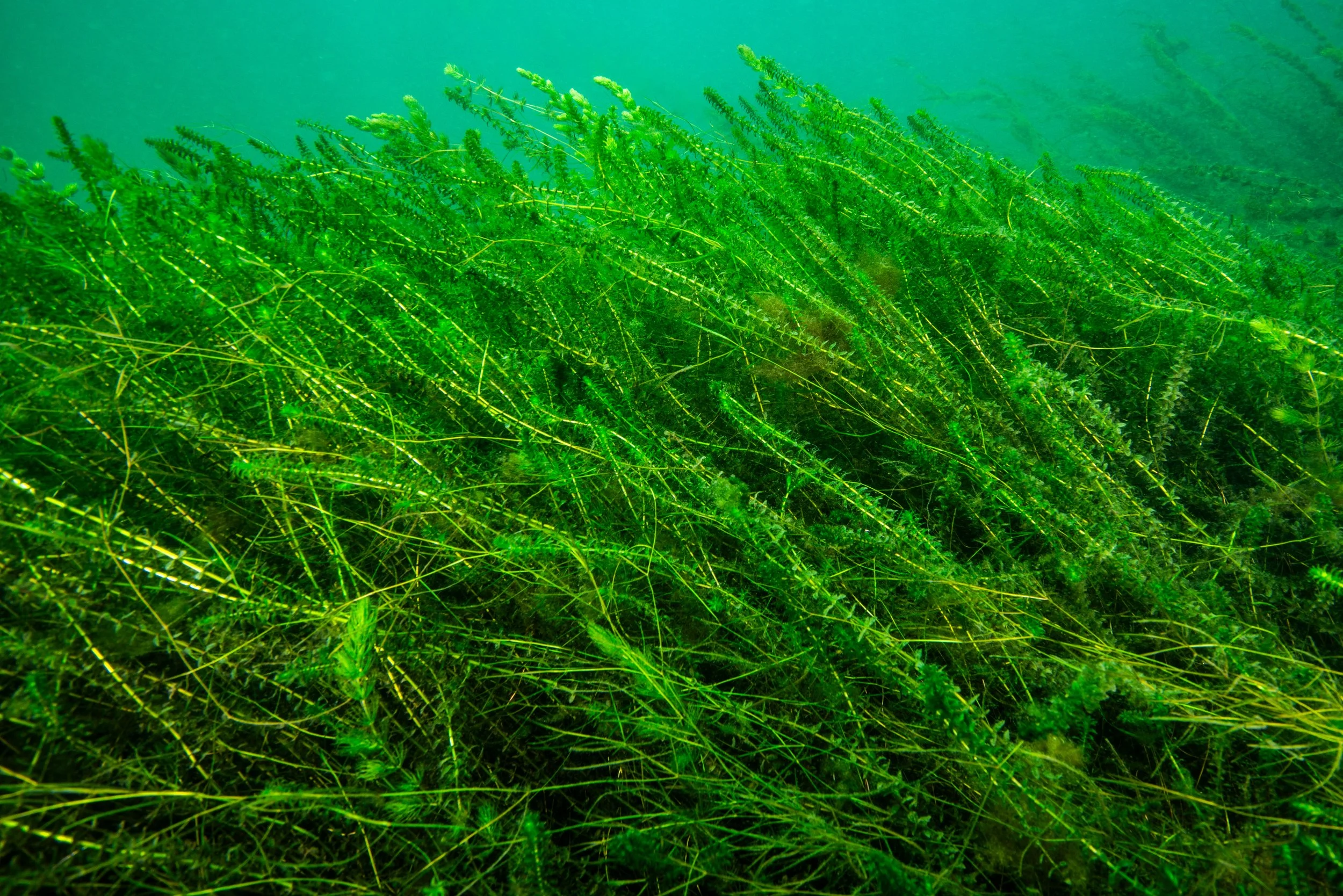
Most of the plants we notice along the St. George River grow in plain sight. But some of the watershed's most important botanical work happens out of view, beneath the surface, in the slow-moving coves and ponds where common waterweed forms dense underwater meadows. Pull a stem from the water, hold it in the light, and you'll find something genuinely beautiful.
The Quiet Workhorse Beneath the Surface: Common Waterweed
Georges River Land Trust — Living River Species Series
Introduction
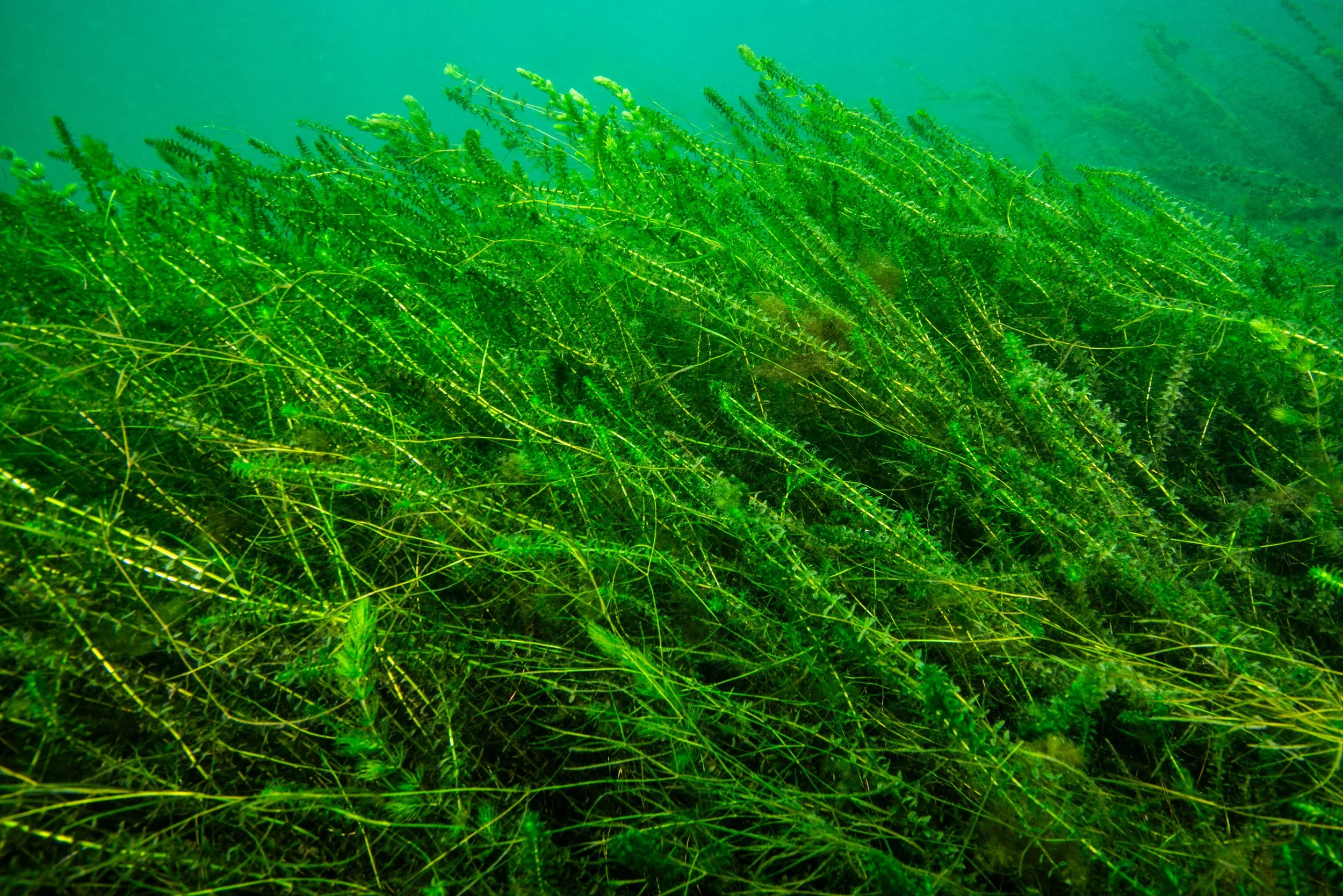
Most of the plants we notice along the St. George River grow in plain sight — lining the banks, arching over the water, blooming in the shallows. But some of the watershed's most important botanical work happens out of view, beneath the surface, in the slow-moving coves and ponds where green threads of common waterweed (Elodea canadensis) form dense underwater meadows that few people ever stop to think about. It's not flashy. It doesn't bloom in a way you'd notice from the bank. But pull a stem from the water, hold it in the light, and you'll find something genuinely beautiful — and quietly essential to the life of the river.
Natural History
Common waterweed is a fully submerged aquatic plant native to North America, found from the Maritimes and New England west to the Pacific and south into much of the United States and Mexico. It belongs to the family Hydrocharitaceae and favors still to slow-moving freshwater: ponds, lake coves, sluggish river backwaters, and sheltered bays where light can penetrate to the bottom.
The plant grows in long, branching stems lined with whorls of three small, dark green leaves — each leaf slightly toothed along its edge, translucent when held to the light, oval and barely half an inch long. In good conditions, stems can reach several feet in length and form dense underwater beds that shift gently with the current.
Elodea flowers are tiny and easily overlooked — small white blossoms that float at the water's surface on thread-thin stalks, pollinated at or just below the surface film. Most North American populations consist almost entirely of female plants. The plant reproduces mainly by fragmentation: a broken stem, carried by current or on the feathers of a duck, can root and establish a new colony. It is one of the most successful clonal colonizers in the freshwater world.
The plant is a vigorous photosynthesizer, producing oxygen throughout the day in quantities that are measurable and significant. In the warmer months, tiny streams of oxygen bubbles rise from a healthy Elodea bed in a display that is, if you happen to be watching from underwater, quietly mesmerizing. This productivity is the foundation of everything the plant provides.
Identification Tips
Common waterweed is a fully submerged plant with long, branching stems lined in tight whorls of three small, oval leaves, each barely half an inch long and finely toothed along the edge — visible only by pulling a stem from the water or peering through the surface on a calm day. The leaves are thin enough to see light through and darker green than most other submerged plants in the watershed, with no floating leaves or emergent flowers to help identify it from the surface (its tiny white blooms float nearly flush with the water on thread-like stalks and are easy to miss). Dense beds form dark, waving patches visible from a dock or canoe in shallow, still coves, distinguishing Elodea from the more open-growing pondweeds it's often confused with. On close inspection, tiny streams of oxygen bubbles rising from the leaves on a sunny day are a reliable confirming sign.
Role in the St. George River Watershed
Common waterweed plays several overlapping roles in the lakes, ponds, and slower river reaches of the St. George watershed, and most of them are easy to underestimate.
As a primary producer, it converts sunlight into plant material that feeds the bottom of the food web — aquatic invertebrates graze on it directly, and the invertebrate communities it shelters in turn feed juvenile fish, ducks, herons, and a cascade of other species. The dense structure of an Elodea bed provides refuge for small fish and the young of larger ones, a place to hide from predators and find food in the same square foot of habitat.
For spawning fish — especially species like yellow perch and sunfish that broadcast eggs over vegetation — Elodea beds serve as nurseries, catching and holding eggs until they hatch. Dabbling and diving ducks feed on the plant directly, pulling stems from the bottom on their dives. Turtles rest in and among the beds. Even the water itself benefits: a thriving submerged plant community reduces water turbidity by trapping fine particles and competing with algae for nutrients, helping to keep the water clear.
In the context of watershed health, healthy submerged aquatic vegetation is an indicator of good water quality — the plants need clear water to photosynthesize, and their presence in turn helps keep it that way. It is a relationship that rewards protection.
Seasonal Notes
Common waterweed begins growing actively in late spring as water temperatures warm and day length increases. Through summer, beds can become dense enough to be visible from the surface as dark patches in shallow coves, occasionally tangling in fishing lines or boat propellers. Growth slows in fall, and by late autumn the stems begin to die back. The plant overwinters as dormant fragments and specialized buds called turions — compact, starchy structures that sink to the bottom, survive the cold months, and generate new plants come spring. Even in the depths of a Maine winter, the material for next year's underwater meadow is already waiting.
Fun Fact
If you ever dissected a high school biology class experiment involving a jar of water and a green sprig giving off bubbles under a lamp, that was almost certainly Elodea. Common waterweed has been the go-to demonstration of photosynthesis in classrooms for well over a century because it produces oxygen so reliably and visibly — the bubbles rising from a freshly illuminated stem are real oxygen, manufactured in real time. Somewhere in the St. George watershed right now, the same process is playing out on a much larger scale, breath by silent breath, in coves and shallows most of us will never see.
Want to Learn More?
- Native Plant Trust: Go Botany — Elodea canadensis — Identification details, range maps, and habitat notes for New England.
- Maine DEP: Aquatic Plants of Maine — A practical guide to Maine's native and invasive aquatic plants, with identification help.
- USDA Plants Database — Elodea canadensis — Range maps, taxonomy, and ecological data.
- Maine Volunteer Lake Monitoring Program — How citizen scientists track aquatic plants and water quality across Maine's lakes and ponds.
The Living River blog series is published by St. George Consulting in support of the Georges River Land Trust and the Maine Council of Trout Unlimited. To explore the important work these organizations are doing to conserve and restore Maine's landscapes, visit georgesriver.org and tumaine.org.
Freshwater Mussels
They don't sing, sprint, or bloom — but freshwater mussels may be the St. George River's most quietly extraordinary residents. Tucked into sandy and gravelly streambeds, these ancient bivalves have been filtering river water for millennia. Three species living right here are among the rarest in the entire Northeast. That makes this river genuinely special.
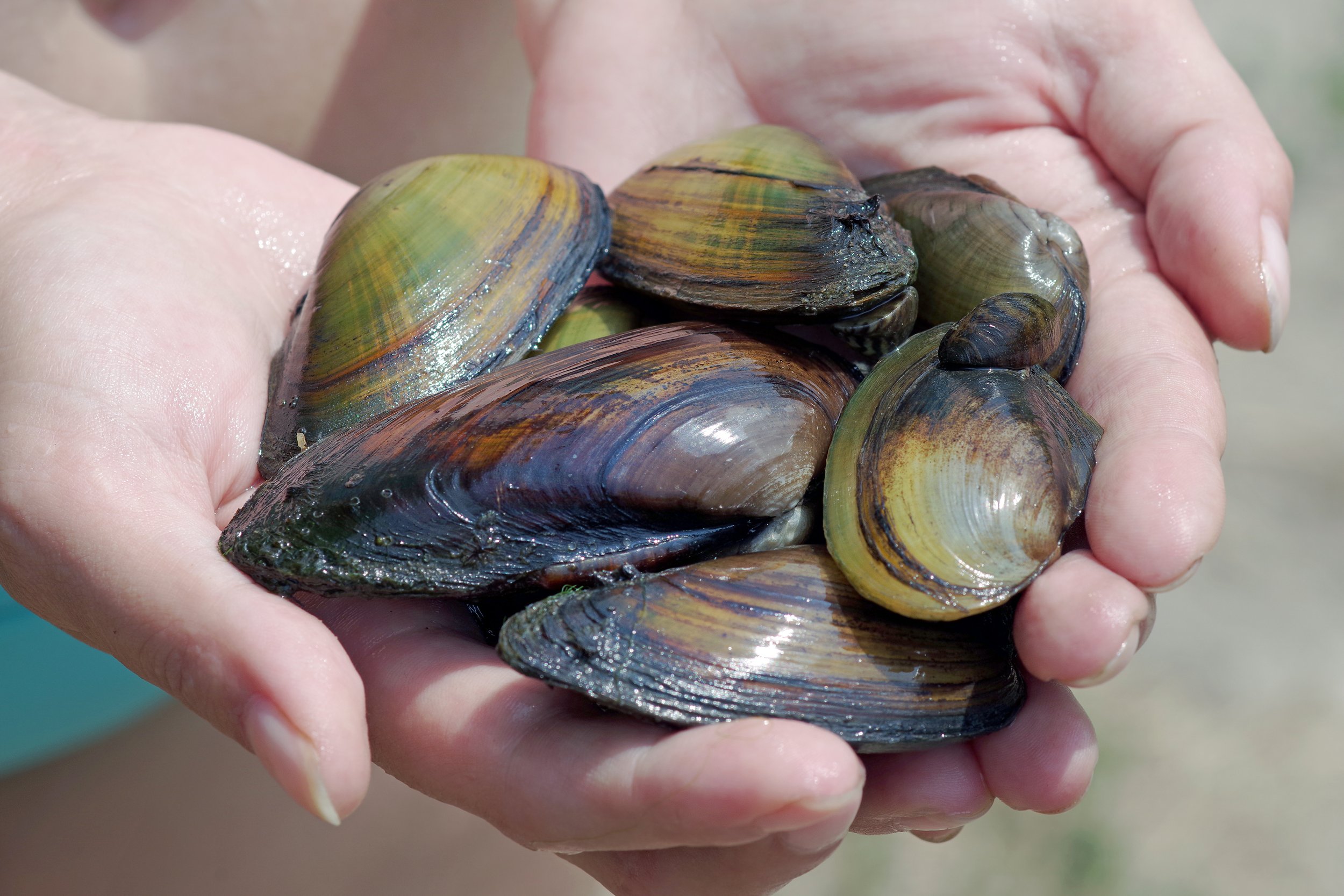
Hidden Gems of the River Bottom: Freshwater Mussels of the St. George
Georges River Land Trust — Living River Species Series
A Living Filter Beneath the Surface
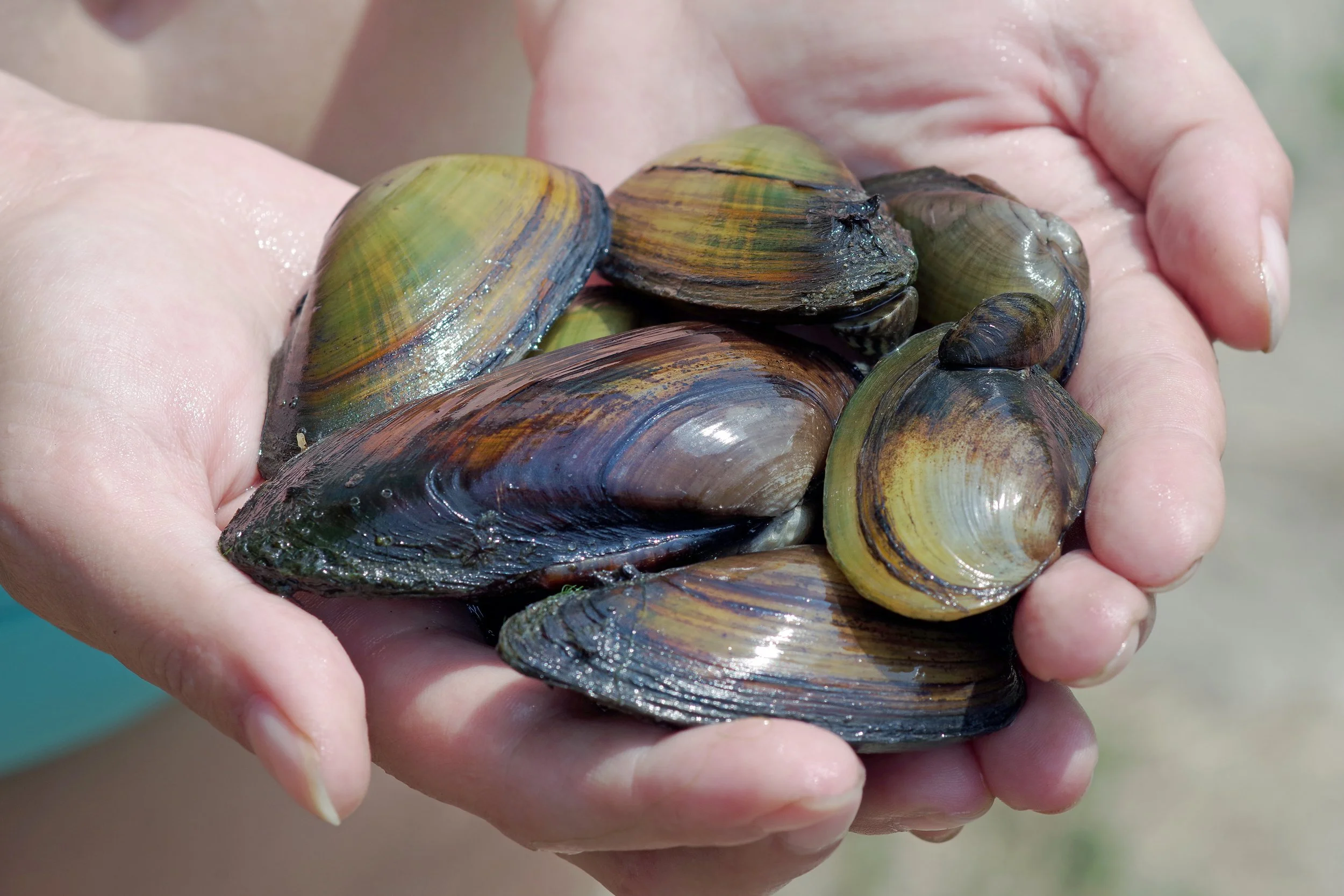
They don't sing, sprint, or bloom, but freshwater mussels may be the St. George River's most quietly extraordinary residents. Tucked into sandy and gravelly streambeds, these ancient bivalves have been filtering our river water for millennia — and a few of the species living right here are among the rarest in the entire Northeast.
Maine is home to ten native species of freshwater mussels, and the St. George River watershed is one of the few places in the state where three threatened species share the same water. That makes this river genuinely special.
Natural History: Ancient and Ingenious
Freshwater mussels are bivalves — two-shelled mollusks related to clams and oysters — but they lead lives far stranger and more fascinating than their humble appearance suggests.
They are filter feeders, drawing water through their gills to extract algae, bacteria, and fine organic particles. A single mussel can filter several gallons of water per day. In a healthy river, a colony of mussels acts like a living water treatment plant, clarifying the flow and cycling nutrients back into the ecosystem.
But the truly astonishing part of their life story is reproduction. Mussel larvae, called glochidia, can't develop on their own — they must spend time as parasites on the gills or fins of a specific host fish. The Yellow Lampmussel has evolved a remarkable trick to get the job done: the fleshy edge of its mantle mimics a small fish, complete with a convincing eye-spot, to lure in a host. When a curious fish investigates, the mussel releases a cloud of larvae. It sounds dramatic, and it is.
Once the larvae drop off their host, they settle into the riverbed and begin their slow, quiet lives. Many freshwater mussels live for decades; some species reach 100 years or more.
Identification Tips
Freshwater mussels are elongated, oval-to-teardrop-shaped bivalves partly or fully buried in sand or gravel streambed, usually with just the shell's posterior edge visible or slightly gaping above the substrate. Shell color and shape help narrow down species: the yellow lampmussel shows a smooth, warm yellowish-brown shell, the tidewater mucket a similar size with a more bronze tone, and the brook floater a smaller, olive-brown shell with a somewhat irregular, sculpted surface. Live mussels typically sit at a slight angle with the hinge down and the growing edge up, unlike empty shells, which lie flat or are found scattered loose on the bottom or bank. Because Maine's rarest mussel species are protected and easily damaged by handling, the best identification approach is to look without touching or lifting them from the streambed.
The St. George's Rarest Residents
Three species found in the St. George River are listed as Threatened under the Maine Endangered Species Act:
Yellow Lampmussel (Lampsilis cariosa) — Up to five inches long with a warm yellowish shell. In Maine, it is found only in the Penobscot, St. George, and lower Kennebec River watersheds.
Tidewater Mucket (Leptodea ochracea) — Similar in size to the Yellow Lampmussel, with a more bronze-toned shell. It shares the same narrow Maine range.
Brook Floater (Alasmidonta varicosa) — Smaller, olive-brown, and considered one of the rarest freshwater mussels in the entire Northeast.
The fact that all three live here is a testament to the St. George's relative health — and a reminder of how much is at stake. Nationwide, more than a third of North America's nearly 300 freshwater mussel species have already disappeared or are at risk of extinction, largely due to dams, water pollution, and the loss of clean, free-flowing rivers.
The Wabanaki and the River's Mussels
Long before European settlement, the rivers of Midcoast Maine were home to the Wabanaki peoples — including the Penobscot, Passamaquoddy, Maliseet, and Mi'kmaq nations — who traveled, fished, and gathered throughout these watersheds across the seasons.
Freshwater mussels were part of that relationship with the river. Archaeological evidence from interior river sites shows mussel shells among food remains, and the sturdy shells were fashioned into practical tools — scrapers, small spoons, and other implements. Coastal shell middens also preserve a rich record of how deeply intertwined Wabanaki people were with the mollusks of their waters.
That long history of careful stewardship is part of why rivers like the St. George still support rare species today.
Seasonal Notes
Mussels are year-round residents, but late summer is when mussel-watching (or rather, mussel-finding) is easiest. Low water levels in July and August expose shallow riffles where mussels sometimes lie partially visible in the gravel. Look, but please don't disturb — these animals are slow to recover from disturbance, and some of those shells belong to animals that have been in that spot for decades.
Fun Fact
The Yellow Lampmussel's fish-luring mantle display is so convincing that it can fool even experienced naturalists at first glance. Evolution, it turns out, is a patient and brilliant artist.
Learn More
- Maine IFW — Rare Freshwater Mussels
- Maine IFW — Freshwater Mussels of Maine (poster/species guide)
- NRCM Creature Feature: Yellow Lampmussel
- Lakes of Maine — Freshwater Mussels
- St. Georges River Focus Area — Maine Natural Areas Program
- UMaine Hudson Museum — Maine's Shell Middens
The Living River blog series is published by St. George Consulting in support of the Georges River Land Trust and the Maine Council of Trout Unlimited. To explore the important work these organizations are doing to conserve and restore Maine's landscapes, visit georgesriver.org and tumaine.org.
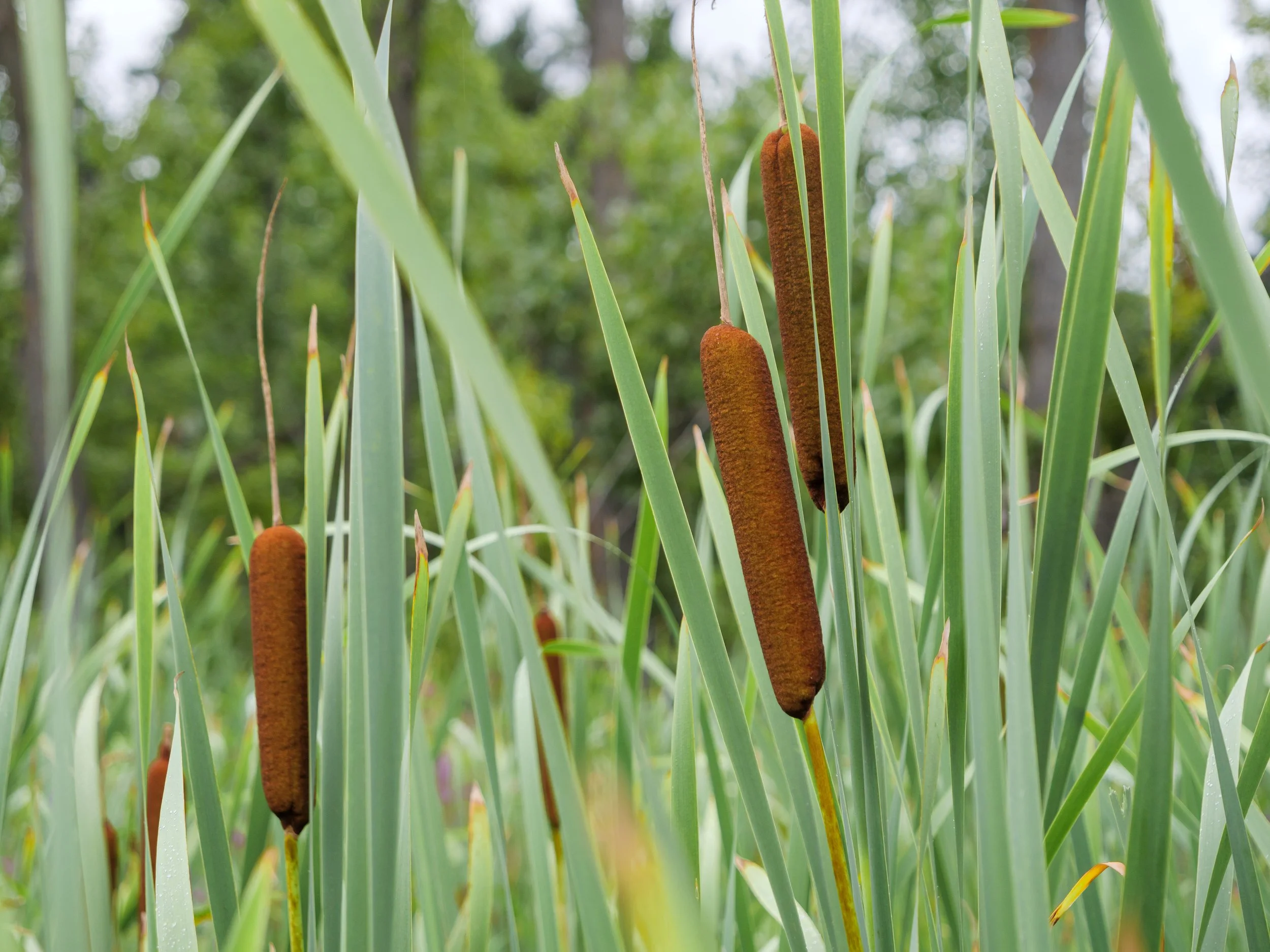
Cattails
There is no more recognizable wetland plant in Maine than the cattail — and most people have seen them their entire lives without thinking much about them. That's a shame, because the cattail is one of the most productive, useful, ecologically valuable, and genuinely fascinating plants in the entire watershed. Once you know what you're looking at, you'll never drive past a cattail marsh the same way again.
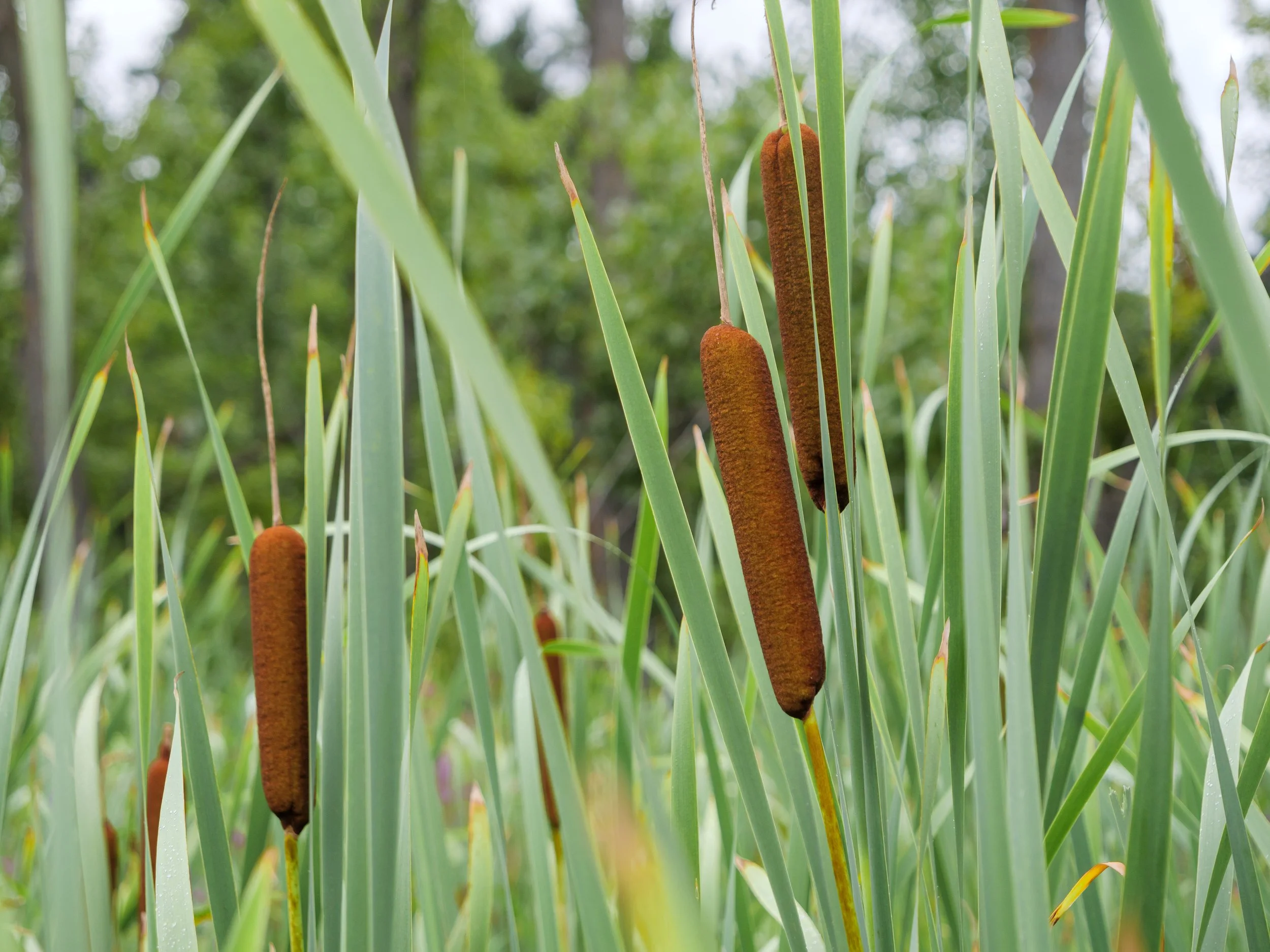
The Marsh's General Store: The Cattail
Georges River Land Trust — Living River Species Series
Introduction
There is no more recognizable wetland plant in Maine than the cattail. Those brown, velvety cylinders on stiff stalks — poker-straight above the waterline, rising from a dense stand of flat green leaves — are a universal shorthand for "marsh." Children poke them. Artists paint them. Most people have seen them their entire lives and never thought much about them. That's a shame, because the cattail is one of the most productive, useful, ecologically valuable, and genuinely fascinating plants in the entire watershed. Once you know what you're looking at, you'll never drive past a cattail marsh the same way again.
Natural History
Two cattail species grow in the St. George watershed, sometimes side by side. Broad-leaved cattail (Typha latifolia) is native and the more common of the two, with leaves up to an inch wide and a dense brown seed cylinder that sits flush against the male flower stalk above it. Narrow-leaved cattail (Typha angustifolia) has slender leaves and a small gap between its male and female flower portions. The two species hybridize freely, producing Typha × glauca, a highly vigorous hybrid that can spread aggressively and crowd out other wetland plants — a reminder that even familiar natives can become ecologically complicated.
The familiar brown "cattail" is actually a densely packed spike of thousands of tiny female flowers, each attached to a tuft of silky fiber. Above it, the thin bare stalk is where the male flowers once were — they produce clouds of bright yellow pollen in early summer, then wither and fall away. Each spike can carry up to 300,000 seeds, and when it finally breaks apart in fall and winter, the marsh erupts in slow-motion blizzards of fluff that drift for miles.
Cattails spread most aggressively not by seed but underground, through a dense network of thick rhizomes that can extend the colony several feet in a single season. A stand that fills a cove today may have started from a single plant not many years ago.
Identification Tips
Cattails are identified at a glance by their tall, straight stalks topped with a dense, velvety brown cylindrical seed head, rising above long, flat, sword-like leaves from the base. Broad-leaved cattail has leaves nearly an inch wide and a seed spike that sits flush against the thinner male flower spike directly above it; narrow-leaved cattail has slimmer leaves and a visible gap of bare stem between the male and female flower portions. In early summer, look for the male flower spike still intact above the brown female portion, dusted with yellow pollen, before it withers and falls away by midsummer. By fall and winter, the brown cylinder frays and releases cottony white seed fluff, a stage that makes cattail identifiable even at a distance across a frozen marsh.
Wabanaki Uses
Of all the plants in the watershed, few were as comprehensively useful to Wabanaki peoples as the cattail. It was, in a very real sense, a general store that was open in every season.
In spring, the young shoots emerging from the water were eaten like asparagus — crisp, mild, and nourishing after a long winter. As summer approached, the green, unripe female flower heads were roasted or boiled and eaten much like corn on the cob. When the male flowers opened and released their pollen, the bright yellow powder was collected in quantity and mixed into breads, porridges, and cakes, adding protein and a golden color. The starchy rhizomes were harvested year-round — dried, pounded into flour, or roasted whole — providing a reliable carbohydrate when other foods were scarce.
Beyond food: the broad leaves were woven into sleeping mats, baskets, and storage containers that were both flexible and waterproof when green. The silky seed down insulated clothing, lined cradle boards, and served as absorbent padding. The pale gel found between young leaves was applied directly to wounds, burns, and skin irritations, a soothing treatment that functions much like aloe. Among the Penobscot, Passamaquoddy, and Abenaki nations, the cattail was among the most versatile plants in the material and medicinal toolkit.
Role in the St. George River Watershed
Cattail marshes along the St. George River and its tributaries are among the most biologically productive habitats in the watershed. Their dense stands provide nesting cover for red-winged blackbirds, marsh wrens, and American bitterns — species that depend almost entirely on emergent marsh vegetation to breed. Common yellowthroats, swamp sparrows, and Virginia rails work the edges. Muskrats eat the rhizomes and leaves and weave entire lodges from cattail material; river otters and mink hunt the muskrats in turn.
Beneath the surface, cattail roots stabilize soft shoreline soils against erosion and filter nutrients and sediment from agricultural and residential runoff before it reaches open water. This filtering function makes cattail marshes a first line of defense for water quality in the watershed — natural infrastructure that no engineered system can fully replicate.
Seasonal Notes
Spring brings the new shoots, and early gatherers — human and wildlife alike — know to look for them. By early summer, the green, unripe seed heads are developing, and the male flowers at the top of the stalk dust everything nearby with yellow pollen. Through late summer, the familiar brown cylinders deepen and firm. Come fall and winter, the stalks dry and the seed heads begin to unravel in the wind, releasing their down across the marsh and beyond. The persistent brown stalks remain visible all winter, marking the marsh even under snow.
Fun Fact
During World War II, when Japanese forces controlled Southeast Asia and cut off the U.S. supply of kapok — the tropical fiber used to stuff life jackets and flight suits — the U.S. government turned to cattail down as an emergency substitute. American schoolchildren were organized into collection brigades, gathering cattail seed heads from marshes across the country. Millions of life jackets were stuffed with cattail fluff before the war's end. The marsh plant that lines the edges of the St. George River helped keep sailors and airmen afloat.
Want to Learn More?
- Native Plant Trust: Go Botany — Typha latifolia — Identification details, range maps, and habitat notes for New England.
- Maine DEP: Wetlands and Water Quality — The role of freshwater wetlands in Maine's landscape and regulatory protections.
- Wabanaki Medicine and Moons Educators Guide — Maine Dept. of Education — Traditional Wabanaki knowledge of seasonal plant use and relationships with the natural world.
- USDA Plants Database — Typha latifolia — Range maps, taxonomy, and ecological data for broad-leaved cattail.
The Living River blog series is published by St. George Consulting in support of the Georges River Land Trust and the Maine Council of Trout Unlimited. To explore the important work these organizations are doing to conserve and restore Maine's landscapes, visit georgesriver.org and tumaine.org.
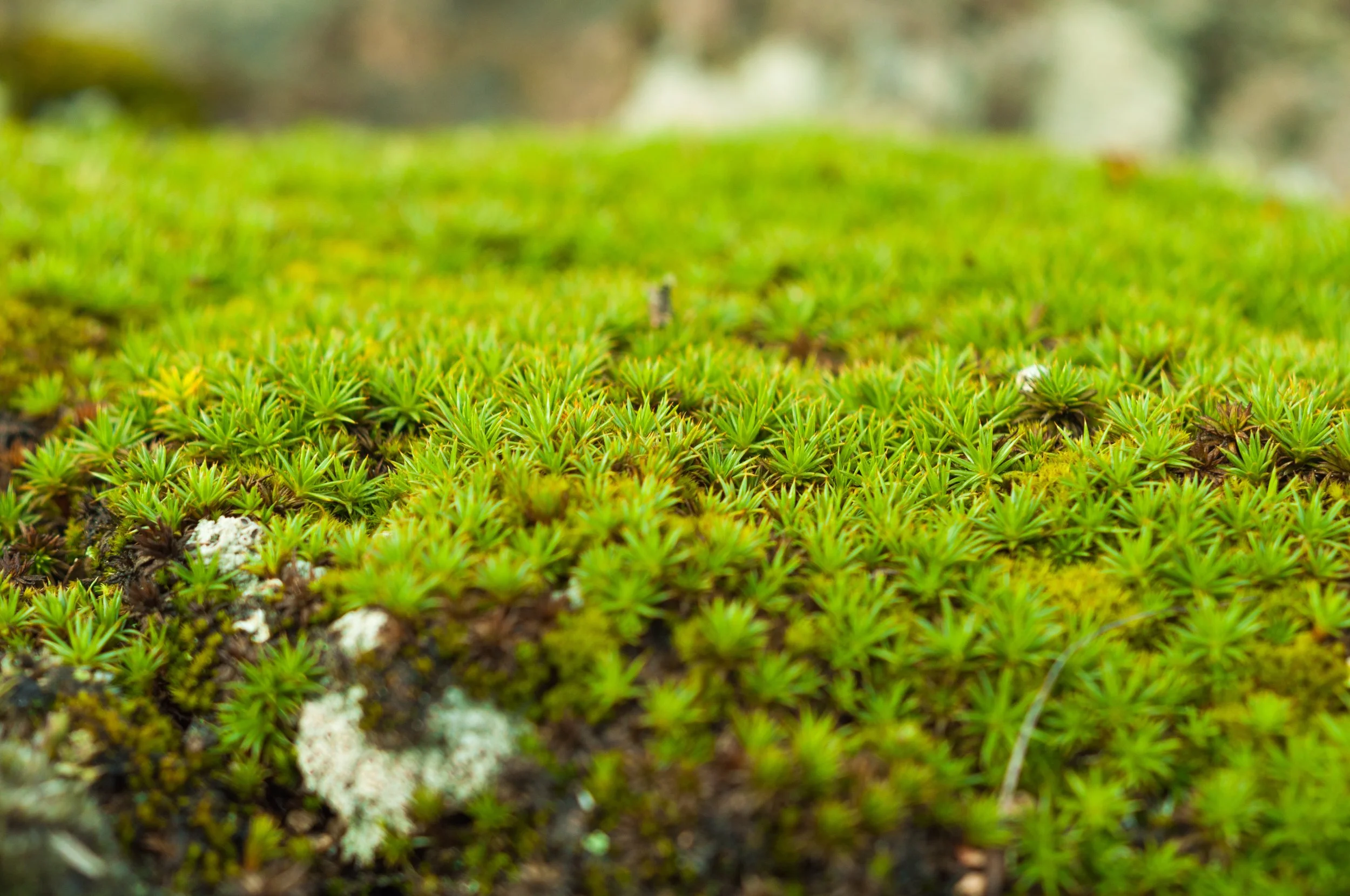
Spagnum Moss
Step carefully into one of the bogs tucked into the upper St. George watershed and the ground gives beneath your feet in a way that is unlike anything else in the Maine landscape — spongy, yielding, alive. Look down and you're standing on sphagnum moss, one of the most ecologically consequential plants on the planet. It doesn't just live in bogs. It makes them.
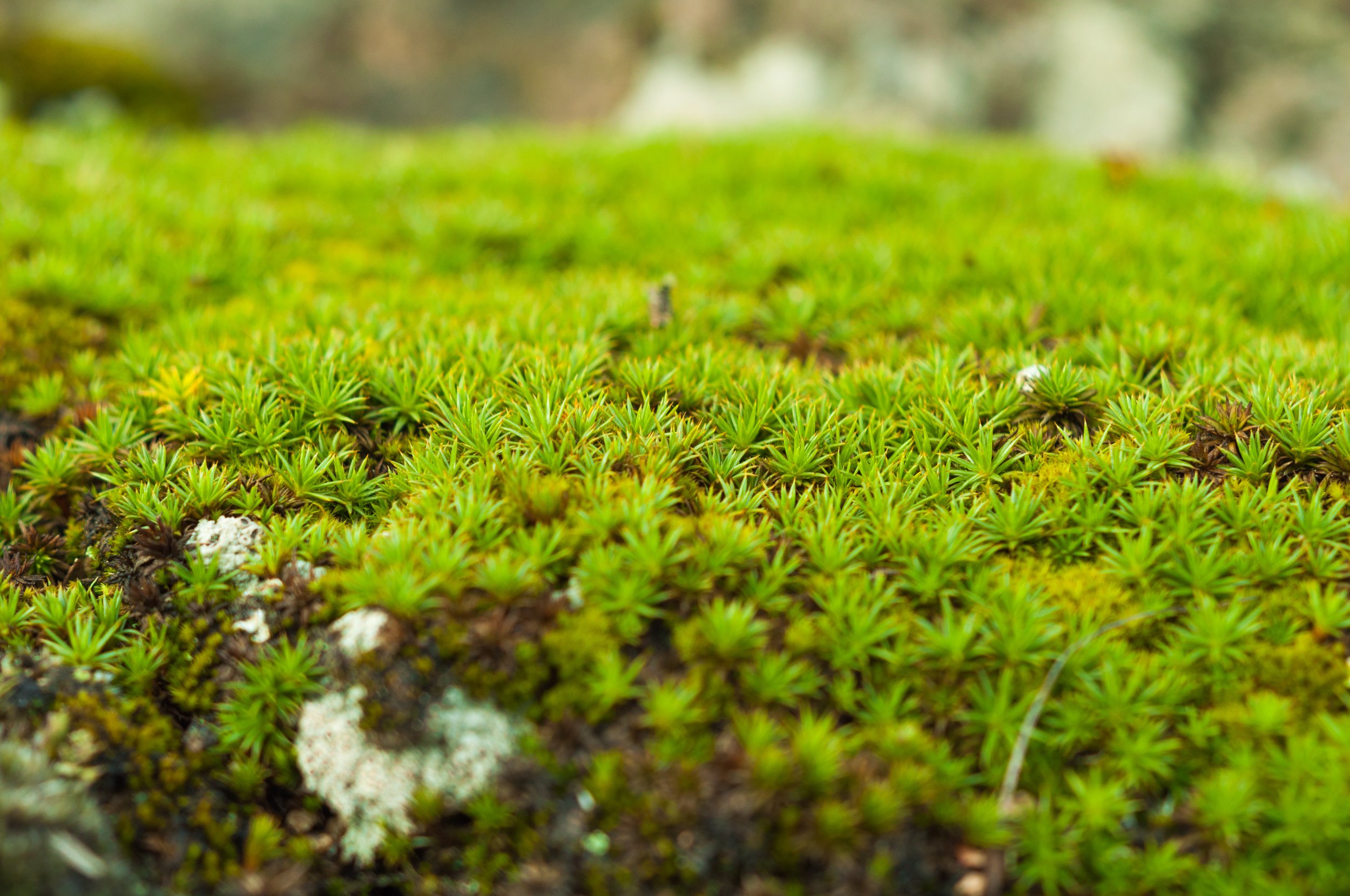
The Moss That Built the Bog: Sphagnum
Georges River Land Trust — Living River Species Series
Introduction
Step carefully into one of the bogs tucked into the upper reaches of the St. George River watershed and the ground gives beneath your feet in a way that is unlike anything else in the Maine landscape — spongy, yielding, alive. Look down and you're standing on a thick, saturated carpet of sphagnum moss, one of the most ecologically consequential plants on the planet. Sphagnum doesn't just live in bogs. It makes them. It acidifies water, hoards carbon, shapes entire ecosystems, and does so one tiny stem at a time, in a process that has been running without interruption since the last ice age.
Natural History
Sphagnum is a genus of mosses — Sphagnum spp. — with more than 300 species worldwide and around 40 in North America. Maine hosts a generous share of them, and their colors alone reward close attention: depending on the species and how much sun reaches them, sphagnum cushions range from vivid lime green to gold to deep burgundy red, painting bog surfaces in muted, jewel-like tones.
What makes sphagnum extraordinary is its structure. Each stem is lined with two kinds of cells: small, living green cells that photosynthesize, and large, dead transparent cells called hyaline cells — hollow, pore-riddled chambers that act like tiny sponges. Together, they allow sphagnum to absorb and hold up to 20 times its dry weight in water. A single handful, wrung out, releases a startling quantity of liquid.
But water storage is only part of the story. As sphagnum grows and absorbs water, it releases hydrogen ions in exchange for the nutrients it takes up — effectively acidifying everything around it. A thriving sphagnum bog can have a pH as low as 3.5 or 4, roughly the acidity of apple juice. Almost nothing decays in those conditions. Dead sphagnum accumulates beneath the living surface as peat, building up layer by layer over centuries and millennia. In some Maine bogs, the peat is ten feet deep or more — a compressed archive of moss that was alive when the first people walked this watershed.
That same cold, acidic, airless environment creates the conditions for carnivorous plants: pitcher plants and sundews thrive in sphagnum bogs because the moss has stripped the water of nutrients so thoroughly that the plants evolved another way to feed.
Wabanaki Uses
Sphagnum was among the most practically valuable plants available to Wabanaki peoples across every season of the year. Its remarkable absorbency and natural antimicrobial properties — the same acidity that preserves peat for millennia also inhibits bacterial growth — made it an ideal material for wound dressings, applied directly to cuts, burns, and injuries to slow bleeding and prevent infection. This was not folk belief: the mechanisms are real, and the practice worked.
Soft, dry sphagnum was used as lining for cradleboards, providing absorbent, gentle padding for infants. It was packed into footwear for insulation and moisture management, used to chink the gaps in bark dwellings, and gathered as tinder for fire-starting. The Penobscot and Passamaquoddy, whose territories encompassed the bogs and wetland corridors of this watershed, understood sphagnum as a versatile and reliable material — one of the most useful things the boggy landscape provided.
Role in the St. George River Watershed
The bogs and fens of the upper St. George watershed — particularly in the hillier terrain of Montville, Appleton, and surrounding towns — support robust sphagnum communities that quietly perform several critical functions.
Sphagnum bogs act as water reservoirs, absorbing rainfall and releasing it slowly, moderating the extremes of flood and drought in downstream waters. They are significant carbon sinks: peatlands globally store more carbon per acre than any other ecosystem, including tropical rainforests, and Maine's peat bogs are active participants in that storage. Draining or disturbing a bog releases that accumulated carbon — making bog protection a genuine climate consideration.
For biodiversity, sphagnum communities are irreplaceable. Bog-dependent species — pitcher plants, sundews, bog laurel, leatherleaf, Labrador tea, and the specialized insects that live among them — exist nowhere else in the watershed. Nesting waterfowl, dragonflies, bog-adapted butterflies, and boreal bird species all use sphagnum habitat. These are not interchangeable with any other wetland type.
Seasonal Notes
Sphagnum grows year-round but is most visibly lush from late spring through fall, when moisture is high and the colors are at their most vivid. A bog visited on a cool, foggy morning in June — the moss saturated, glistening, and deeply green — is one of the quieter visual rewards the watershed offers. Through summer, the bog surface can take on golden and red tones as drier conditions stress some species. Winter finds sphagnum dormant but largely intact beneath snow, already ready for the following spring.
Fun Fact
During World War I, when cotton bandages ran critically short on the Western Front, British and Canadian military medical services turned to sphagnum moss as an emergency substitute. Volunteers — many of them women and children — harvested millions of pounds from bogs across Britain, Ireland, and Canada. The moss was dried, packed into gauze, and shipped to field hospitals, where it outperformed cotton: more absorbent, naturally sterile, and gentler against wounds. Estimates suggest sphagnum dressings were used for more than a million soldiers during the war. Wabanaki peoples had understood these properties for generations before a world war confirmed them.
Want to Learn More?
- Native Plant Trust: Go Botany — Sphagnum — Identification resources for New England sphagnum species.
- Maine Natural Areas Program — Peatlands — An overview of Maine's bog and fen communities, their ecology, and their distribution.
- Maine DEP — Wetlands Protection — Why Maine's wetlands, including sphagnum bogs, are protected and how that protection works.
- Wabanaki Medicine and Moons Educators Guide — Maine Dept. of Education — Traditional Wabanaki knowledge of plant uses and seasonal relationships with the natural world.
The Living River blog series is published by St. George Consulting in support of the Georges River Land Trust and the Maine Council of Trout Unlimited. To explore the important work these organizations are doing to conserve and restore Maine's landscapes, visit georgesriver.org and tumaine.org.
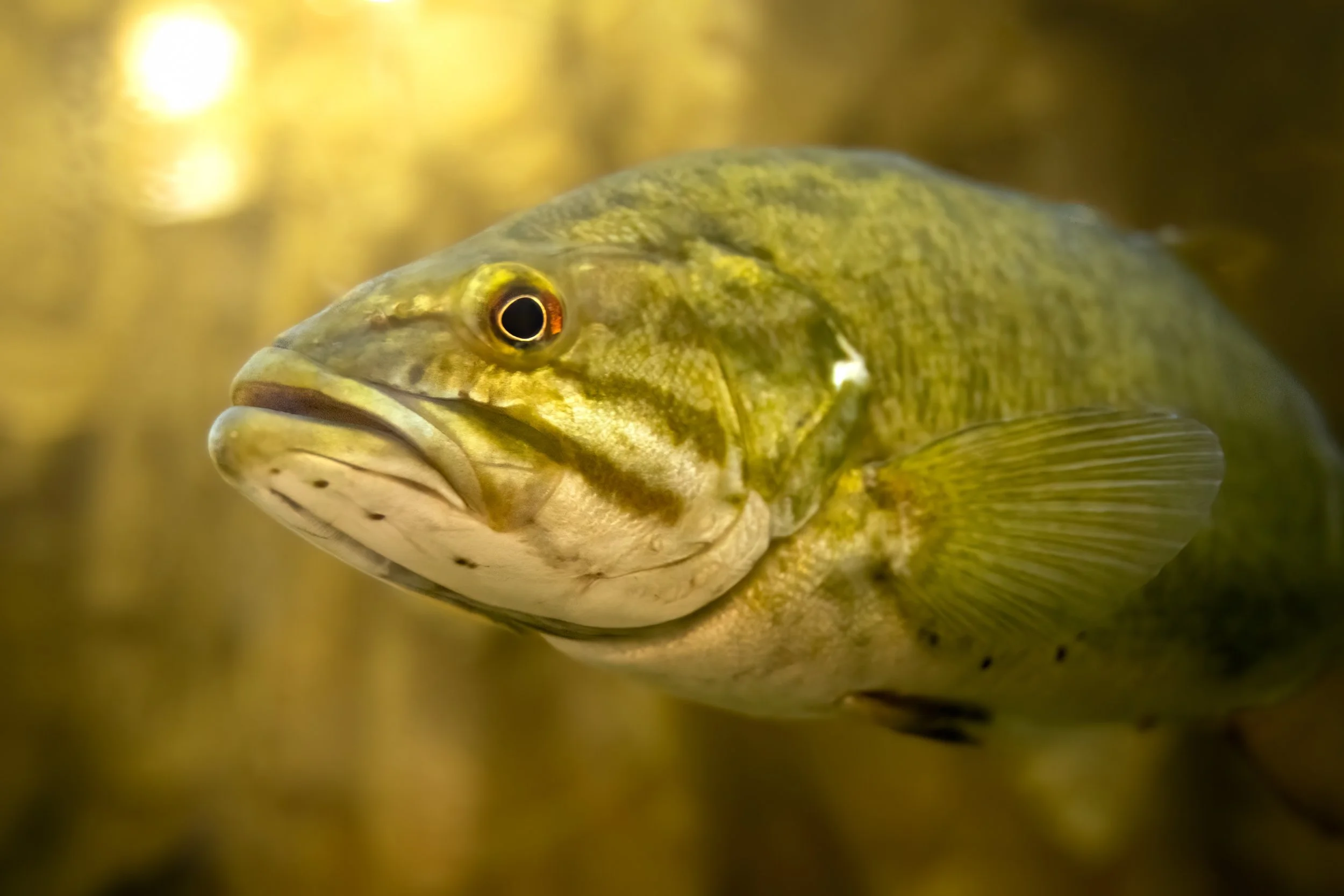
Smallmouth Bass
Pull a smallmouth bass from a sun-warmed pool on the lower St. George River and you are holding one of the most beautiful fish in fresh water. The flanks flash bronze and olive green. Anglers love them for good reason. The river's ecology has a more complicated relationship with them — and understanding both sides makes the fish more interesting, not less.
Bronze and Beautiful: The Smallmouth Bass of the St. George
Georges River Land Trust — Living River Species Series
Introduction
Pull a smallmouth bass from a sun-warmed pool on the lower St. George River and you are holding one of the most beautiful fish in fresh water. The flanks flash bronze and olive green, banded with dark vertical bars that catch the light like hammered metal. The jaw is wide, the eye a deep burnt orange, and the fish itself — even a modest pound-and-a-half — fights with energy out of all proportion to its size. Anglers love smallmouth bass for good reason. The river's ecology has a more complicated relationship with them — and understanding both sides makes the fish more interesting, not less.
Natural History
The smallmouth bass (Micropterus dolomieu) is native to the river systems of the upper Midwest and mid-Atlantic — not to Maine. It was introduced throughout New England in the late nineteenth century, spread enthusiastically by anglers and fish culturists who recognized its sporting qualities, and is now firmly established across much of the state, including the St. George watershed.
It is a fish built for moving water. Smallmouth prefer clear, cool rivers and lakes with rocky or gravelly bottoms, where they hold in the current behind boulders, in the shade of undercut banks, and along the edges of deeper pools. Water temperature is a key constraint — smallmouth thrive between roughly 60 and 75°F, tolerating warmer conditions than brook trout but still requiring reasonably clean, well-oxygenated water.
Spawning occurs in late May and June, when males fan out shallow, gravel-bottomed nests, court females, and guard eggs and fry with fierce dedication — chasing off fish many times their size. The young grow quickly on aquatic invertebrates, shifting to crayfish, small fish, and frogs as they mature. Adults in Maine rivers can reach three pounds or more and live ten to fifteen years.
Identification Tips
Smallmouth bass are bronze to olive-green with faint dark vertical bars along the sides — not the solid dark horizontal stripe that marks a largemouth bass. The most reliable field mark is the jaw: on a smallmouth, the upper jaw (maxilla) extends only to about the middle of the eye, never past its rear edge, while a largemouth's jaw reaches well behind the eye. The dorsal fin is a single continuous fin with only a shallow notch between its spiny and soft portions, versus the deep, almost fully separated notch on a largemouth. Look also for the chunky, deep-bodied build and the burnt-orange eye. Habitat is a good clue too — smallmouth favor the St. George's rocky, current-swept pools, while largemouth stick to slower, weedier water.
Role in the St. George River Watershed
The smallmouth bass sits near the top of the food web in the lower St. George, and its presence shapes the behavior and abundance of nearly everything below it.
Crayfish are the cornerstone of the adult smallmouth's diet in the St. George, and the bass's preference for rocky substrate directly overlaps with crayfish habitat. Blacknose dace, common shiners, and other small fish make up much of the rest of the diet, along with dragonfly and damselfly nymphs, caddisfly larvae, hellgrammites (the larvae of dobsonflies), and — on summer evenings — insects taken at the surface. Water striders, giant water bugs, and even small frogs are all fair game.
In turn, juvenile smallmouth are eaten by great blue herons, belted kingfishers, and river otters. Larger adults have few natural predators in the watershed, which is part of what makes their introduction ecologically significant.
It is worth being honest: smallmouth bass prey on juvenile brook trout and shift the competitive landscape for native species. Maine IF&W actively manages bass populations and restricts their introduction to new waters for this reason. In the lower St. George, where they have been established for well over a century, smallmouth are a permanent part of the watershed's ecology — but their story is a reminder of how lasting the consequences of introductions can be.
Seasonal Notes
Smallmouth are most visible and most catchable from late May through September. They move into the shallows to spawn in June, often in easily observed locations in calm coves and river edges. Through July and August they are active in riffles and pool edges in early morning and evening, taking insects off the surface as the light fades. As water cools in October, they move to deeper pools and slow stretches, becoming less active through winter, though they do not fully cease feeding until temperatures drop to near freezing.
Fun Fact
A male smallmouth guarding a nest will not leave it — not for rival males, not for herons, not even for a swimming snake. Researchers studying nest-guarding behavior have found that males will return to the nest within seconds of being chased off, repeatedly, for as long as the threat persists. It is one of the most tenacious parental performances of any fish in the watershed.
Want to Learn More?
- Maine IF&W — Smallmouth Bass — Maine's fisheries management approach to smallmouth bass, including regulations and stocking history.
- iNaturalist — Micropterus dolomieu — Regional sightings and photographs from New England observers.
- Trout Unlimited — Bass and Brook Trout Interactions — Conservation context for the relationship between introduced bass and native cold-water fish.
- Bug Guide — Hellgrammites — The dobsonfly larvae that are among the smallmouth's most important prey items.
The Living River blog series is published by St. George Consulting in support of the Georges River Land Trust and the Maine Council of Trout Unlimited. To explore the important work these organizations are doing to conserve and restore Maine's landscapes, visit georgesriver.org and tumaine.org.
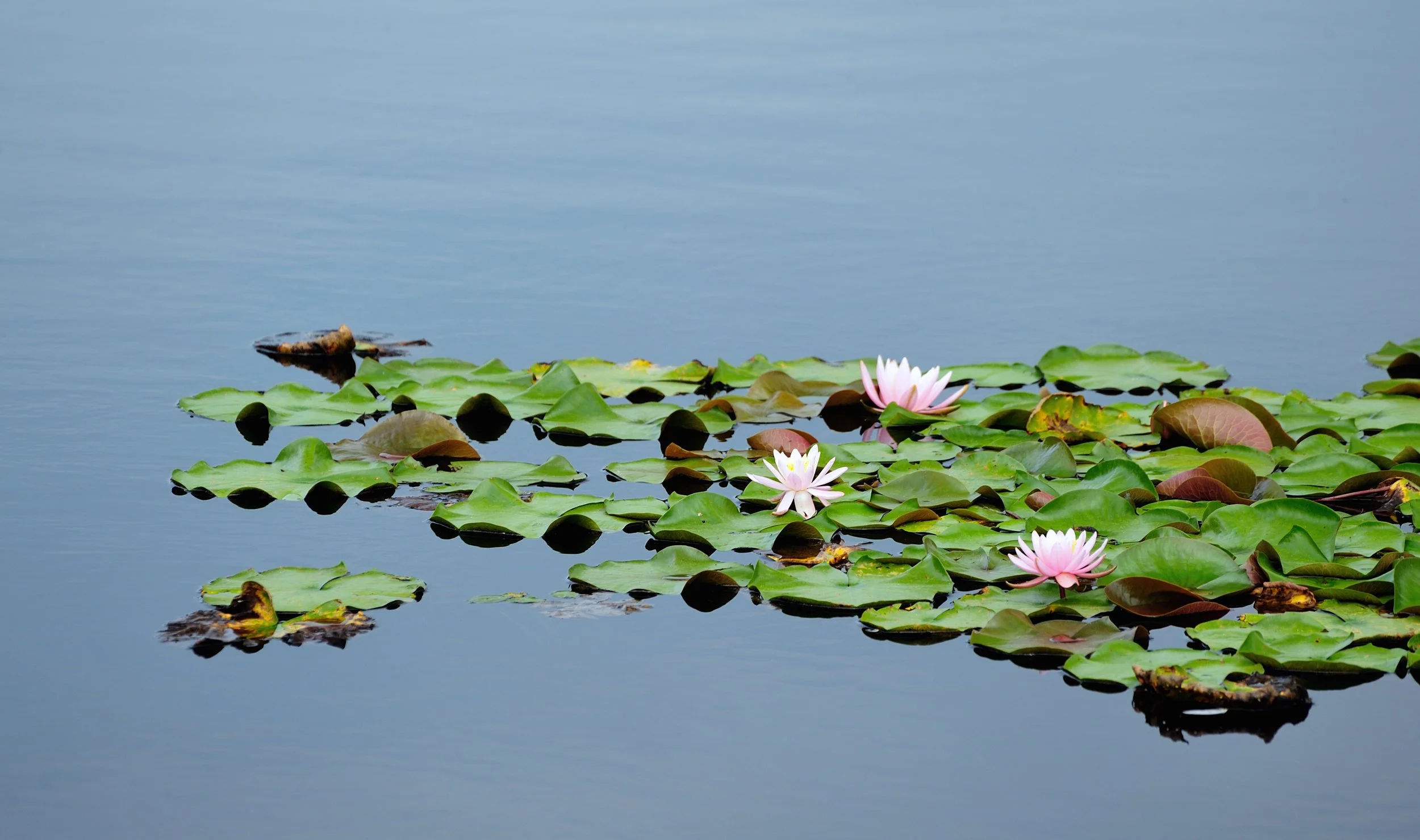
Water Lilies
On a still July morning, with mist sitting low over a quiet cove of the St. George River, there is nothing quite like a bed of water lilies in bloom. The broad, waxy pads spread across the surface in overlapping circles, each one a small world unto itself — and one of the most productive microhabitats in the entire watershed.
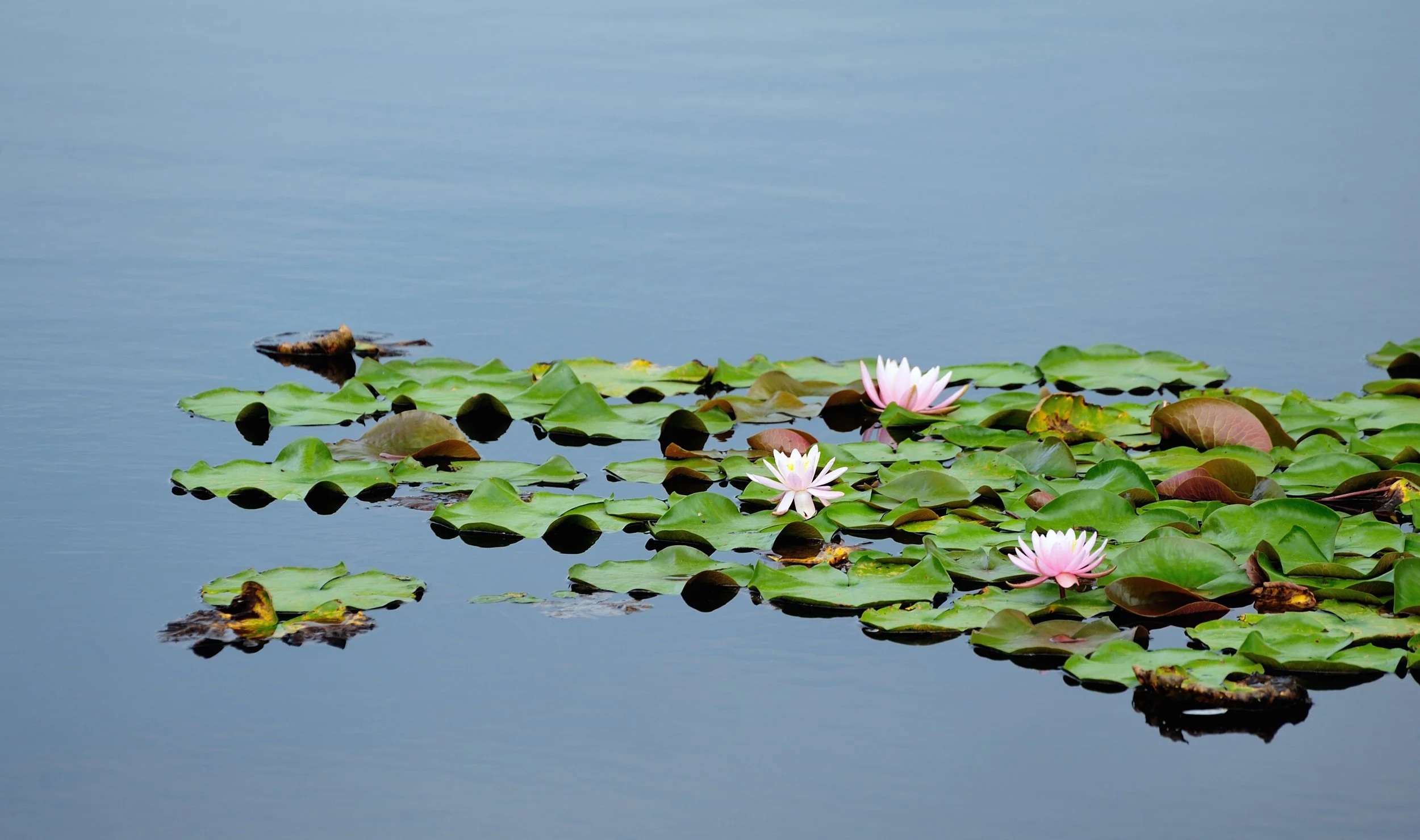
A Floating World: Water Lilies of the St. George Watershed
Georges River Land Trust — Living River Species Series
Introduction
On a still July morning, with mist sitting low over a quiet cove of the St. George River, there is nothing quite like a bed of water lilies in bloom. The white-petaled flowers of the fragrant water lily (Nymphaea odorata) open with the sun and close again by early afternoon, and the broad, waxy pads spread across the surface in overlapping circles, each one a small world unto itself. Alongside them in the shallower, murkier margins, the yellow pond lily (Nuphar variegata) holds its globe-shaped flowers just above the water on stout stems, stouter-leaved and less delicate but equally native and equally essential. Together, these two plants form one of the most recognizable and ecologically productive habitats in the watershed.
Natural History
Both species are rooted in the mud of pond and river bottoms, sending up long, flexible stems to floating leaves and flowers above. The fragrant water lily is the showier of the two — its flowers can reach five inches across, with layers of white petals surrounding a yellow center, and on a calm morning they carry a faint, sweet scent. The yellow pond lily is tougher and more tolerant of disturbance, with heart-shaped leaves that often stand above the surface rather than floating, and flowers that look more like small yellow globes than open blossoms.
The pollination strategy of the fragrant water lily is worth pausing on. The flowers are pollinated primarily by beetles, not bees. On its first day open, a flower is in its female phase, luring beetles into a central cup of sweet liquid. By the second day it shifts to male, coating visitors with fresh pollen to carry elsewhere. Beetles that linger overnight are trapped when the flower closes at dusk — a reliable, if unglamorous, way to ensure cross-pollination.
Both species spread primarily through rhizomes — thick, starchy underground stems anchored in the sediment — which can extend many feet and form extensive, long-lived colonies.
Identification Tips
The two native water lilies are easy to tell apart at a glance. Fragrant water lily has round, waxy, floating pads with a single slit from edge to center, and showy white, many-petaled flowers with a yellow center that open in morning sun and close by afternoon. Yellow pond lily has thicker, more heart-shaped leaves that often stand slightly above the water rather than lying flat, and small, globe-shaped yellow flowers that never fully open into broad petals. Both root in mud and send a single leaf or flower up on its own stem, unlike floating-leaved pondweeds, which branch and cluster their leaves along a stem. If you're unsure which lily you're looking at, the flower shape settles it — broad, layered petals mean fragrant water lily, while a tight yellow ball means pond lily.
Role in the St. George River Watershed
Water lily beds are among the most productive microhabitats in the watershed, functioning simultaneously as shelter, hunting ground, basking platform, and food source for a remarkable range of species.
Painted turtles haul out onto lily pads to bask, their dark shells warming in the morning sun. Bullfrogs and green frogs rest on the pads at the water's edge, ready to leap at passing insects. Pickerel and largemouth bass hold in the shade beneath the canopy of pads, ambushing prey from cover. Great blue herons wade the margins of lily beds and stand motionless among the stems.
The pads themselves are food and habitat. Waterlily leaf beetles (Galerucella nymphaeae) feed on the upper surface of the leaves, leaving characteristic scalloped scars. Dragonflies and damselflies perch on upright stems and newly opened flowers. Water striders hunt across the spaces between pads. Beneath the surface, the rhizomes are a crucial food source for beavers, which dive to cut and carry them back to their lodges, and for muskrats, which feed on rhizomes and young stems throughout the growing season. Wood ducks eat the seeds.
The floating pads do important physical work too — shading the water to slow algae growth, and in exposed coves dampening wave energy to reduce bank erosion and keep the water clearer downstream.
Seasonal Notes
Lily pads begin surfacing in May, sometimes as early as late April in sheltered coves. Flowers open from late June through August, with peak bloom in July. The pads remain through September and into October, gradually yellowing and breaking down as water temperatures fall. By November the surface is clear, though the rhizomes overwinter in the mud and will send up new growth when the water warms again the following spring.
Fun Fact
The rhizomes of both native water lilies were an important food source for the Wabanaki peoples of Maine, eaten raw, roasted, or ground into flour. The yellow pond lily in particular produces large, starchy rhizomes that were harvested in late summer and fall. A plant that feeds beavers, muskrats, wood ducks, and people has earned its place in the watershed.
Want to Learn More?
- USDA Plants — Nymphaea odorata — Range maps and botanical profile for fragrant water lily.
- iNaturalist — Water Lilies in Maine — Community sightings and photographs from New England observers.
- Maine Natural Areas Program — Aquatic Communities — How water lily beds fit into Maine's aquatic plant community classification.
- Wabanaki Studies — University of Maine — Resources on Wabanaki culture and traditional ecological knowledge in Maine.
The Living River blog series is published by St. George Consulting in support of the Georges River Land Trust and the Maine Council of Trout Unlimited. To explore the important work these organizations are doing to conserve and restore Maine's landscapes, visit georgesriver.org and tumaine.org.
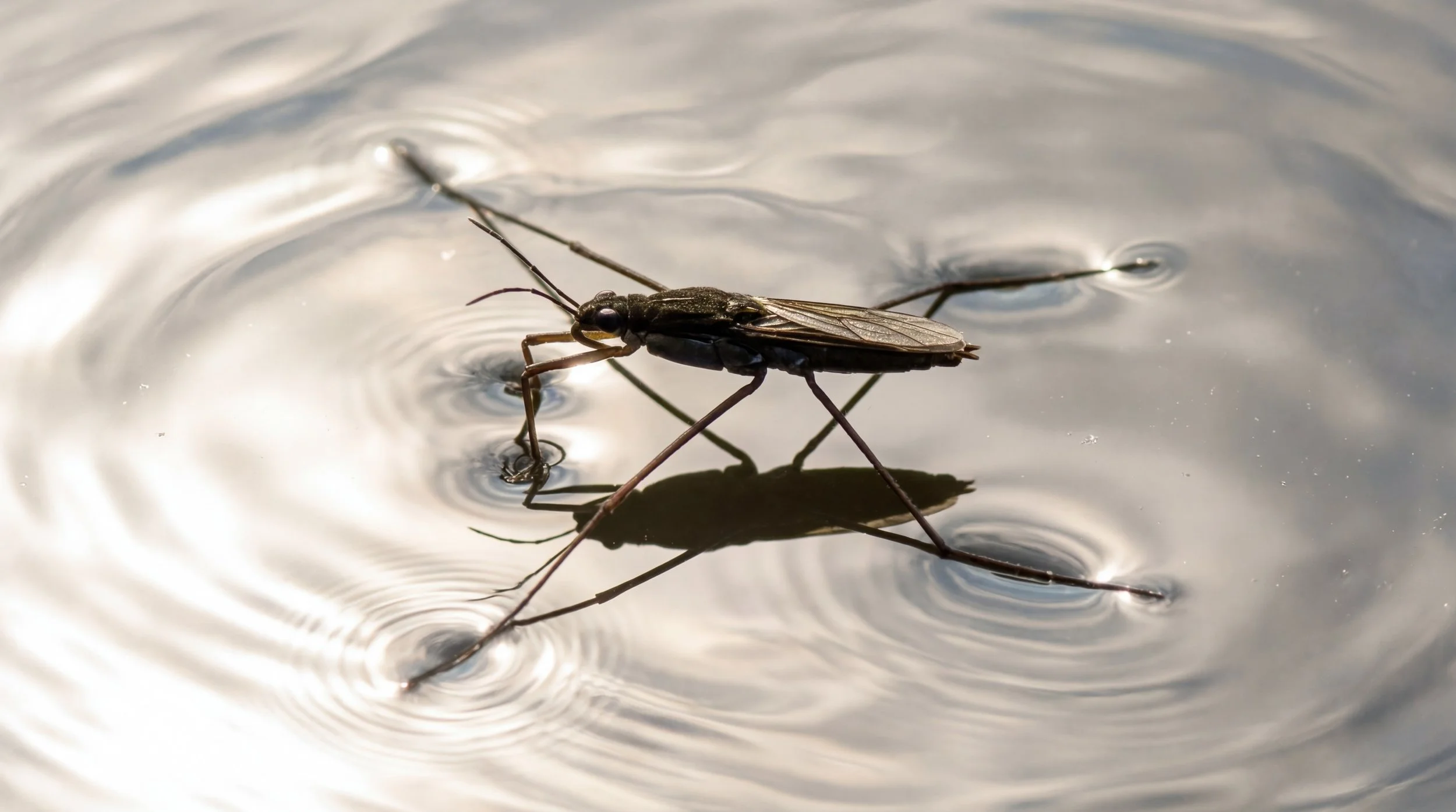
Water Strider
Every calm pool and slow backwater of the St. George River hosts a community living in a place most animals cannot access: the surface of the water itself. Water striders skate across the film between air and water with effortless speed, leaving only tiny dimples where their legs touch — and not breaking through. Children notice them immediately. The physics is remarkable.
Walking on Water: The Water Strider
Georges River Land Trust — Living River Species Series
Introduction
Every calm pool and slow backwater of the St. George River hosts a community that lives in a place most animals cannot access: the surface of the water itself. Water striders (Family Gerridae) skate across the film between air and water with effortless speed, leaving only tiny dimples where their legs touch — and not breaking through. Children notice them immediately and want to know how. The answer turns out to involve physics, microscopic hairs, and a sensory system so finely tuned that the strider can detect a struggling insect from across a pool through vibrations alone. The water strider is a small animal with an extraordinary relationship with its environment, and the calm pools of the St. George watershed are better, more ecologically complete places for having them.
Natural History
Water striders are true bugs — members of the Order Hemiptera, the same group as stink bugs and assassin bugs — equipped with the piercing, sucking mouthpart called a rostrum that all true bugs share. Several species inhabit Maine's freshwaters, with members of the genus Gerris being the most common on streams and ponds.
The secret to walking on water is not magic but microscopic engineering. Each of the strider's six legs is covered in thousands of tiny, water-repellent hairs — called hydrofuge setae — that trap a layer of air against the leg surface. This prevents the leg from breaking through the water's surface tension, and the broad spread of the middle and hind legs distributes the insect's weight across a large enough area that the surface film holds. The result is four small dimples in the surface where the legs rest, each dimple casting an oval shadow on the streambed below — often larger than the insect itself, and sometimes the first thing a watching trout or heron notices.
Water striders are predators, feeding on insects that fall onto or become trapped in the water surface — ants, small flies, beetles, moths, and any other terrestrial insect that makes the mistake of landing on or being blown into the stream. The strider detects its prey not by sight but by surface vibrations — the ripples a struggling insect creates spread outward like concentric rings, and the strider's legs sense these waves and orient toward their source with speed and precision. Once the prey is located, the rostrum is driven in and digestive saliva injected, liquefying the soft internal tissues, which the strider then draws out. It is an efficient and entirely successful hunting strategy for an insect that occupies one of the most nutrient-rich surfaces in the watershed: the exact spot where terrestrial insects fall in from overhanging vegetation and aquatic insects emerge to become adults.
Identification Tips
Water striders are easy to identify by posture and behavior alone: a slender, dark body held up on four long, widely splayed legs that rest on the surface film, each leg producing a small dimpled shadow on the streambed below, with a much shorter front pair used for grabbing prey. They skate and dart rather than swim, never breaking the surface tension. This sets them apart from whirligig beetles, which are compact, shiny, and spin in tight loops while partly submerged. Water striders cluster in the calmest water available — quiet pools, eddies behind rocks, and sheltered pond margins — and are most visible on still, sunny days when their shadows stand out clearly on the bottom.
Role in the St. George River Watershed
Water striders occupy a niche that no other organism in the watershed fills in quite the same way — the interface between air and water — and their ecological role reflects that position.
As predators of terrestrial insects that fall onto the stream surface, they capture energy that would otherwise drift downstream unused or sink to the streambed. Ants knocked from streamside alders and willows, small moths and midges, beetles and crane flies — all become food at the surface film. In doing so, water striders transfer nutrients from the riparian forest into the aquatic food chain.
They also scavenge spent aquatic insects — the exhausted adults of mayflies, caddisflies, and stoneflies that fall back onto the water after mating, too depleted to escape. The surface of a calm pool on a summer evening after a mayfly hatch is, from the water strider's perspective, a feast.
Brook trout and smallmouth bass eat water striders, striking from below — though the strider's ability to detect the pressure wave of an approaching fish through the surface gives it a fraction-of-a-second warning. Frogs and toads take them from the water's edge, as do great blue herons and occasionally belted kingfishers. Tree swallows occasionally snatch them from the surface in flight.
Their preference for calm, slow-moving water — shaded pools, eddies behind rocks, pond margins sheltered by emergent vegetation — means they are closely associated with the cattails, water lilies, and aquatic sedge beds of the watershed's quieter reaches. These plant communities create the still-water conditions the strider requires, and the overhanging vegetation above them delivers the terrestrial insect prey the strider depends on.
Water striders are year-round residents in adult form, one of the few aquatic insects that overwinters above water rather than as eggs or nymphs. In autumn they leave the water and shelter under leaf litter, bark, and streamside logs, emerging again in early spring to be among the first insects visible on the water's surface — sometimes while ice still lingers on shaded edges.
Seasonal Notes
Water striders are visible on the water surface from April through October, appearing some years while ice still covers parts of shaded pools. Population numbers build through May and June as individuals mate and lay eggs along the edges of aquatic plants. Summer brings the highest densities, with striders concentrated in calm pools and lake margins. On warm autumn days they remain active well into October before retreating to overwinter under streamside debris. Early spring mornings — when the water is still and cold and few other insects are active — offer some of the clearest views of their skating behavior.
Fun Fact
Water striders communicate with each other using deliberate ripple signals — not just detecting ripples passively, but generating them intentionally. Males produce species-specific ripple patterns by rapidly vibrating their legs against the surface, sending courtship signals to females and territorial warnings to rival males. Researchers studying these signals found they are structured enough to carry distinct information: a male's courtship ripple and his rival-warning ripple are measurably different waveforms, and females respond selectively to each. The water strider is, in effect, conducting a conversation on the surface of the stream in a language made entirely of waves.
Want to Learn More?
- Bug Guide — Gerridae — Photographic identification guide to North American water strider species.
- Maine DEP — Surface Water Ecology — Maine's freshwater monitoring programs and the ecological communities they track.
- iNaturalist — Water Striders — Regional sightings and community photographs from New England naturalists.
- Xerces Society — Aquatic Invertebrates — Conservation context for aquatic insects and the freshwater habitats that support them.
The Living River blog series is published by St. George Consulting in support of the Georges River Land Trust and the Maine Council of Trout Unlimited. To explore the important work these organizations are doing to conserve and restore Maine's landscapes, visit georgesriver.org and tumaine.org.
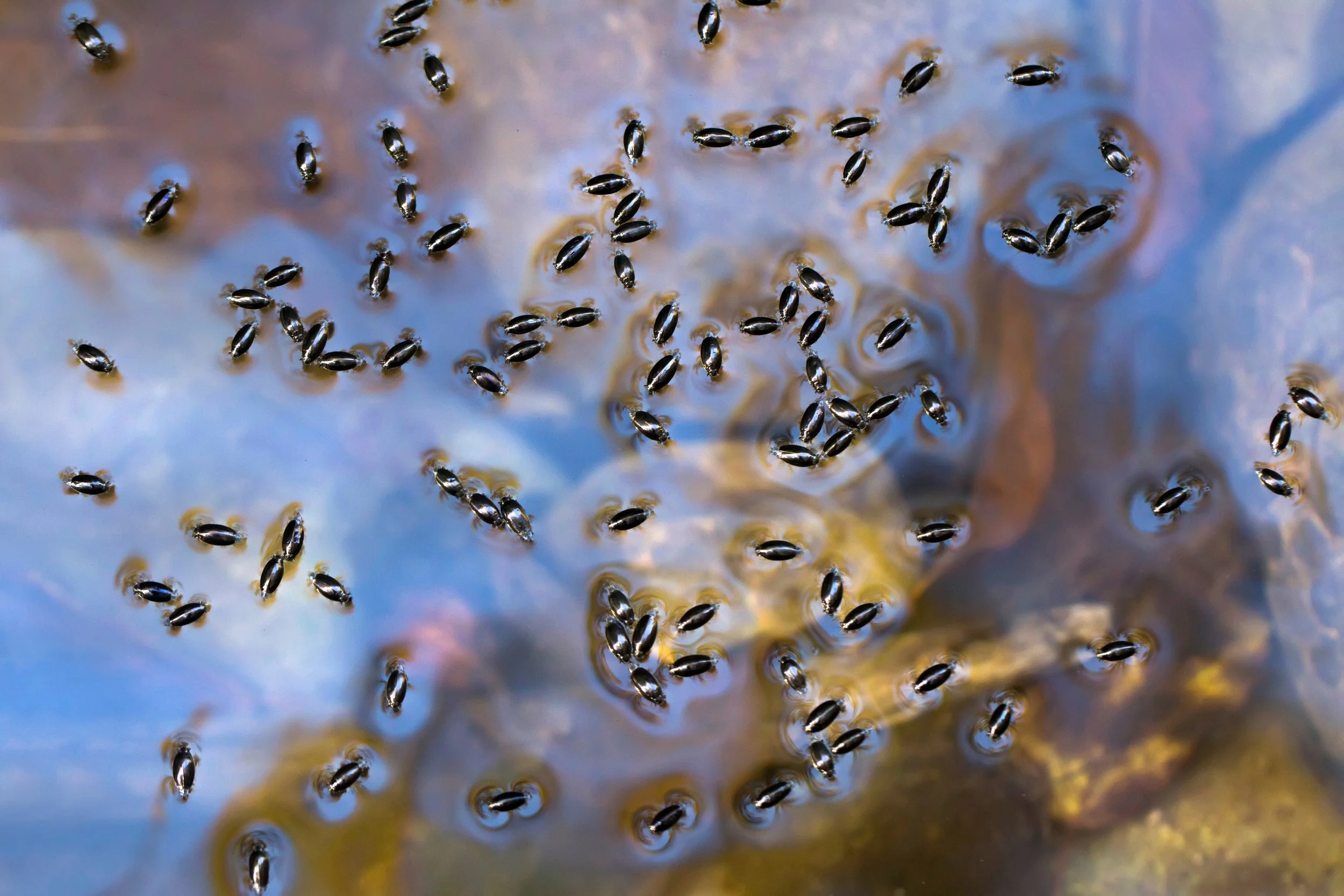
Whirligig Beetle
If you've ever paused on a riverbank and watched a cluster of small, shiny beetles zipping around each other in tight, erratic loops on the water's surface, you've already met one of the watershed's most endearing residents: the whirligig beetle. Part bumper car, part radar dish — and one of the river's most watchable summer inhabitants.
Spinning in Circles and Loving It: Meet the Whirligig Beetle
Georges River Land Trust — Living River Species Series
Introduction
If you've ever paused on a riverbank or dock and watched a cluster of small, shiny beetles zipping around each other in tight, erratic loops on the water's surface, you've already met one of our watershed's most endearing residents: the whirligig beetle. Part bumper car, part radar dish, part tiny acrobat — these little creatures are one of the St. George River's most watchable inhabitants, and they reward a few minutes of quiet attention.
Natural History
Whirligig beetles belong to the family Gyrinidae, a group that has been perfecting the art of surface living for tens of millions of years. There are roughly 700 species worldwide and about 50 in North America. Here in Maine, you're most likely to encounter members of the genera Gyrinus and Dineutus — oval, polished-looking beetles ranging from about 4 to 15 millimeters long, their backs gleaming like a tiny black mirror.
What makes whirligigs so remarkable starts with their eyes. Each beetle has two pairs of compound eyes: one set looks upward into the air, and another set looks downward into the water — simultaneously. In effect, they see two worlds at once without ever having to choose between them.
Their legs are just as specialized. The forelegs grip prey; the middle and hind legs have been flattened into broad, oar-like paddles that beat so rapidly they're nearly invisible. This design lets whirligigs accelerate, stop, and pivot with startling precision.
But perhaps most fascinating is how they navigate those swirling group displays. Whirligigs detect the ripples bouncing off nearby objects through a sensitive organ near their antennae — a kind of living echolocation on the water's surface. They're essentially reading the river the way a bat reads the night air.
When threatened, they release a milky chemical compound called gyrinidal that smells faintly of apples or almonds. Fish and other predators find it deeply unappetizing, making it one of nature's more unusual deterrents.
Whirligig larvae are entirely aquatic, living among bottom debris and preying on small invertebrates. Adults overwinter buried in mud or leaf litter along stream margins, then emerge when temperatures warm in spring.
Identification Tips
Whirligig beetles are small, oval, and glossy black, with a mirror-like sheen that catches the light — easy to spot from their spinning, looping motion on calm water, usually in loose clusters. Look closely and you may notice the split-level eyes, a pair looking up above the waterline and a second pair looking down into it at the same time, a feature unique to this family. Their middle and hind legs are flattened into short, broad paddles, quite different from the long, thin legs of a water strider skating on the surface film rather than swimming through it. If disturbed, whirligigs dive underwater trailing a bubble of air, then resurface and resume spinning — behavior that, along with the group choreography, is as diagnostic as the beetle's shape.
Role in the St. George River Watershed
Whirligig beetles are both predators and prey, placing them squarely in the middle of the river's food web. As adults, they hunt insects that land or fall onto the water's surface — midges, small moths, mayflies — helping to regulate those populations. Their larvae are active hunters in the substrate, preying on aquatic worms, small crustaceans, and other invertebrates.
In turn, whirligigs are an important food source for brook trout, sunfish, and a variety of wading birds and swallows that skim the water's surface.
They're also quiet messengers about river health. Whirligig beetles tend to congregate in clean, well-oxygenated water with stable banks and good riparian vegetation. A thriving whirligig community in a cove or slow bend of the St. George River is a reassuring sign that the habitat is in good shape. Their presence — or absence — is something watershed stewards pay attention to.
Seasonal Notes
In Midcoast Maine, whirligigs become visible in May, as water temperatures climb above 50°F. They're most active and conspicuous through the summer months, often forming loose groups of dozens on calm stretches of the river, in sheltered coves, and along the edges of ponds within the watershed.
By October, as temperatures drop and daylight shortens, they disappear into the mud and organic debris of stream banks to overwinter. They're remarkably cold-tolerant once they've settled in, capable of surviving a Maine winter buried just below the frost line.
Fun Fact
Whirligig beetles are named for their spinning behavior — but there's real method to that apparent madness. Scientists believe the circular, group-swimming behavior may confuse predators (it's hard to single out one target in a spinning crowd), while also allowing each beetle to monitor its neighbors' ripple patterns. It's a collective sensor array, an early-warning system built from beetles.
Want to Learn More?
- BugGuide — Gyrinidae (Whirligig Beetles) — Photo identification and species range maps for North American species.
- Maine DEP Volunteer Lake Monitoring Program — Learn how aquatic invertebrates like whirligigs are used as bioindicators of water quality.
- University of Maine Cooperative Extension: Aquatic Insects of Maine — A helpful general resource for identifying Maine's aquatic invertebrate community.
- The Life of a Whirligig Beetle — Cornell Lab of Entomology resources via AllAboutBirds — Broader context on aquatic insect ecology.
The Living River blog series is published by St. George Consulting in support of the Georges River Land Trust and the Maine Council of Trout Unlimited. To explore the important work these organizations are doing to conserve and restore Maine's landscapes, visit georgesriver.org and tumaine.org.
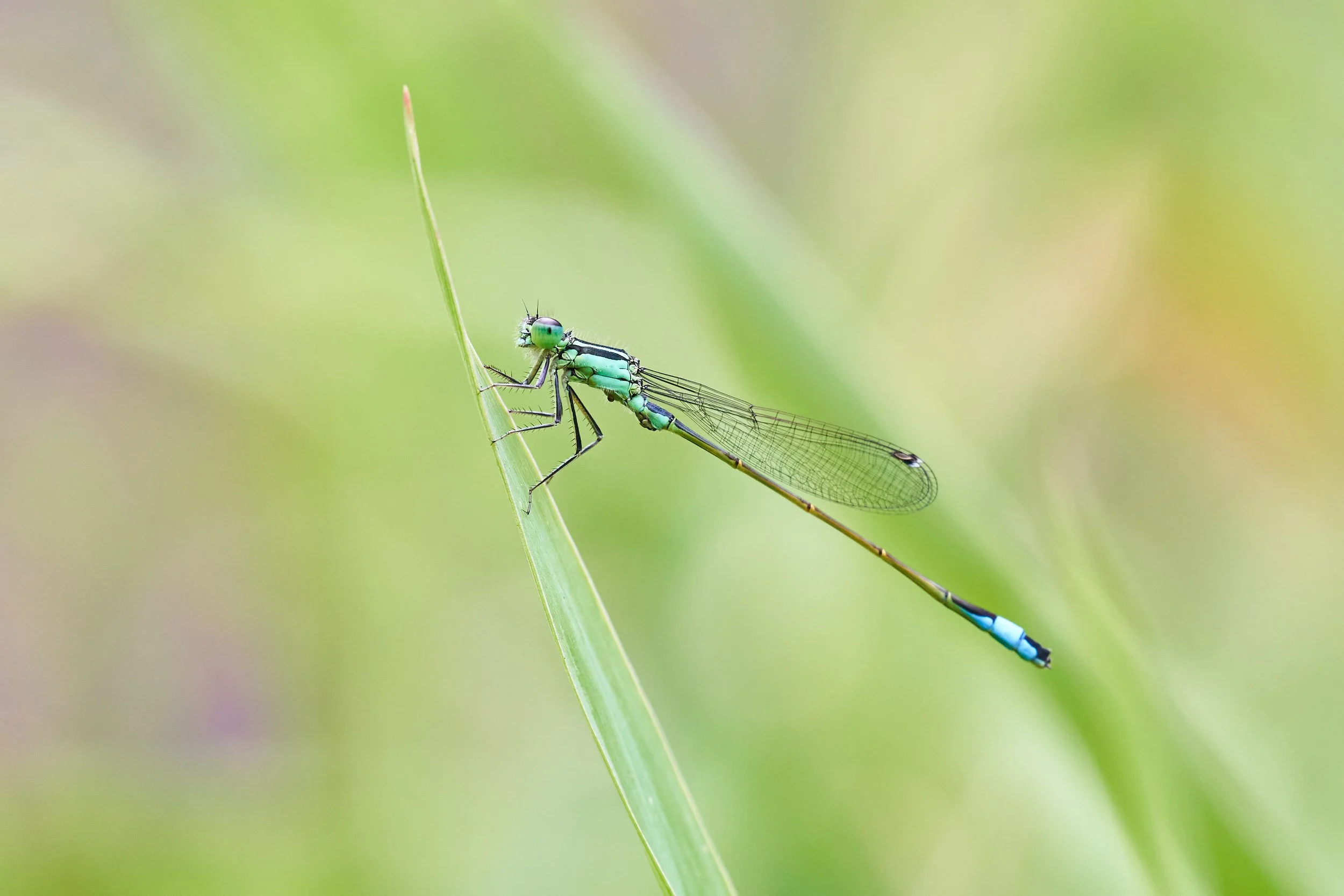
Damselflies
On a warm July afternoon along a shaded reach of the St. George River, where sunlight breaks through the canopy in shifting pools, watch for something that stops you mid-step: a small, iridescent creature with dark wings flickering above the surface, its body flashing metallic blue-green. This is the ebony jewelwing, one of the most beautiful insects in the watershed.
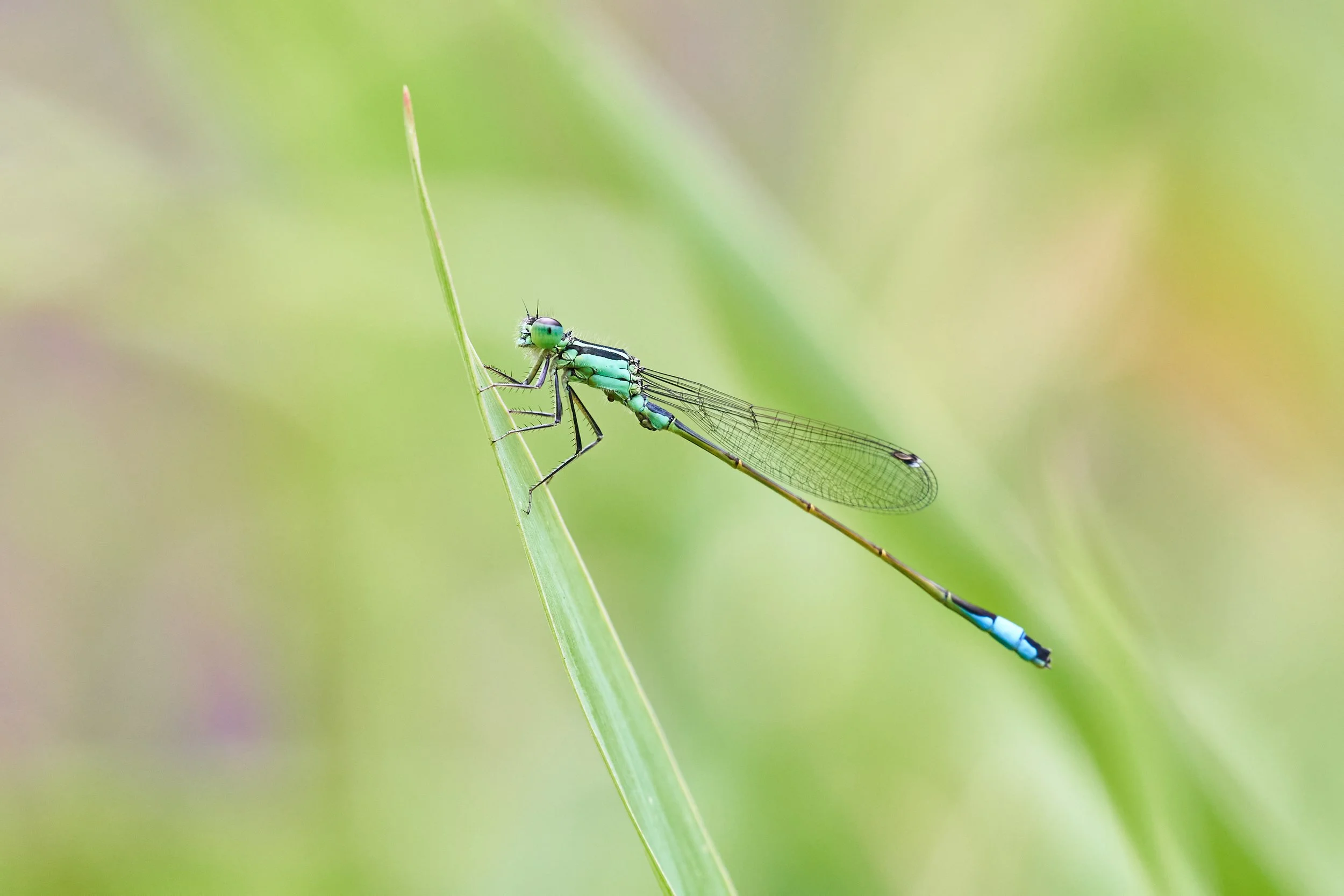
Jewels at the Water's Edge: Damselflies
Georges River Land Trust — Living River Species Series
Introduction
On a warm July afternoon along a shaded reach of the St. George River, if you watch the water where sunlight breaks through the canopy in shifting pools, you may see something that stops you mid-step: a small, iridescent creature with dark wings flickering in a slow, almost butterfly-like flight just above the surface, its body catching the light in flashes of metallic blue-green. This is the ebony jewelwing (Calopteryx maculata), one of the most beautiful insects in the watershed — and one of the more visible members of a group that most people have seen without quite registering: the damselflies. Cousins to the dragonfly, slender and jewel-bright and tied to clean water their entire lives, damselflies are as much a part of the living river as the current itself.
Natural History
Damselflies belong to the Order Odonata — the same ancient lineage as dragonflies — but occupy their own distinct suborder, Zygoptera. The difference is worth knowing. Where dragonflies hold their wings flat and out to the sides at rest, damselflies fold theirs back along the body, like a small aircraft parked with folded wings. Damselflies are also more slender and delicate, and their large compound eyes are set to the sides of the head rather than wrapping nearly all the way around as in dragonflies.
Maine hosts a wonderful variety of species. The ebony jewelwing haunts the shaded banks of clean, flowing streams — the male's dark, iridescent wings and metallic green body making him unmistakable. The bluets (Enallagma spp.) are far more numerous but easily overlooked: tiny, vivid blue damselflies that emerge in clouds from ponds and lake margins through summer. Spreadwings (Lestes spp.) hold their wings slightly open at rest, an intermediate posture between the dragonfly and the typical damselfly. American rubyspots glow with red wing patches along faster stream reaches.
All damselflies are aquatic as nymphs, living in ponds, slow streams, and wetland vegetation for one to three years before emerging as adults. The nymph breathes through three leaf-like gills that project from the tip of its abdomen — a feature that immediately distinguishes it from a dragonfly nymph, which breathes through internal rectal gills. Adults are aerial hunters, catching small flying insects with precise, basket-like legs while in flight.
Identification Tips
Damselflies are easiest to separate from their dragonfly cousins by wing posture: damselflies fold their wings back along the body at rest, while dragonflies hold theirs flat out to the sides. Damselflies are also more slender overall, with a thinner abdomen and eyes set apart on the sides of the head rather than nearly meeting on top. The ebony jewelwing is unmistakable — inky black wings and a metallic green-blue body, fluttering low over shaded stream banks. Bluets are tiny and, true to the name, vivid blue with black markings, usually seen in loose swarms over pond and lake edges. Spreadwings hold their wings at a partial angle, neither fully open nor fully closed — a useful in-between clue when you're unsure which group you're looking at.
Role in the St. George River Watershed
Damselflies connect the watershed's aquatic and terrestrial worlds in both directions — feeding below the surface as nymphs and above it as adults, and being fed upon by creatures of both realms.
Nymphs are active predators of small aquatic invertebrates — midge larvae, tiny mayfly nymphs, water fleas, and small crustaceans — in the pond margins and slow backwaters of the watershed. They are in turn consumed by brook trout, yellow perch, and bass, which take them from the vegetation and streambed. Painted turtles eat them along pond edges, and great blue herons and kingfishers take both nymphs and adults near the water's surface.
Adults hunt midges, gnats, small flies, and other tiny insects on the wing, contributing to the regulation of flying insect populations in the riparian zone through summer. They are eaten by tree swallows and barn swallows in flight, by cedar waxwings and flycatchers from perches, and by little brown bats in the evening — the same bats that hunt caddisfly adults over the water after dark, as we described in that post.
Damselfly eggs are laid directly into aquatic plant tissue — species like the jewelwing insert eggs into the stems of submerged and emergent vegetation, including water lilies, pondweeds, and aquatic sedges. The health of the watershed's aquatic plant communities is therefore directly tied to damselfly reproductive success.
The ebony jewelwing's dependence on clean, cool, well-shaded streams with silt-free bottoms makes it a meaningful water quality indicator in the tributaries of the St. George. Like the stonefly and the blacknose dace, its presence signals something real and good about the water it inhabits. Degraded, silted, or warmed streams lose jewelwings quickly — their absence is as informative as their presence.
The sphagnum bogs of the upper watershed — another subject in this series — support specialized spreadwing and bluet species adapted to the cool, acidic, low-nutrient conditions of bog pools, adding yet another layer to the damselfly's ecological range across the watershed.
Seasonal Notes
The first damselflies appear in late May and early June, with bluets and spreadwings often the earliest to emerge from ponds and lake margins. Ebony jewelwings are most abundant along streams in June and July, when the male's courtship display — slow, fluttering flight with those dark wings catching the light — is at its peak. Peak diversity across species runs from late June through August. Most damselflies are gone by mid-September, though warm autumns can push stragglers into early October. Nymphs are present in the streambed and pond vegetation year-round, growing slowly through winter and spring before emerging the following summer.
Fun Fact
When a damselfly nymph is grabbed by a fish or other predator, it can shed its three tail gills — dropping them the way a lizard drops its tail — and escape while the predator is momentarily distracted by the detached, still-wriggling appendages. The gills do not regenerate fully, which means a nymph that has lost them breathes less efficiently for the remainder of its aquatic life. It is a costly but sometimes life-saving sacrifice.
Want to Learn More?
- Maine Damselfly and Dragonfly Survey — Maine Odonata, the citizen science effort tracking dragonfly and damselfly distribution across the state; you can contribute sightings.
- Cornell Lab — Odonata Central — The leading North American database for dragonfly and damselfly observations, with range maps and species accounts.
- Bug Guide — Zygoptera — Photographic identification guide to North American damselfly species and life stages.
- iNaturalist — Damselflies — Regional sightings and community photos; an excellent tool for learning to identify species in the field.
The Living River blog series is published by St. George Consulting in support of the Georges River Land Trust and the Maine Council of Trout Unlimited. To explore the important work these organizations are doing to conserve and restore Maine's landscapes, visit georgesriver.org and tumaine.org.
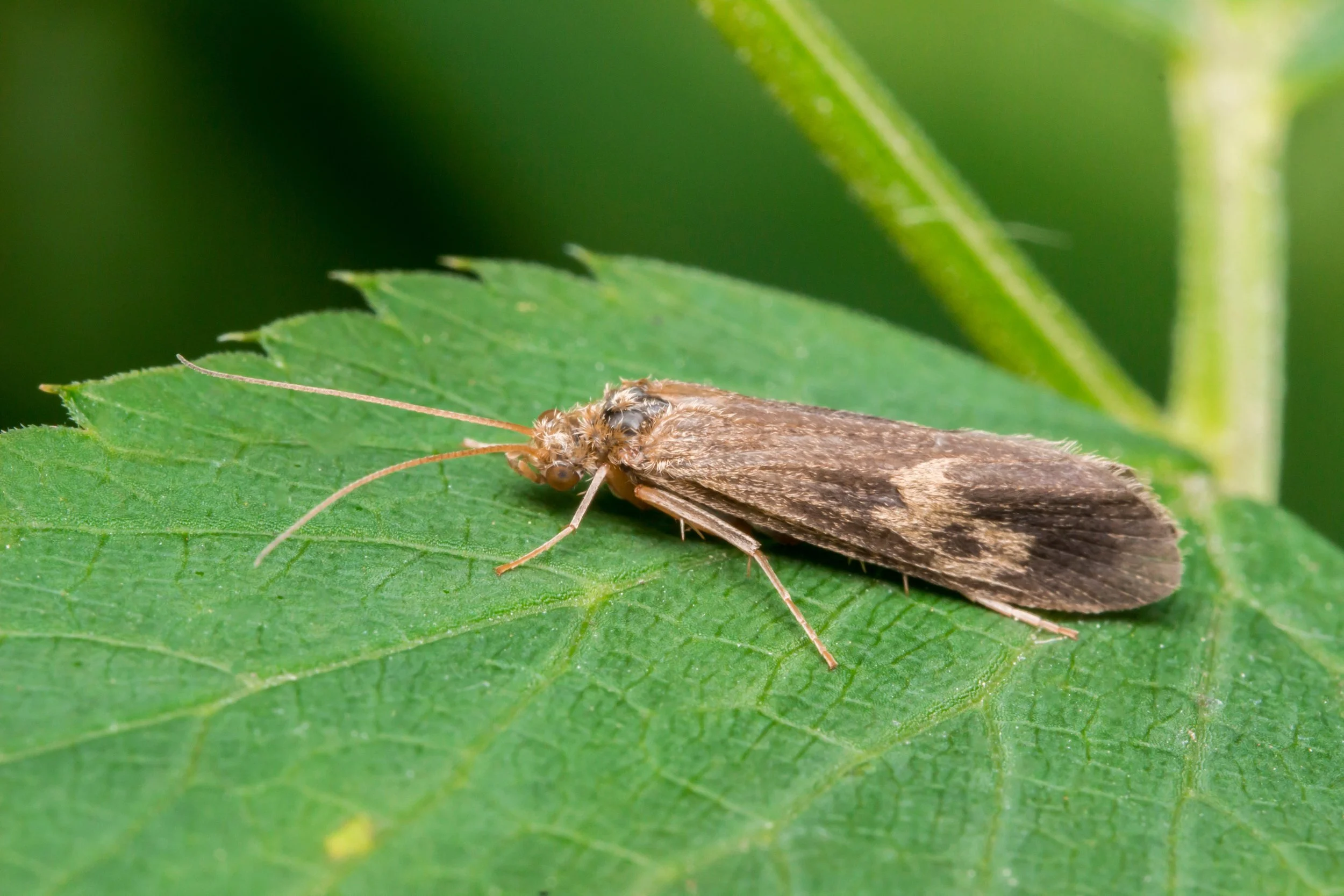
Caddisflies
Turn over a smooth rock in any clean riffle of the St. George River and look at what clings to the underside. Among the algae and mayfly nymphs you will almost certainly find something that looks like a small piece of the streambed itself — a tidy cylinder of sand grains, moving with quiet determination. Inside is a caddisfly larva in a house it built by itself.
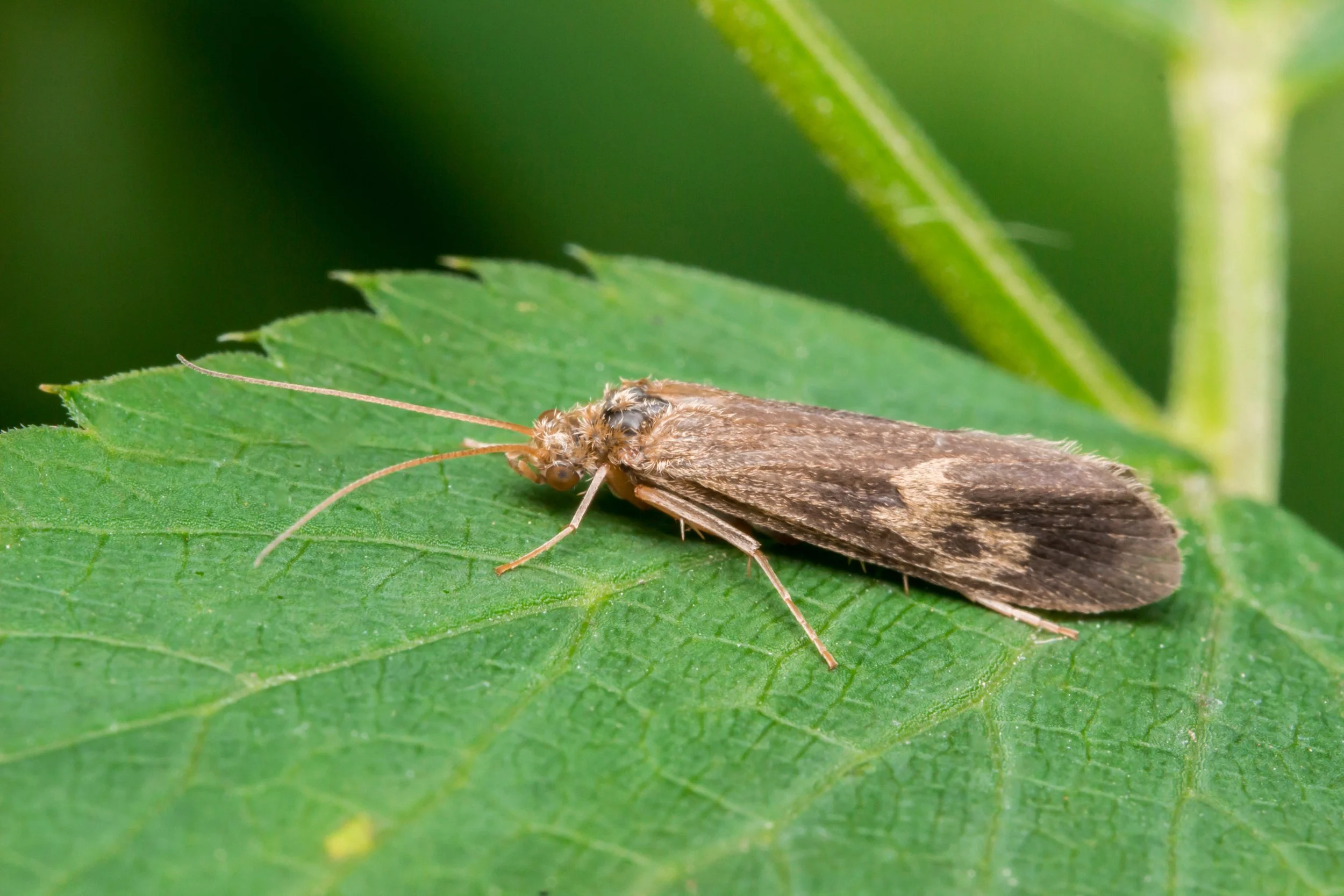
Architects of the Streambed: Caddisflies
Georges River Land Trust — Living River Species Series
Introduction
Turn over a smooth rock in any clean riffle of the St. George River and look at what clings to the underside. Among the algae and mayfly nymphs you will almost certainly find something that at first glance looks like a small piece of the streambed itself — a tidy cylinder of sand grains, or a bundle of tiny twigs, or a mosaic of pebbles, all fitted together with uncanny precision and moving with quiet determination across the rock face. Inside is a caddisfly larva (Order Trichoptera), going about its business in a house it built entirely by itself, grain by grain, from materials it found on the bottom of the stream. Caddisflies are among the most ecologically vital and biologically extraordinary insects in the watershed, and most people have never given them a second look.
Natural History
Caddisflies are closely related to moths and butterflies — so closely that entomologists consider them sister groups. As adults they are moth-like in appearance: soft-bodied, long-antennae'd, and holding their wings in a tent-like fold over their bodies when at rest. The difference is in the wings themselves, which bear tiny hairs rather than scales, giving the order its name: Trichoptera means "hair wings." Adults are short-lived, eating little or nothing, their purpose concentrated entirely into finding a mate and returning to the water to lay eggs.
It is the larval stage where caddisflies reveal their full character, and where the diversity of the order becomes apparent. Maine hosts hundreds of caddisfly species, each adapted to a slightly different niche in the stream ecosystem. Most larvae are architects. Using silk produced from glands near their mouths — true silk, chemically similar to that of silkworms — they construct protective cases from whatever material the local stream offers: sand grains arranged in precise spirals, leaf fragments cut and assembled like shingles, small pebbles stacked in careful rows, or fine mineral particles smoothed into a seamless tube. Each species builds a recognizable design, as consistent as a fingerprint.
Some caddisflies forgo the portable case and instead spin silk nets anchored between rocks in the current — fixed filters that intercept fine organic particles drifting downstream, which the larva then harvests. Others are free-living predators that roam the streambed without a case at all. The order spans the full range of aquatic feeding strategies, from leaf-shredder to algae-grazer to active predator, making caddisflies collectively one of the most functionally diverse insect groups in any freshwater system.
Identification Tips
The larvae are the easiest life stage to identify: look for a small, cylindrical case — built from sand grains, tiny pebbles, leaf fragments, or bits of twig, each species with its own signature pattern — inching across submerged rocks with only the head and legs protruding from the open end. Net-spinning species instead leave a small silk net strung between rocks or debris in the current. Adult caddisflies look moth-like at rest, holding their wings tent-fashion over the body, but lack the powdery scales of a true moth — the wings look dull and slightly hairy rather than patterned. The surest way to separate a caddisfly from a similar-looking small moth resting near water is habitat and posture: caddisflies stay close to the stream, wings folded low and roof-like, antennae held forward.
Role in the St. George River Watershed
The caddisfly's ecological importance in the watershed operates at every level of the stream food web simultaneously.
As shredders, case-building species that feed on leaf litter work alongside stonefly nymphs — as we described last week — to process the annual leaf fall from the riparian forest. Alder, birch, and red maple leaves are broken down by shredding larvae into fine particles that drift downstream and feed the net-spinning filterers waiting to intercept them. It is an assembly line of decomposition, with caddisflies occupying multiple stations.
As scrapers, other species graze the algae and diatom biofilm from rock surfaces in the same riffles where blacknose dace forage — the two sharing the same food resource from opposite biological kingdoms, the fish working the water column, the insect working the rock face.
As prey, caddisfly larvae are indispensable to brook trout, brown trout, and landlocked salmon throughout the year. The larva in its case is consumed whole, case and all. Fly anglers have imitated caddis larvae, pupae, and adults for centuries; the elk hair caddis and similar patterns rank among the most effective trout flies ever devised, which is not coincidence — it reflects the centrality of caddisflies to a trout's diet across every season.
When caddisflies hatch in numbers — emerging from the water as winged adults in the evening — the event reorganizes the immediate food web around it. Trout rise. Tree swallows and barn swallows course over the water's surface snapping adults in flight. After dark, little brown bats take over, hunting by echolocation in the same airspace the swallows abandoned. The hatch is brief, sometimes lasting less than an hour, and during it the boundary between the aquatic and terrestrial worlds briefly dissolves.
The silk nets of net-spinning caddisflies also stabilize streambed gravel — their threads bind particles together and reduce the scouring effect of high flows, providing a subtle but real benefit to the stability of the habitat they inhabit.
Seasonal Notes
Caddisfly larvae are present in the streambed year-round, growing through one to two years before pupating. Spring hatches begin in April and May and are often spectacular on the St. George's cleaner tributaries. Summer hatches continue through June and July, typically in the evening. Fall species emerge in September and October, sometimes on warm afternoons, providing late-season feeding opportunities for trout before winter. In winter, larvae remain active in the gravel of fast, cold runs, one of the few invertebrate groups still feeding and growing under the ice.
Fun Fact
In the 1980s, French artist Hubert Duprat began providing caddisfly larvae with gold flakes, turquoise, opals, and tiny pearls instead of the usual sand and pebbles. The larvae, utterly indifferent to the material's monetary value, incorporated the precious stones into their cases using the same precise silk-spinning technique they would use on gravel. The resulting structures — tiny jeweled tubes of remarkable elegance — have been exhibited in museums as art objects. The caddisfly is the only non-human animal whose unmodified natural behavior has produced work displayed in fine art galleries.
Want to Learn More?
- Maine DEP — Biological Monitoring — How Maine uses aquatic invertebrates including caddisflies to assess stream health.
- Bug Guide — Trichoptera — Photographic guide to North American caddisfly species, larvae, cases, and adults.
- Xerces Society — Freshwater Invertebrates — Conservation context for aquatic insects and the clean-water habitats they require.
- Hubert Duprat — Caddisfly Art — For those intrigued by the fun fact: search "Hubert Duprat caddisfly" for images of the jeweled cases.
The Living River blog series is published by St. George Consulting in support of the Georges River Land Trust and the Maine Council of Trout Unlimited. To explore the important work these organizations are doing to conserve and restore Maine's landscapes, visit georgesriver.org and tumaine.org.
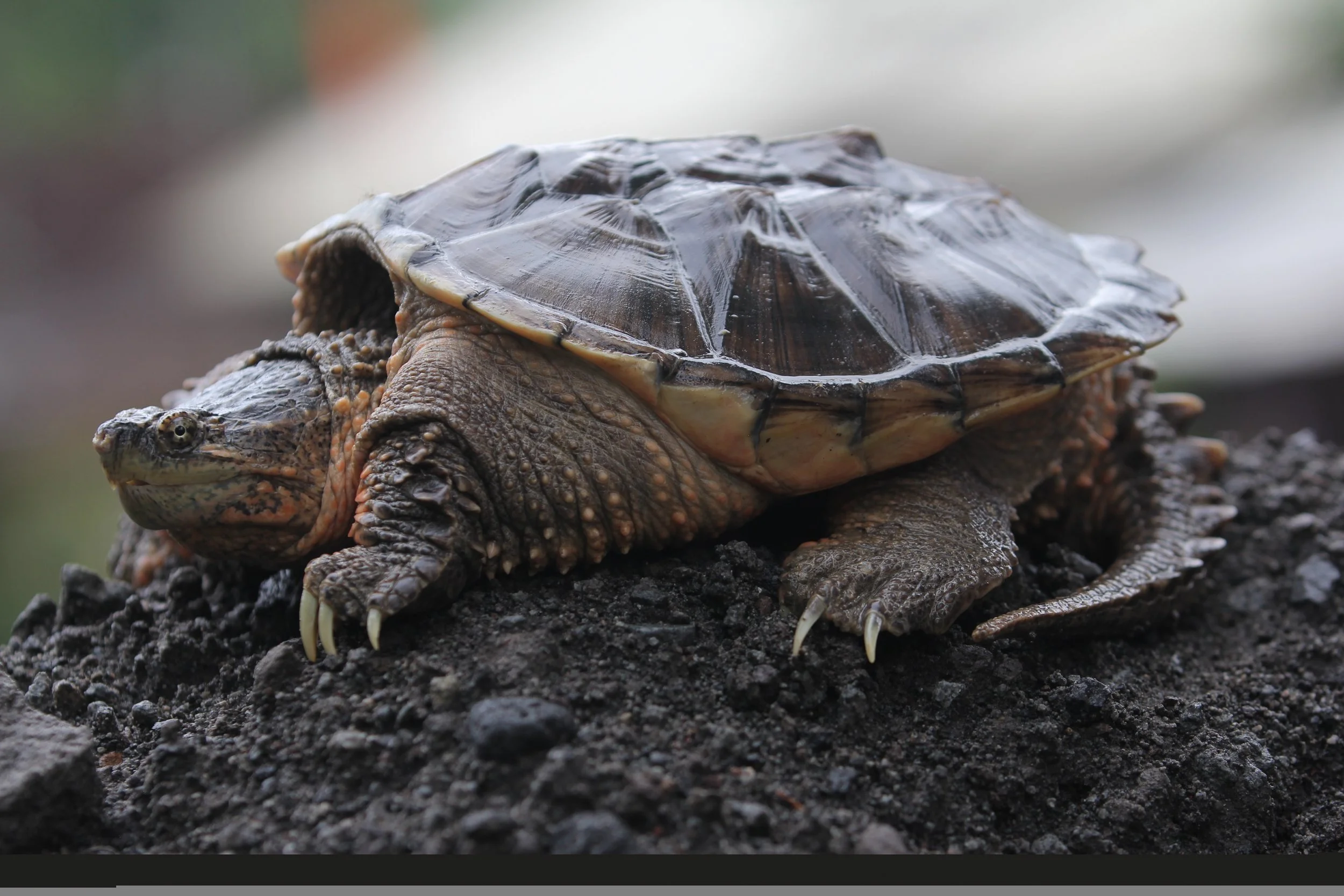
Snapping Turtle
Ancient, unhurried, and often misunderstood, the snapping turtle is one of the St. George watershed's most important ecological players — a scavenger, predator, and quiet sanitation engineer of the pond floor. Large adults may be older than many of the people who share their shoreline. In June, females cross roads to nest — please slow down and give them space.
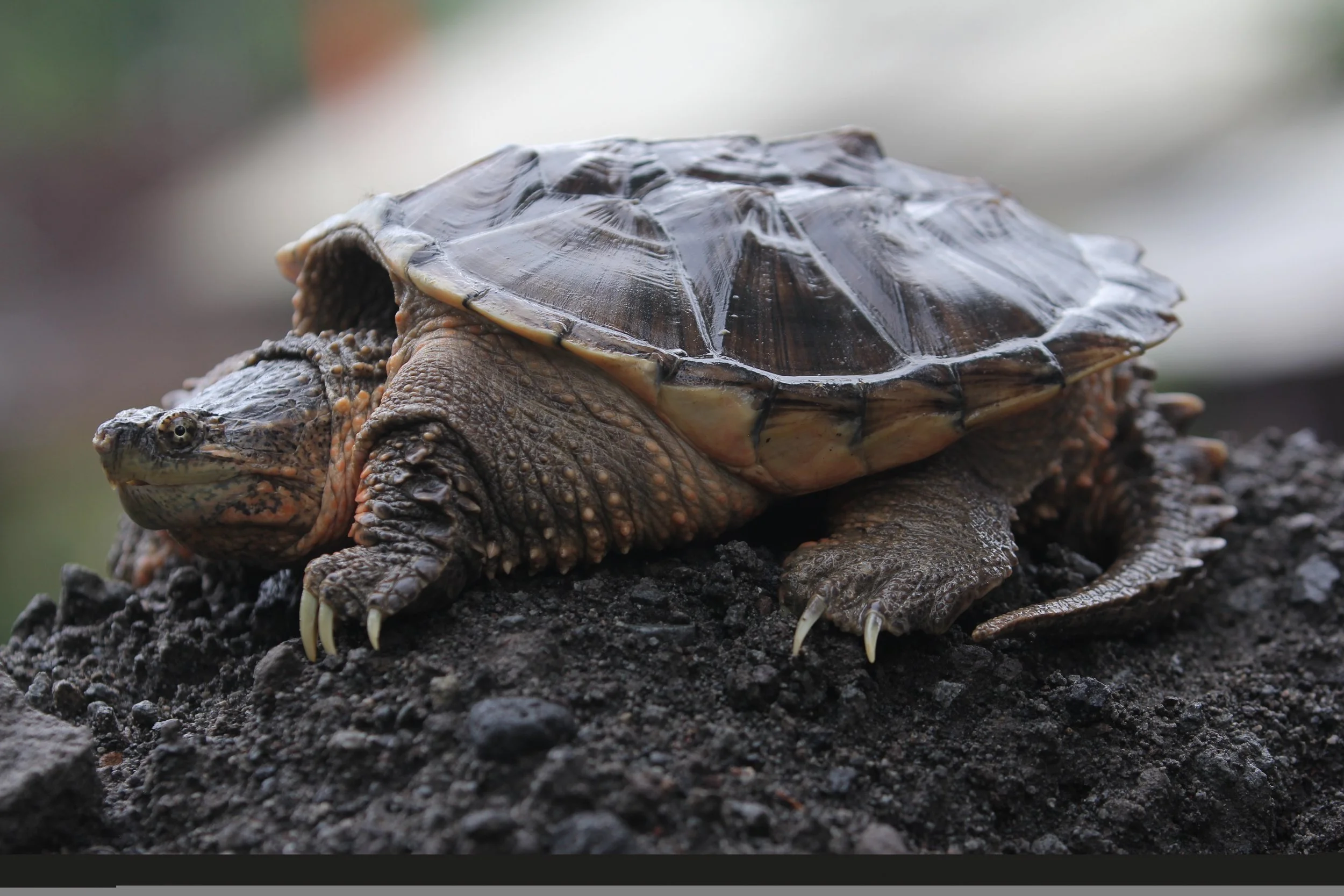
Ancient and Unhurried: The Snapping Turtle
Georges River Land Trust — Living River Species Series
Introduction
If the painted turtle is the watershed's sun-worshipping neighbor, easy to spot and pleasant to observe, the snapping turtle (Chelydra serpentina) is something altogether different — older-feeling, more secretive, with a reputation that precedes it. People who grew up near Maine ponds know the snapper mostly as a warning: don't put your hand near that one. And while the snapping turtle's defensive bite is real and not to be trifled with, there is a great deal more to this animal than its temperament on land. The snapping turtle is one of the watershed's most important ecological players — a long-lived, wide-ranging omnivore that has been keeping these waters clean and balanced for millions of years.
Natural History
Snapping turtles are large, prehistoric-looking animals with rough, dark shells often blanketed in algae, powerful hooked beaks, long necks, and tails ridged like a small dinosaur's. Adults commonly weigh 10 to 35 pounds, with some individuals reaching 40 pounds or more after decades of steady growth. They are among the largest freshwater turtles in the Northeast.
Unlike the painted turtle, snappers are highly aquatic and rarely haul out to bask. They spend most of their lives submerged in the muddy bottoms of ponds, lakes, slow rivers, and marshy wetlands, buried in silt with little more than their eyes and nostrils exposed. In the water they are surprisingly docile — a swimmer who accidentally brushes one is far more alarmed than the turtle. On land, however, a snapper feels exposed and vulnerable, and reacts accordingly.
They are true omnivores of remarkable flexibility: fish, frogs, crayfish, aquatic insects, snails, waterfowl, small mammals, aquatic vegetation, algae, and carrion all end up on the menu. This dietary breadth is part of what makes them so ecologically important — and so effective as survivors.
Snappers mature slowly, typically reaching breeding age at 15 to 20 years. They can live well past 40, and possibly much longer. A large snapping turtle in the St. George watershed may be older than many of the people who share its shoreline.
Identification Tips
Snapping turtles are large and unmistakable: a rough, often algae-covered dark shell that looks almost too small for the body, a long, saw-toothed tail nearly as long as the shell, a thick neck, and a hooked, beak-like jaw. Unlike painted turtles, snappers rarely bask in the open — look instead for just the eyes and nostrils breaking the surface, or a wake moving through duckweed. The plastron, or belly shell, is small and cross-shaped, leaving the legs and tail exposed, a useful mark if you see one out of water. Hatchlings, barely the size of a quarter, already show the ridged tail and hooked beak in miniature. Size alone is a strong clue too — a freshwater turtle in the St. George watershed over a foot long and 10 or more pounds is almost certainly a snapper.
Role in the St. George River Watershed
Few animals in the watershed hold as many ecological roles simultaneously as the snapping turtle.
As scavengers, they consume dead fish, waterfowl, and other carrion, performing a quiet sanitation function in ponds and slow-moving water that is easy to overlook but genuinely important. A wetland with healthy snapper populations is one with fewer rotting carcasses accumulating in the shallows.
As predators, they regulate populations of fish, frogs, and aquatic invertebrates. They are one of the few freshwater predators capable of taking adult painted turtles and their eggs — a relationship we noted in our painted turtle post. Ducklings and goslings are vulnerable in areas with large snappers, which creates predictable tension with people who feed waterfowl, but this predation is a natural and ancient dynamic. Muskrats occasionally fall prey to large adults as well.
As prey, snapping turtles contribute most during their early life. Raccoons, skunks, foxes, crows, and herons raid snapper nests with high success — nest predation rates can exceed 80 percent in some populations. Hatchlings face additional predation from large fish, herons, and hawks during their scramble from nest to water. The small fraction that survive to adulthood enjoy relative safety: a full-grown snapper has few natural predators in Maine.
The algae that colonizes their shells provides microhabitat for aquatic invertebrates, and the burrows snappers create in muddy pond bottoms are occasionally used by other species. Their movement between wetlands also aids in dispersal of aquatic plant seeds and invertebrate eggs carried on their bodies — a small but real contribution to the connectivity of wetland habitats across the watershed.
Road mortality during the June nesting season is one of the most significant human-caused threats. Females travel surprising distances from water to find nesting sites, often crossing roads, and their slow pace and late-to-reproduce biology make vehicle strikes a serious population concern.
Seasonal Notes
Snappers emerge from hibernation in the muddy pond bottom in April and May. June is nesting season — the time when females are most likely to be seen on land and on roads, sometimes far from water. Eggs incubate through summer, hatching in August and September. Hatchlings may overwinter in the nest in some years, emerging in spring. By October, adults return to the pond bottom to hibernate, buried in mud where they absorb enough oxygen through their skin to sustain their minimal winter metabolism.
Fun Fact
Snapping turtles can absorb oxygen directly through specialized tissue around their tail and cloaca — effectively breathing through their backside while hibernating underwater all winter. This adaptation, called cloacal bursae respiration, allows them to remain submerged for months without surfacing, even under ice.
Want to Learn More?
- Maine IF&W — Reptiles and Amphibians — Maine species accounts and conservation status for native turtles.
- Maine Audubon — Turtles and Road Safety — How to safely help a snapping turtle across a road without injuring yourself or the turtle.
- Maine Turtle Research, Outreach and Conservation (ME-TROC) — University of Maine program studying turtle populations and road mortality across the state.
- iNaturalist — Snapping Turtle — Track sightings across the region and contribute your own observations.
The Living River blog series is published by St. George Consulting in support of the Georges River Land Trust and the Maine Council of Trout Unlimited. To explore the important work these organizations are doing to conserve and restore Maine's landscapes, visit georgesriver.org and tumaine.org.
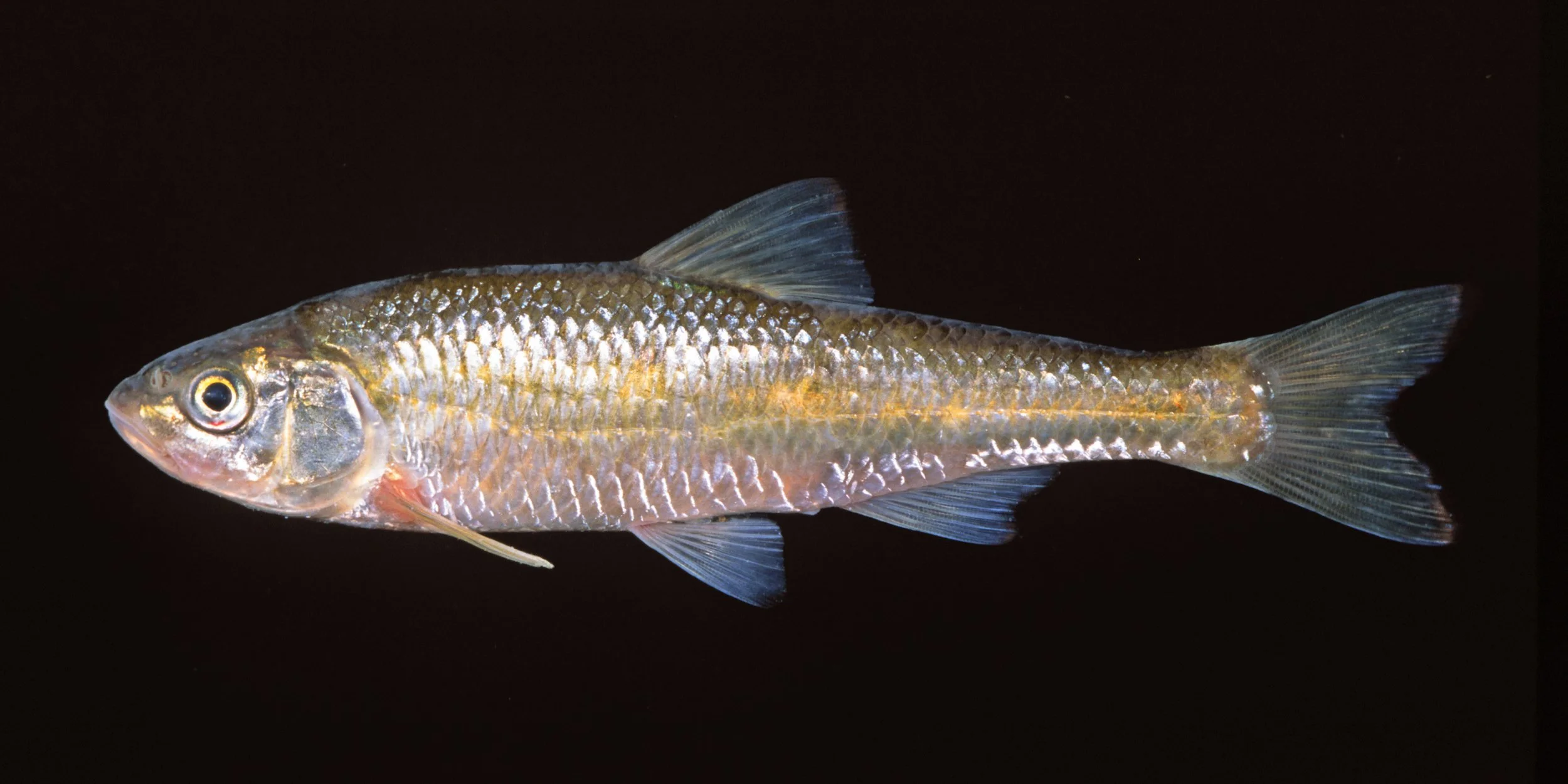
Common Shiner
Wade into any clean, clear tributary of the St. George River on a summer morning and look down. Flashes of silver dart through the current — common shiners, moving in loose schools that catch the light and scatter like thrown coins. Modest in appearance most of the year, the males transform in late May and June into something genuinely beautiful.
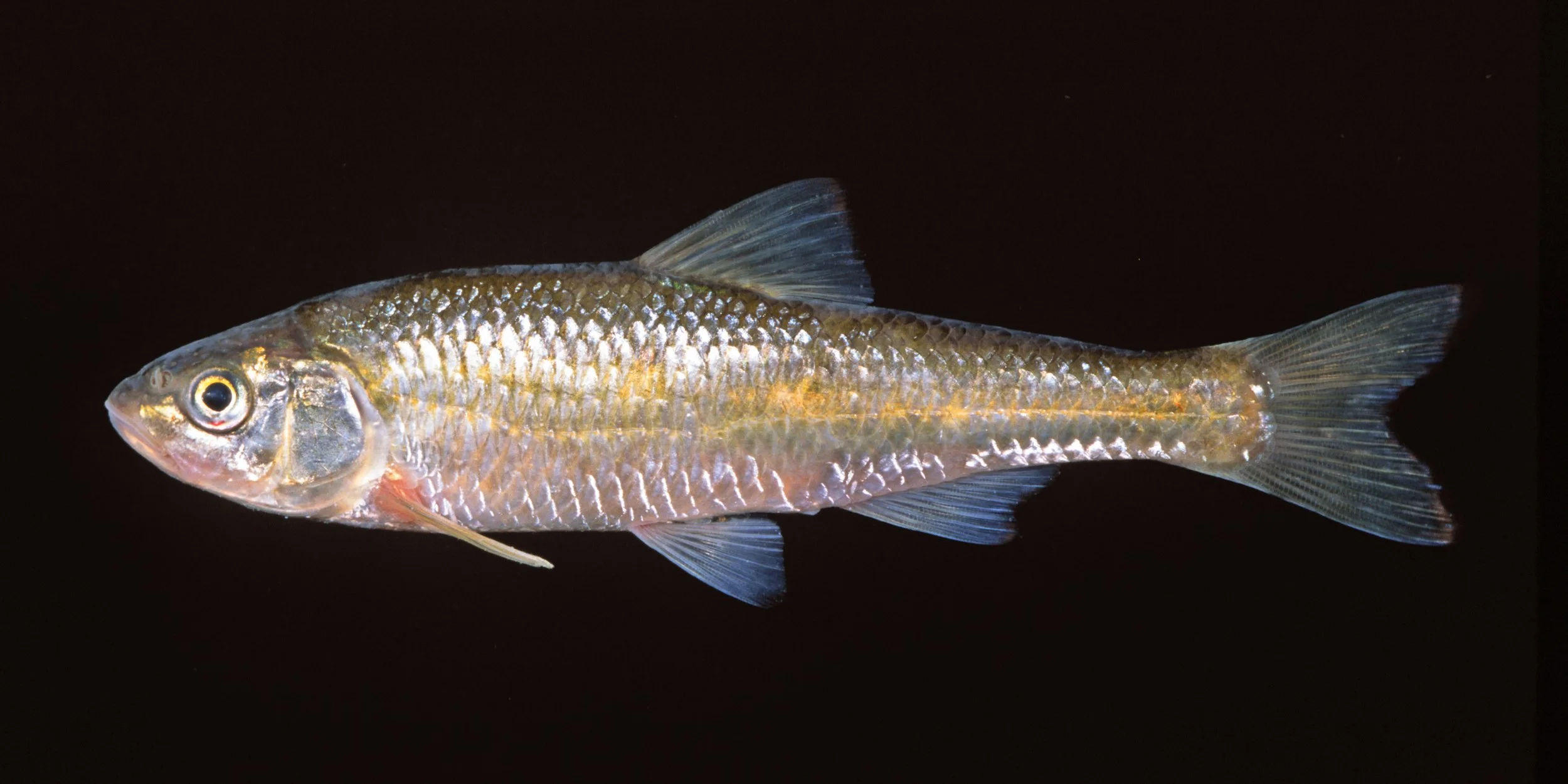
The Stream's Silver Currency: The Common Shiner
Georges River Land Trust — Living River Species Series
Introduction
Wade into any clean, clear tributary of the St. George River on a summer morning and look down. If the water is healthy, you will almost certainly see them — flashes of silver darting through the current, small fish moving in loose schools that catch the light and scatter like thrown coins. These are almost certainly common shiners (Luxilus cornutus), and they are easy to overlook precisely because they are so reliably, abundantly there. But the common shiner is anything but ordinary. It is one of the watershed's most ecologically important fish — a living link between the aquatic insects in the streambed and the larger predators above — and in late spring, the males transform into something genuinely beautiful.
Natural History
Common shiners are small, streamlined fish, typically three to five inches long, with the bright silvery sides that give them their name. For most of the year they are modestly handsome — silver flanks, olive-toned backs, a dark lateral stripe running from snout to tail. But come late May and June, the males change. Their sides flush with rose and pink, their fins warm to orange-red, and their heads develop small, hard bumps called nuptial tubercles that play a role in spawning competition. For a few weeks, the common shiner of the St. George's gravel runs is a genuinely striking animal.
They are native to eastern North America and strongly associated with clean, well-oxygenated streams and rivers — the kind of cool, clear water that defines the upper tributaries of the St. George watershed. They school readily, moving in loose groups through riffles and pools, feeding opportunistically on whatever the current delivers: aquatic insects, terrestrial insects that fall onto the water surface, algae, zooplankton, and small invertebrates. Their position as generalist feeders in the middle of the food web makes them indispensable connectors in the stream ecosystem.
One of the common shiner's most remarkable traits is its spawning behavior — or more accurately, its relationship with another fish while spawning.
Identification Tips
Common shiners are slim, silvery minnows three to five inches long, with an olive-toned back and a subtle dark lateral stripe that fades toward the tail — much fainter than the bold, continuous stripe of a blacknose dace. A useful technical mark: the dorsal fin sits slightly behind the pelvic fins, distinguishing shiners from several similar minnows. Outside the breeding season, look for loose, flashing schools of small silver fish holding in riffles and pool edges of clean, clear tributary streams. In late May and June, breeding males are unmistakable — rose-pink flanks, orange-red fins, and small hard bumps (nuptial tubercles) on the head.
Role in the St. George River Watershed
The common shiner occupies a central position in the watershed's stream food web, functioning simultaneously as predator and prey in ways that support nearly every other species in the river.
Looking upward in the food web: common shiners are primary forage for brook trout, brown trout, and landlocked salmon — all of which depend heavily on small forage fish through the warmer months when aquatic insect hatches are less predictable. Smallmouth bass and chain pickerel take them in slower pools and lake margins. Above the surface, belted kingfishers plunge-dive for shiners with precision, and great blue herons and common mergansers wade and dive among schools. The shiner's abundance is what makes these predators' success possible.
Looking downward: common shiners consume enormous quantities of mayflies, caddisflies, stoneflies, and midges — both as larvae in the streambed and as adults on the surface during hatches. In doing so, they transfer the energy stored in aquatic insects upward through the food chain to trout, birds, and beyond. They also consume terrestrial insects — ants, beetles, grasshoppers — that fall from overhanging streamside vegetation, creating a direct link between the riparian forest and the river.
One of the most fascinating ecological relationships in the watershed involves spawning. Common shiners frequently spawn in or immediately adjacent to nests built by creek chubs, a slightly larger minnow that constructs gravel mounds in stream riffles. The creek chub males defend these nests aggressively, but common shiners dart in to deposit eggs among the gravel — effectively borrowing the chub's carefully tended real estate. Both species end up spawning in the same nest at times, a relationship that benefits the shiner while the chub tolerates it with varying degrees of success.
As a water quality indicator, the common shiner is genuinely useful. It requires clean, well-oxygenated water to thrive. A healthy shiner population in a St. George tributary is meaningful evidence that the stream's basic conditions — temperature, dissolved oxygen, sedimentation, and chemical quality — are reasonably intact.
Seasonal Notes
Common shiners are active throughout the open-water season, from ice-out in April through late October. Feeding activity peaks in May and June as aquatic insect hatches intensify. Spawning occurs from late May through June in gravelly riffles and shallows, when males are at their most colorful. Schools are most visible in clear, shallow water on calm summer mornings. By November, shiners move to deeper, slower water as temperatures drop, remaining sluggish through winter beneath the ice.
Fun Fact
Common shiners can detect the chemical alarm signals released by injured members of their own school — a substance called schreckstoff (German for "fright substance") — and respond instantly with an evasive schooling response. This chemical warning system, shared by many minnow species, means that a predator's first strike alerts the entire school before it can strike again.
Want to Learn More?
- Maine IF&W — Freshwater Fishes of Maine — Maine's native and naturalized fish species, with biology and distribution.
- FishBase — Common Shiner — Global species database with range maps, ecology, and biological detail.
- Maine Rivers — Stream Health — Advocacy and education around Maine's river ecosystems and the species that depend on them.
- iNaturalist — Common Shiner — Regional sightings and photos from community naturalists across New England.
The Living River blog series is published by St. George Consulting in support of the Georges River Land Trust and the Maine Council of Trout Unlimited. To explore the important work these organizations are doing to conserve and restore Maine's landscapes, visit georgesriver.org and tumaine.org.