Water Boatmen
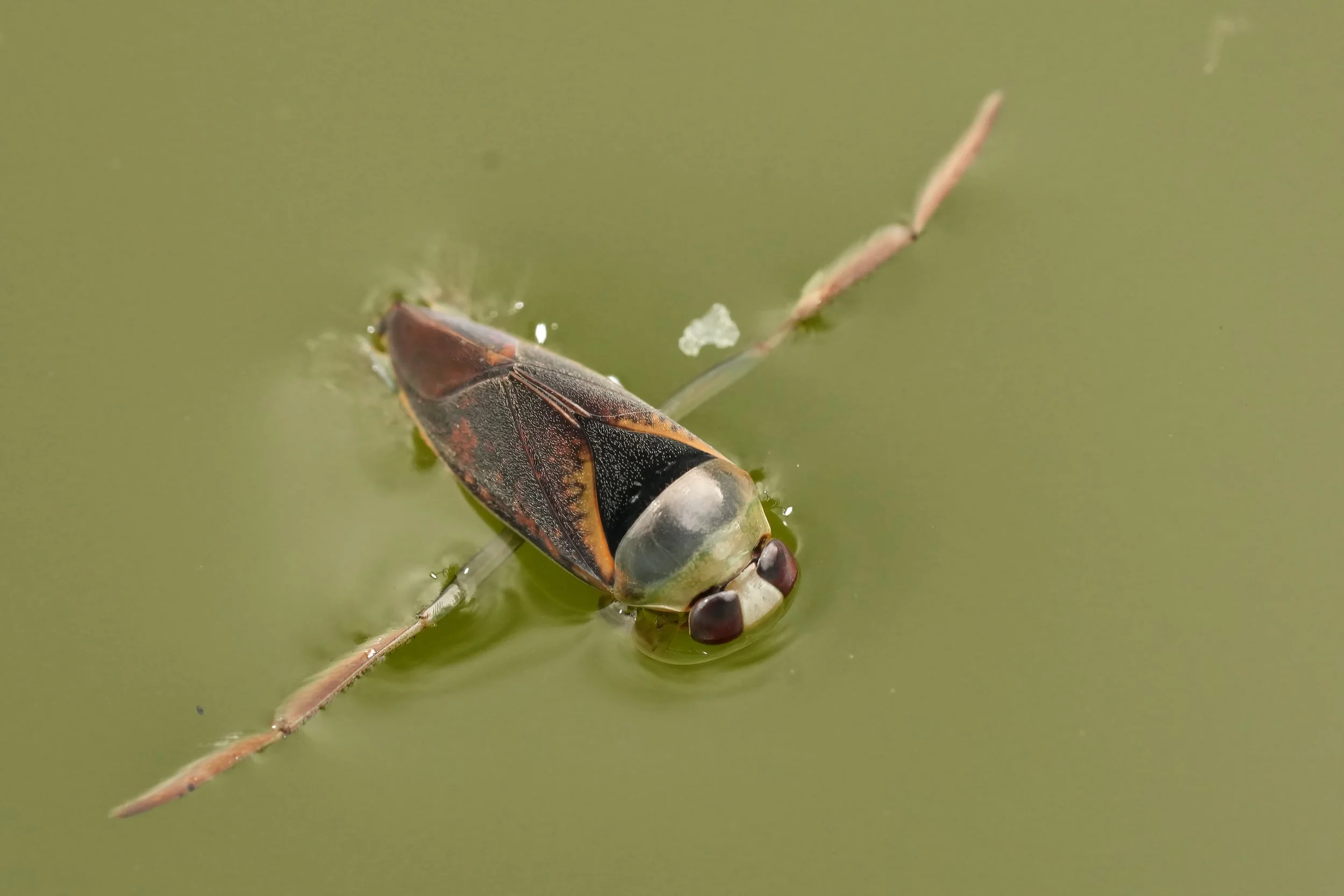
The Rowboat of the Pond: Water Boatmen
Georges River Land Trust — Living River Species Series
Introduction
Last week we looked at the water strider, skating across the surface film of the St. George's still pools. This week we go beneath the surface, to an insect that is every bit as common, considerably more abundant, and almost entirely overlooked: the water boatman (Family Corixidae). Barely the size of a watermelon seed, shaped like a tiny hull, and rowing through the water column with a pair of flattened hind legs that work exactly like oars, water boatmen are among the most numerous aquatic insects in the watershed's ponds, lake shallows, and quiet river reaches. They are also, as it turns out, one of the most astonishing animals in the world — though you would never guess it by looking at them.
Natural History
Water boatmen are true bugs, members of the Order Hemiptera and close relatives of the water striders we featured last week, though their lives could hardly be more different. Where the strider walks on the surface and never gets wet, the water boatman lives entirely submerged — rowing through open water, clinging to aquatic vegetation, and grazing across the mud and algae of the pond bottom with a blunt, scraping mouthpart.
They breathe air, as all insects do, but they solve the underwater breathing problem with elegant simplicity: before diving, the water boatman traps a bubble of air beneath its wings or along the surface of its abdomen, carrying it down like a miniature scuba tank. The bubble not only provides oxygen but functions as a physical gill — as the oxygen in the bubble is consumed, dissolved oxygen from the surrounding water diffuses in to replace it, extending the dive significantly beyond what the original air supply alone would support. Eventually the bubble is exhausted and the insect must return to the surface to replenish it, a quick trip that takes only a moment before the boatman dives again.
Unlike most of their Hemipteran relatives — which are predators that inject digestive enzymes and suck out liquefied prey — water boatmen are primarily herbivores and detritivores. They scrape algae, diatoms, and decaying organic matter from submerged surfaces, and some species supplement this with small invertebrates and midge larvae. They are grazers of the underwater garden, moving through the same biofilm community that the blacknose dace browses from riffle rocks in fast water — here in the quieter, softer reaches of ponds and backwaters.
Water boatmen are capable fliers and disperse readily between water bodies, particularly at night. This flight ability makes them important early colonizers of new or restored wetlands — often among the first insects to arrive and establish populations in habitat that has been created or recovered.
Role in the St. George River Watershed
In a watershed full of ecologically important insects, water boatmen earn their place through sheer abundance and the breadth of species that depend on them.
As grazers of algae and aquatic biofilm, they help regulate the growth of algae in ponds and lake shallows, performing in slow, vegetated water the same function the blacknose dace performs on fast riffle rocks. By cropping algae before it can form dense mats, they contribute to the water clarity that benefits every other species in the system.
As prey, they are consumed by an impressive roster of the watershed's animals. Brook trout, yellow perch, and smallmouth bass eat them throughout the open-water season. Painted turtles pick them off submerged vegetation. Great blue herons and belted kingfishers take them in the shallows. And — in a connection that links directly to an earlier post in this series — buffleheads diving in the lower river and tidal reaches through winter consume water boatmen as a significant component of their diet. Water boatmen remain active beneath the ice through winter, one of the few aquatic insects that does not enter dormancy, which makes them a critical food source for any predator active in cold-water months.
Their flight dispersal between water bodies also carries ecological benefits beyond colonization. As they move from pond to pond across the watershed, they transport algae, bacteria, and microscopic invertebrates on their bodies and in the water clinging to them — passively connecting isolated water bodies and contributing to the biological continuity of the wetland landscape.
The aquatic vegetation of the watershed's ponds — water lilies, pondweeds, cattail roots, submerged sedges — provides both foraging substrate and shelter for water boatmen, creating a mutual dependency between the insect and the plant community it inhabits.
Seasonal Notes
Water boatmen are active year-round, including under ice in winter — one of their most ecologically distinctive traits. They are among the first insects visible in ponds each spring, sometimes active before ice has fully cleared. Mating and egg-laying occur in spring and early summer, with eggs attached to submerged vegetation. Population densities peak through summer in warm, shallow, well-vegetated water. On calm autumn evenings, adults take flight to disperse, and they are strongly attracted to artificial lights — a water boatman buzzing around a porch lamp near a pond is a common and largely unrecognized autumn encounter. Under winter ice, they can be observed with a flashlight through clear ice in shallow ponds, still rowing methodically through the cold water below.
Fun Fact
Water boatmen hold a remarkable distinction: they are among the loudest animals on Earth relative to their body size. Males produce a mating call by stridulating — rubbing a small body part across a ridged surface on the abdomen, much as a cricket rubs its legs together — generating sounds that have been recorded at nearly 100 decibels. For an insect roughly two millimeters long, this is a sound output so disproportionate to body size that researchers who first measured it assumed their equipment was malfunctioning. The song travels through water and is inaudible above the surface, but beneath it, the ponds and quiet backwaters of the watershed are considerably louder than they appear.
Want to Learn More?
- Bug Guide — Corixidae — Photographic identification guide to North American water boatman species and life stages.
- Maine DEP — Biological Monitoring — How Maine uses aquatic invertebrates to assess the health of freshwater systems.
- Xerces Society — Freshwater Invertebrates — Conservation context for aquatic insects and the wetland habitats they depend on.
- iNaturalist — Water Boatmen — Regional sightings and community photographs from New England naturalists.
The Living River blog series is published by St. George Consulting in support of the Georges River Land Trust and the Maine Council of Trout Unlimited. To explore the important work these organizations are doing to conserve and restore Maine's landscapes, visit georgesriver.org and tumaine.org.