Backswimmers
100%
Upside Down and Dangerous: Backswimmers
Georges River Land Trust — Living River Species Series
Introduction
If you have spent any time peering into a pond or slow backwater of the St. George watershed, you have probably seen them without knowing what they were — small, torpedo-shaped insects rowing steadily through the water with long, oar-like hind legs, their pale undersides catching the light as they move. They look, at first glance, like water boatmen, which we wrote about last week. They are not. Backswimmers (Family Notonectidae) are doing something water boatmen never do: they are swimming upside down, and they are hunting. Where the water boatman is a peaceful grazer of algae and detritus, the backswimmer is an aggressive predator — one of the most effective ambush hunters in the watershed's quiet waters, and an animal that commands a certain respectful distance.
Natural History
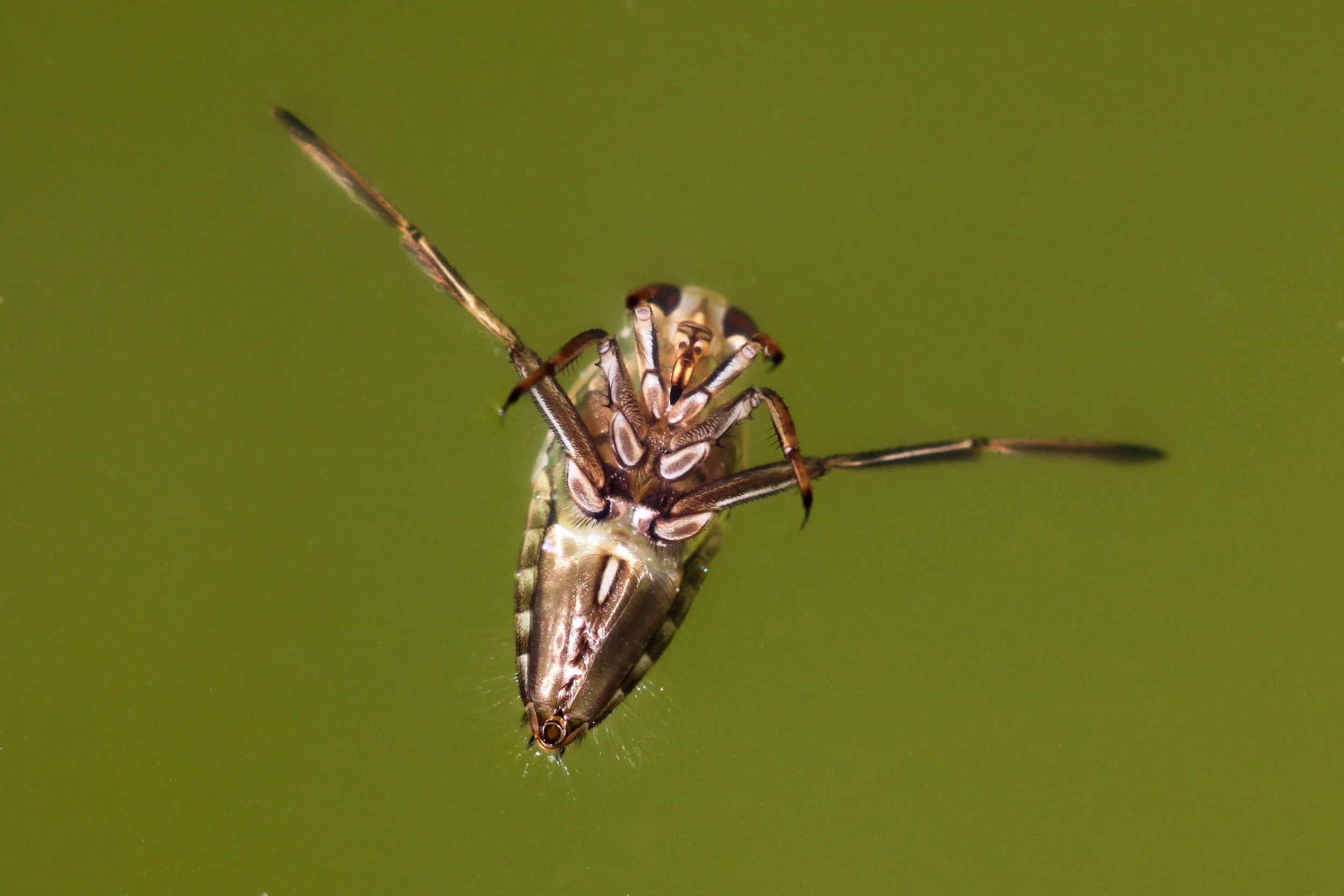
Backswimmers are true bugs (Order Hemiptera), close relatives of both the water striders and water boatmen featured in the past two posts. The family name Notonectidae means "back swimmer" in Greek, which is precisely what they do: they cruise through the water inverted, belly up, using their long, fringed hind legs as synchronized oars. The keel-shaped back — which faces downward in the water — cuts through the resistance of the water column efficiently, and the pale, often silvery underside, now facing up, reflects the light in a way that can make them shimmer as they move.
Like water boatmen, backswimmers carry a bubble of air trapped against their body to breathe while submerged. But where the water boatman must work to stay on the bottom, the backswimmer faces the opposite problem: the buoyancy of its air bubble makes it naturally float upward. A backswimmer that stops swimming immediately begins to rise toward the surface — they must actively swim downward to remain submerged, which means hunting requires continuous effort. At rest, they hang just below the surface film, air bubble touching the water's surface for a breath, hind legs splayed, waiting.
They are piercing predators with a sharp, three-segmented rostrum capable of delivering a painful bite. Backswimmers will attack prey considerably larger than themselves — mosquito larvae, aquatic insect nymphs, small tadpoles, and even tiny fish fry are all fair game. The rostrum is driven in, digestive enzymes injected, and the liquefied contents drawn out, true-bug style. A word of practical advice: if you scoop pond water and find a backswimmer in your hand, release it promptly. Their bite has been compared to a bee sting and is genuinely uncomfortable — impressive for an insect less than half an inch long.
Role in the St. George River Watershed
Backswimmers are apex invertebrate predators in the pond and still-water communities of the watershed, and their position at the top of the aquatic invertebrate food web gives them an outsized ecological influence.
Their most publicly appreciated role is as predators of mosquito larvae. Mosquito larvae develop in exactly the warm, still, vegetated water that backswimmers favor, and a pond with a healthy backswimmer population is a pond with meaningful biological pressure on mosquito reproduction. This is natural pest control that operates quietly, continuously, and without any human intervention.
They also consume water boatmen — the very species we featured last week — along with midge larvae, mayfly nymphs, small caddisfly larvae, and other soft-bodied aquatic invertebrates. In doing so, they regulate the abundance of these mid-level consumers and keep the invertebrate community in balance. Their predation on tadpoles connects them directly to the watershed's amphibian community — wood frog and spring peeper tadpoles developing in warm pond margins are vulnerable to backswimmer attack, a pressure that likely influences where and how amphibians use pond habitat for breeding.
Backswimmers are in turn eaten by brook trout, yellow perch, and largemouth bass, which take them both in the water column and at the surface. Great blue herons and belted kingfishers pick them off in shallow margins. Diving ducks — including the buffleheads we wrote about earlier in the series — consume them through winter, as backswimmers remain active beneath the ice in the same months when other invertebrate prey becomes scarce.
Like water boatmen, backswimmers are capable fliers and disperse between water bodies at night, rapidly colonizing new or restored wetland habitat and knitting together the watershed's network of ponds and slow reaches into a connected ecological system.
Seasonal Notes
Backswimmers are active year-round, including under ice in winter — one of several aquatic true bugs that maintain activity through the coldest months, making them an important food source when the watershed's invertebrate diversity contracts sharply. They are visible in open water from April through November, with populations building through late spring and summer in warm, vegetated pond shallows. Mating occurs in spring, and eggs are inserted into aquatic plant tissue. On warm autumn nights, adults take flight to disperse — like water boatmen, they are attracted to artificial lights and occasionally found far from any water body. In winter, look for them through clear ice in shallow ponds, still rowing steadily upside down through the cold darkness below.
Fun Fact
Backswimmers navigate by using the brightness of the sky above the water surface as their primary reference for which way is up. Their compound eyes are divided into upper and lower halves with different sensitivities, and they orient themselves by swimming away from the brightest light source — which, in a natural setting, is always the sky above. This system works flawlessly in nature. Near artificial lights at night, however, the system fails: a bright lamp below or to the side of the pond registers as "up," and backswimmers will swim toward it, sometimes ending up stranded far from water. The same elegant navigation that has served them for millions of years becomes a liability in a world lit from unexpected directions.
Want to Learn More?
- Bug Guide — Notonectidae — Photographic identification guide to North American backswimmer species and life stages.
- Maine DEP — Biological Monitoring — How Maine uses aquatic invertebrates to assess freshwater ecosystem health.
- Xerces Society — Freshwater Invertebrates — Conservation context for aquatic insects and the pond and wetland habitats they depend on.
- iNaturalist — Backswimmers — Regional sightings and community photographs from New England naturalists.
The Living River blog series is published by St. George Consulting in support of the Georges River Land Trust and the Maine Council of Trout Unlimited. To explore the important work these organizations are doing to conserve and restore Maine's landscapes, visit georgesriver.org and tumaine.org.