Mosquito
More Than a Nuisance: The Mosquito
Georges River Land Trust — Living River Species Series
Introduction
Last week we made the ecological case for the black fly — Maine's most notorious warm-season insect. This week we take on the other one. The mosquito (Family Culicidae) needs no introduction to anyone who has stepped outside between May and September in the St. George watershed, and its reputation is, if anything, harder to rehabilitate than the black fly's. Mosquitoes carry disease. They are genuinely a public health concern, and that should not be minimized. They are also pollinators of native orchids, food for bats and swallows in quantities that matter enormously, and aquatic processors of organic matter in the still-water habitats that support much of the watershed's biodiversity. The mosquito contains multitudes, and understanding them fully changes the relationship — if not the itch.
Natural History
Maine hosts approximately 50 mosquito species, and once again the essential biological fact is that only females bite. Males feed entirely on nectar and plant juices and are harmless. Females, like female black flies, require a blood meal to develop eggs — but females also feed on nectar for their own energy, visiting flowers throughout their lives. The blood and the bite are reproductive, not nutritional.
Mosquito larvae are strictly aquatic but occupy the opposite end of the water quality spectrum from black fly larvae. Where black flies require fast, cold, clean riffles, mosquito larvae thrive in still, warm, often stagnant water: vernal pools, roadside ditches, the water trapped in a hollow tree or an overturned bucket, the slow margins of ponds, the flooded woodland floor. Larvae hang from the surface film, breathing through a tube called a siphon, and filter algae, bacteria, and fine organic particles from the water below — the same filter-feeding strategy that midges and black flies use, adapted here for the quiet, nutrient-rich water of still environments.
Different species have adapted different seasonal strategies. Aedes species — the aggressive spring biters familiar to anyone who has walked through the woods in May — overwinter as eggs in dried vernal pool basins and leaf litter, hatching en masse when spring flooding arrives. Culex species breed through summer in stagnant water and are the primary vectors of West Nile virus and eastern equine encephalitis (EEE) in Maine, both of which are genuine health concerns worth monitoring through public health advisories. Knowing which mosquito is biting and when is more than academic trivia.
Identification Tips
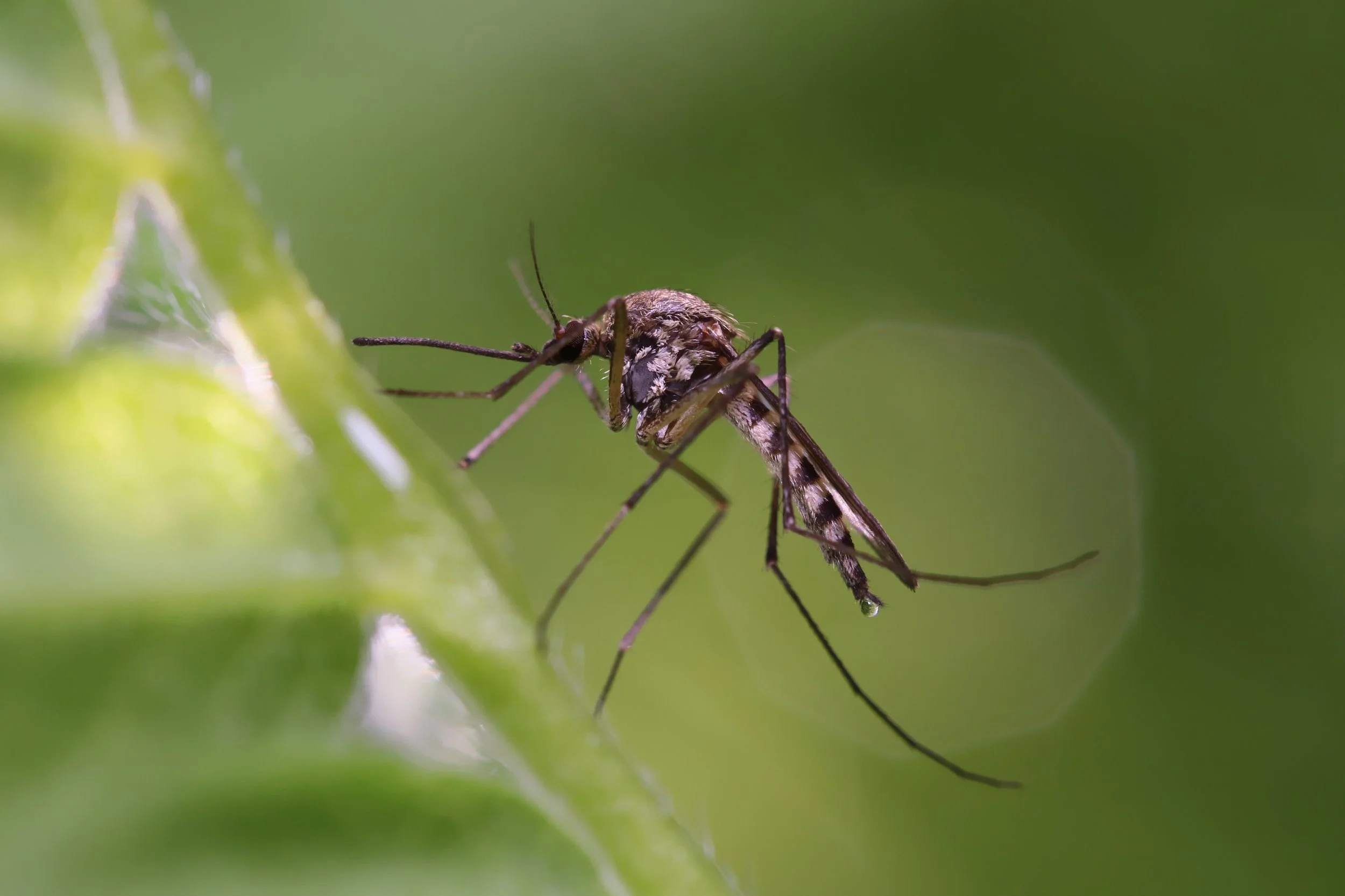
Mosquitoes are small, slender flies with long, thin legs, narrow wings, and — the single most reliable field mark — an elongated, needle-like proboscis extending forward from the head, used by females to pierce skin. This distinguishes them at a glance from midges, which look superficially similar in flight but lack the piercing mouthpart and don't bite. Larvae hang just below the water's surface at a distinct angle, breathing through a siphon tube at the tail end, and move with a distinctive wriggling, S-shaped thrash when disturbed — different from the free-swimming midge larvae that share the same still water. The high-pitched whine near your ear, produced by rapid wingbeats, is often the first and most familiar identification cue of all.
Role in the St. George River Watershed
Strip mosquitoes from the watershed entirely — a thought experiment that some people entertain with pleasure — and the effects would ripple through the food web in ways that are difficult to fully predict.
Little brown bats are the watershed's most efficient mosquito consumers, and they matter enormously here. A single bat can consume more than 1,000 mosquitoes in a single night of foraging, and the bat populations roosting in the watershed's old buildings, hollow trees, and bridge crevices represent a combined nightly predation pressure on mosquitoes that no pesticide program could replicate. Tree swallows and barn swallows, nighthawks, and chimney swifts consume adults in large numbers during daylight and dusk hours. Dragonflies and damselflies — both covered in this series — catch them on the wing. Spiders in the vegetation around water's edges take them in webs. The adults are prey for so many species that their removal would cascade unpredictably upward through the food chain.
Mosquito larvae are food for backswimmers, predaceous diving beetles, dragonfly and damselfly nymphs, and small fish including minnows and juvenile perch — a connection we noted in last week's backswimmer post. In vernal pools, they share the water with wood frog and spring peeper tadpoles in the same weeks that tadpoles are developing — a crowded, predation-rich environment that mosquito larvae must survive to complete development.
The most surprising ecological role belongs to the males, and to females visiting flowers: mosquitoes are pollinators of native orchids. Several Maine native orchids — including bog orchids in the genus Platanthera, which grow in the watershed's wetter edges and sphagnum bogs — are pollinated primarily or exclusively by mosquitoes, which enter the flowers to feed on nectar and carry pollen between plants. These orchids and their mosquito pollinators have co-evolved over millions of years, a partnership so specific that removing one would jeopardize the other. The orchid that blooms at the sphagnum bog margin in July has mosquitoes to thank.
Seasonal Notes
Spring Aedes emerge in late April and May, often before the snow is fully gone, hatching from overwintered eggs in vernal pools and flooded woodland. They peak in May and early June and largely decline as pools dry and temperatures rise. Summer Culex and other species build through June and July, with peak activity at dusk and dawn on calm, humid evenings. Activity declines noticeably with the first frosts of September, though some species remain active into October in mild autumns. No mosquitoes overwinter as adults in Maine — the species that bite in May hatched from eggs that survived the winter, not from adults that did.
Fun Fact
The high-pitched whine of a mosquito is produced by its wingbeats — females beat their wings at a slightly different frequency than males, and the difference is detectable. Researchers studying mosquito courtship discovered that when a male and female fly near each other, they adjust their wingbeat frequencies to harmonize — tuning toward each other until their flight tones converge on a shared frequency. The insects are, in effect, finding each other in the air by listening for a match and then adjusting their pitch to meet it. A mosquito's whine, in other words, is not random noise — in the right context, it is a duet.
Want to Learn More?
- Maine CDC — Mosquito-Borne Disease — Current monitoring data, EEE and West Nile risk, and public health guidance specific to Maine.
- Maine Medical Entomology Laboratory — University of Maine research on mosquito species, distribution, and disease risk.
- Bug Guide — Culicidae — Photographic identification guide to North American mosquito species and life stages.
- iNaturalist — Mosquitoes — Regional sightings and community observations from New England naturalists.
The Living River blog series is published by St. George Consulting in support of the Georges River Land Trust and the Maine Council of Trout Unlimited. To explore the important work these organizations are doing to conserve and restore Maine's landscapes, visit georgesriver.org and tumaine.org.