Smallmouth Bass
Bronze and Beautiful: The Smallmouth Bass of the St. George
Georges River Land Trust — Living River Species Series
Introduction
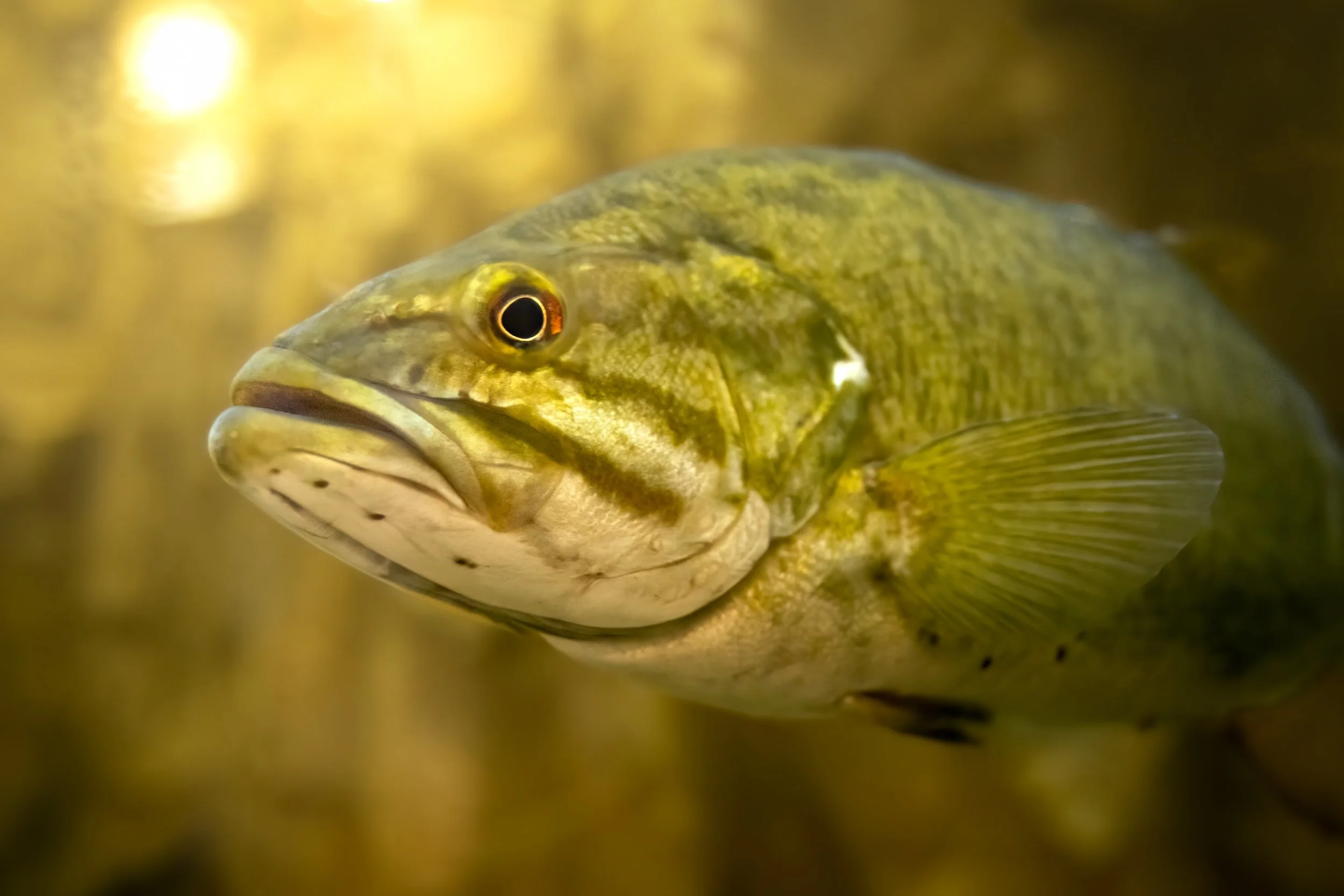
Pull a smallmouth bass from a sun-warmed pool on the lower St. George River and you are holding one of the most beautiful fish in fresh water. The flanks flash bronze and olive green, banded with dark vertical bars that catch the light like hammered metal. The jaw is wide, the eye a deep burnt orange, and the fish itself — even a modest pound-and-a-half — fights with energy out of all proportion to its size. Anglers love smallmouth bass for good reason. The river's ecology has a more complicated relationship with them — and understanding both sides makes the fish more interesting, not less.
Natural History
The smallmouth bass (Micropterus dolomieu) is native to the river systems of the upper Midwest and mid-Atlantic — not to Maine. It was introduced throughout New England in the late nineteenth century, spread enthusiastically by anglers and fish culturists who recognized its sporting qualities, and is now firmly established across much of the state, including the St. George watershed.
It is a fish built for moving water. Smallmouth prefer clear, cool rivers and lakes with rocky or gravelly bottoms, where they hold in the current behind boulders, in the shade of undercut banks, and along the edges of deeper pools. Water temperature is a key constraint — smallmouth thrive between roughly 60 and 75°F, tolerating warmer conditions than brook trout but still requiring reasonably clean, well-oxygenated water.
Spawning occurs in late May and June, when males fan out shallow, gravel-bottomed nests, court females, and guard eggs and fry with fierce dedication — chasing off fish many times their size. The young grow quickly on aquatic invertebrates, shifting to crayfish, small fish, and frogs as they mature. Adults in Maine rivers can reach three pounds or more and live ten to fifteen years.
Identification Tips
Smallmouth bass are bronze to olive-green with faint dark vertical bars along the sides — not the solid dark horizontal stripe that marks a largemouth bass. The most reliable field mark is the jaw: on a smallmouth, the upper jaw (maxilla) extends only to about the middle of the eye, never past its rear edge, while a largemouth's jaw reaches well behind the eye. The dorsal fin is a single continuous fin with only a shallow notch between its spiny and soft portions, versus the deep, almost fully separated notch on a largemouth. Look also for the chunky, deep-bodied build and the burnt-orange eye. Habitat is a good clue too — smallmouth favor the St. George's rocky, current-swept pools, while largemouth stick to slower, weedier water.
Role in the St. George River Watershed
The smallmouth bass sits near the top of the food web in the lower St. George, and its presence shapes the behavior and abundance of nearly everything below it.
Crayfish are the cornerstone of the adult smallmouth's diet in the St. George, and the bass's preference for rocky substrate directly overlaps with crayfish habitat. Blacknose dace, common shiners, and other small fish make up much of the rest of the diet, along with dragonfly and damselfly nymphs, caddisfly larvae, hellgrammites (the larvae of dobsonflies), and — on summer evenings — insects taken at the surface. Water striders, giant water bugs, and even small frogs are all fair game.
In turn, juvenile smallmouth are eaten by great blue herons, belted kingfishers, and river otters. Larger adults have few natural predators in the watershed, which is part of what makes their introduction ecologically significant.
It is worth being honest: smallmouth bass prey on juvenile brook trout and shift the competitive landscape for native species. Maine IF&W actively manages bass populations and restricts their introduction to new waters for this reason. In the lower St. George, where they have been established for well over a century, smallmouth are a permanent part of the watershed's ecology — but their story is a reminder of how lasting the consequences of introductions can be.
Seasonal Notes
Smallmouth are most visible and most catchable from late May through September. They move into the shallows to spawn in June, often in easily observed locations in calm coves and river edges. Through July and August they are active in riffles and pool edges in early morning and evening, taking insects off the surface as the light fades. As water cools in October, they move to deeper pools and slow stretches, becoming less active through winter, though they do not fully cease feeding until temperatures drop to near freezing.
Fun Fact
A male smallmouth guarding a nest will not leave it — not for rival males, not for herons, not even for a swimming snake. Researchers studying nest-guarding behavior have found that males will return to the nest within seconds of being chased off, repeatedly, for as long as the threat persists. It is one of the most tenacious parental performances of any fish in the watershed.
Want to Learn More?
- Maine IF&W — Smallmouth Bass — Maine's fisheries management approach to smallmouth bass, including regulations and stocking history.
- iNaturalist — Micropterus dolomieu — Regional sightings and photographs from New England observers.
- Trout Unlimited — Bass and Brook Trout Interactions — Conservation context for the relationship between introduced bass and native cold-water fish.
- Bug Guide — Hellgrammites — The dobsonfly larvae that are among the smallmouth's most important prey items.
The Living River blog series is published by St. George Consulting in support of the Georges River Land Trust and the Maine Council of Trout Unlimited. To explore the important work these organizations are doing to conserve and restore Maine's landscapes, visit georgesriver.org and tumaine.org.