Sea Lamprey
Older Than the Atlantic: The Sea Lamprey of the St. George
St. George Consulting — Living River Series
Give It a Second Chance
The sea lamprey has an image problem. Most people picture the invasive pest that devastated Great Lakes fisheries in the twentieth century — a toothy, eel-like creature with a sucker mouth that sounds more like a horror film prop than a wild neighbor worth appreciating. But in Maine, the sea lamprey is something entirely different: a native fish, a river builder, and one of the most ancient vertebrates on Earth. It deserves a second look.
Natural History: 360 Million Years and Counting
The sea lamprey (Petromyzon marinus) belongs to a lineage that has been swimming in the world's waters for roughly 360 million years — predating the dinosaurs, the Atlantic Ocean itself, and most of the plant life we think of as ancient. It is one of the last surviving jawless vertebrates, a group that once dominated the seas before fish with jaws appeared and changed everything. The lamprey's basic design has barely changed since.
Its life cycle is among the more remarkable in the river world. Adults spawn in late spring and early summer, moving rocks with their sucker mouths to build gravel nests in clean, flowing water. A single female deposits over 100,000 eggs, and shortly after spawning, both parents die — their bodies a pulse of nutrients for the stream.
The larvae — called ammocoetes — are blind and look nothing like their parents. They burrow into soft streambed sediment and spend the next four to six years filter-feeding on algae and organic particles, invisible to most passersby. Then comes a dramatic metamorphosis: eyes develop, the toothed oral disk forms, and the young lamprey migrates to the sea.
In salt water, it spends one to two years as a parasite, attaching to host fish and feeding on blood and tissue. Then, following some ancient internal signal, it stops feeding, returns to freshwater, spawns, and dies. The whole cycle takes roughly seven years.
Role in the St. George River Watershed
In Maine, sea lamprey are native and ecologically important — a fact lost in the understandable alarm over their Great Lakes invasion. Here, they evolved alongside Atlantic salmon, alewives, and shad over millions of years.
Their nest-building is genuinely valuable: as spawning adults move rocks with their mouths, they loosen compacted sediment and create clean, well-oxygenated gravel that Atlantic salmon and brook trout also depend on for spawning. They are, in the language of ecologists, habitat engineers.
Their post-spawning die-off matters too. Spent carcasses enrich the stream with marine-derived nutrients — phosphorus, nitrogen, organic matter — fertilizing the invertebrate communities that fish depend on.
Like so many native sea-run species, lamprey populations in Maine have declined due to dams blocking spawning migrations. Restoring fish passage on the St. George and its tributaries benefits lamprey as much as salmon and shad.
The Wabanaki and the Lamprey
For the Wabanaki peoples who have lived in and traveled these watersheds since long before European contact, sea lamprey were part of the spring river bounty. The Mi'kmaq people are documented as having eaten sea lamprey, and lamprey featured in the food traditions of Indigenous peoples across the Northeast.
The appeal was nutritional as well as cultural. Lamprey are exceptionally rich in fat and calories — more so than salmon — making them a prized food, especially after lean winter months. They were harvested during spring spawning runs, smoked for preservation, and their oil was valued for food and medicine. The lamprey's predictable spring arrival, alongside alewives and salmon, was part of the seasonal river rhythm that sustained Wabanaki communities for millennia.
Seasonal Notes
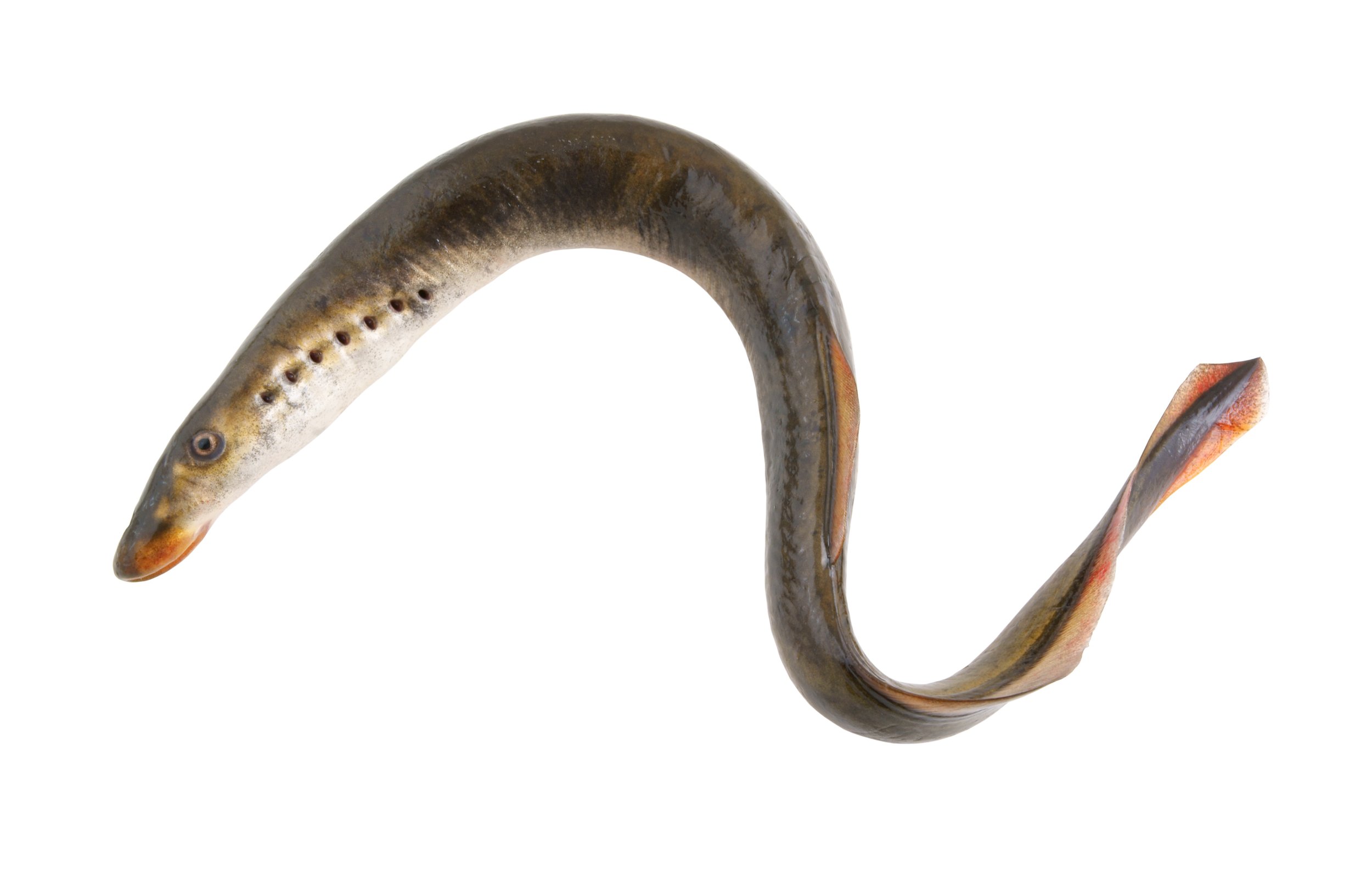
Sea lampreys enter St. George River tributaries in late May and June to spawn. Look for the characteristic circular nest depressions — called redds, like those of salmon — in shallow gravel riffles. The adults are distinctive: gray-brown, eel-shaped, one to two feet long, with a round, jawless mouth.
Fun Fact
Sea lampreys have no jaw, no scales, and no bones — their skeleton is cartilage throughout. They have seven gill openings on each side of the body, giving them an otherworldly, polka-dotted look. And they navigate by smell, homing on the precise chemical signature of the stream where they hatched.
Learn More
- Maine DMR — Sea Lamprey
- NRCM Creature Feature — Sea Lamprey
- NRCM — Sea Lamprey Migration in the Sheepscot River
- US Fish & Wildlife Service — Sea Lamprey
- Traditional Animal Foods of Indigenous Peoples — Lampreys
The Living River blog series is published by St. George Consulting in support of the Georges River Land Trust and the Maine Council of Trout Unlimited. To explore the important work these organizations are doing to conserve and restore Maine's landscapes, visit georgesriver.org and tumaine.org.