Northern Pike
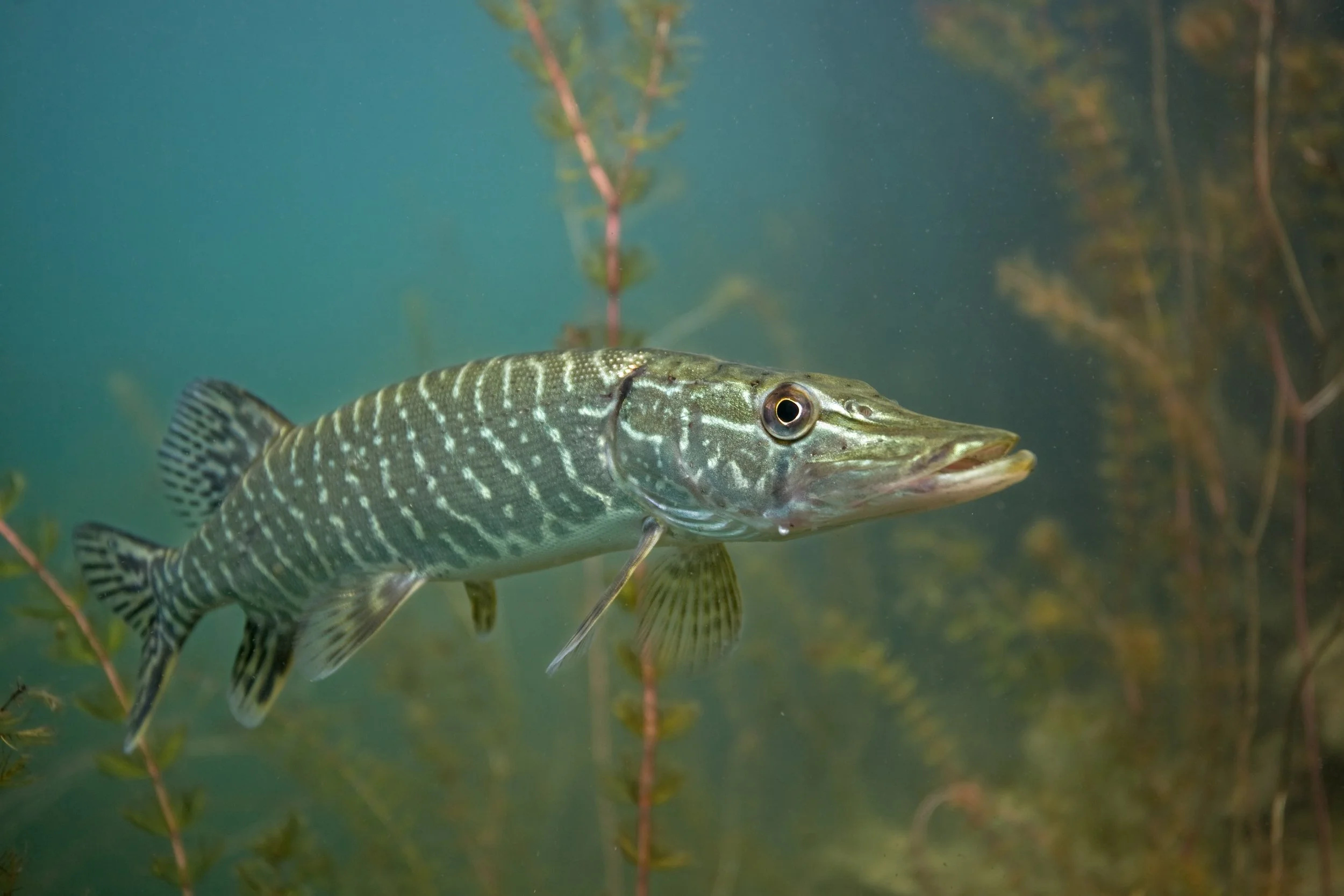
The Apex Ambusher: The Northern Pike
Georges River Land Trust — Living River Species Series
Introduction
There is no mistaking a northern pike (Esox lucius). Long, torpedo-shaped, and patterned in olive and gold like something that belongs in a deeper, older world, the pike is one of the most formidable freshwater predators on the continent. It is also, in the St. George watershed, a complicated presence — a species whose power and ecological significance deserve respect, and whose spread into waters where it does not belong deserves honest attention. Understanding the pike means holding both of those things at once.
Natural History
Northern pike are built for one thing: ambush. They lie motionless among aquatic vegetation, nearly invisible, and then accelerate with startling speed to seize prey in a mouthful of backward-angled teeth designed to grip and not release. They will eat fish, frogs, ducklings, small muskrats — nearly anything that crosses their path and fits in their mouth. Large pike have been reliably documented taking prey half their own length.
They are among the largest freshwater fish in the Northeast. Adults commonly reach 24 to 36 inches; exceptional individuals can exceed four feet and weigh more than 20 pounds. Females grow larger and live longer than males, sometimes reaching 25 years of age. Their preferred habitat is the weedy, shallow margin of lakes and slow rivers — exactly the productive, vegetated edges that support so much other life in the watershed.
Spawning occurs in very early spring, often in March or April, when pike push into flooded vegetation along lake shores and stream margins while ice may still be retreating. Females scatter thousands of adhesive eggs among the vegetation and depart, leaving the eggs and eventual fry entirely to chance.
Identification Tips
A pike's body is long and torpedo-shaped, with a flattened, duck-bill snout full of sharp backward-pointing teeth. The color runs dark olive-green to gray, marked with light, bean-shaped or oval spots arranged in rows along the sides — the reverse of the chain pickerel's dark chain-link markings on a lighter background, a useful way to separate the two at a glance. Pike also have a fully scaled cheek but only the upper half of the gill cover (operculum) scaled, a technical but reliable mark for ruling out muskellunge or pickerel. The dorsal and anal fins sit far back on the body, close to the tail, giving pike their distinctive ambush-predator silhouette. Any fish over two feet long with this profile lurking in a weedy cove is almost certainly a pike — few other St. George fish approach that size.
Role in the St. George River Watershed
Here is where the pike's story in this watershed requires some care.
Northern pike are native to Maine — but only in the northern and eastern portions of the state, primarily the St. John River drainage. In the lakes and ponds of Midcoast Maine, including the St. George watershed, pike are an introduced species, almost certainly the result of illegal bucket stocking by anglers attracted to their reputation as hard-fighting sport fish. Maine IF&W has documented their spread into numerous southern and coastal Maine waters over recent decades, and the ecological consequences are serious.
As apex predators with enormous appetites, pike can rapidly reorganize the fish communities they enter. Brook trout, landlocked salmon, and yellow perch — species native to the St. George system — are highly vulnerable to pike predation, particularly juveniles. In waters where pike establish themselves, populations of these native fish often decline sharply. The carefully managed salmon fishery in Lake St. George is among the resources that benefit most directly from limiting pike's spread.
At the same time, in ecosystems where they are ecologically appropriate, pike play a meaningful role in controlling populations of smaller fish and maintaining balance. Great blue herons, ospreys, river otters, and mink will take juvenile pike; humans are the primary check on adult populations. The aquatic vegetation the pike depends on — water lilies, pondweeds, emergent sedges — is the same productive habitat that supports dragonflies, painted turtles, and waterfowl. The pike is a creature of these rich, weedy edges, even where it does not belong.
Wabanaki people across the pike's native range in northern and central North America depended on them as an important food source, particularly in late winter and early spring when few other fish were available. Pike were taken through the ice using spears and lines, and their size made them valuable. In northern Maine, Penobscot people knew them well and incorporated them into the seasonal cycle of fishing that structured life along the rivers and lakes.
Seasonal Notes
Pike are most active in early spring, spawning in March and April in shallow, weedy areas. Summer finds them in deeper, cooler water during the hottest weeks, moving back to vegetated shallows in morning and evening. Fall brings renewed activity as water temperatures drop and the fish feed aggressively before winter. They remain active under the ice throughout winter, making them one of the more productive ice-fishing targets — and a reason Maine IF&W encourages harvest of pike in waters where they are invasive.
Fun Fact
Pike have been documented in fossil records dating back more than 60 million years — making the genus Esox one of the most ancient lineages of freshwater fish in the Northern Hemisphere. The pike you see in a Maine lake is, in a real sense, a very old design that evolution has seen little reason to improve.
Want to Learn More?
- Maine IF&W — Invasive Aquatic Species — Maine's guidance on pike as an introduced species and what anglers can do.
- Maine IF&W — Northern Pike — Species biology and management information specific to Maine.
- Lake St. George State Park — One of the St. George watershed's most important recreational and ecological resources.
- Stop Aquatic Hitchhikers — Maine — The broader context of invasive aquatic species in Maine and how the public can help.
The Living River blog series is published by St. George Consulting in support of the Georges River Land Trust and the Maine Council of Trout Unlimited. To explore the important work these organizations are doing to conserve and restore Maine's landscapes, visit georgesriver.org and tumaine.org.