Wax, Warblers, and Good Fortune: The Northern Bayberry
Georges River Land Trust — Living River Species Series
Introduction
Crush a single leaf between your fingers. That warm, spicy-sweet scent that rises — green and resinous and distinctly coastal — is northern bayberry, and once you know it you'll recognize it for the rest of your life. Morella pensylvanica grows in dense, wind-sculpted thickets along the rocky shores, old fields, and forest edges of the lower St. George watershed, and it rewards attention in every season. It feeds birds that almost nothing else can feed in winter. It fixes nitrogen from thin air. It has been burned as incense, boiled for wax, and brewed as medicine for centuries. And it has a candle-and-good-luck tradition that some Maine families still observe on New Year's Eve.
Natural History
Northern bayberry is a native shrub of the northeastern coast, ranging from Newfoundland south through New England and the Mid-Atlantic. In the St. George watershed, it is most abundant in the lower reaches — along the St. George Peninsula, on rocky headlands, at the margins of salt marshes, and throughout the old fields and open edges of the coastal zone, though it ventures inland along dry, open ridges as well.
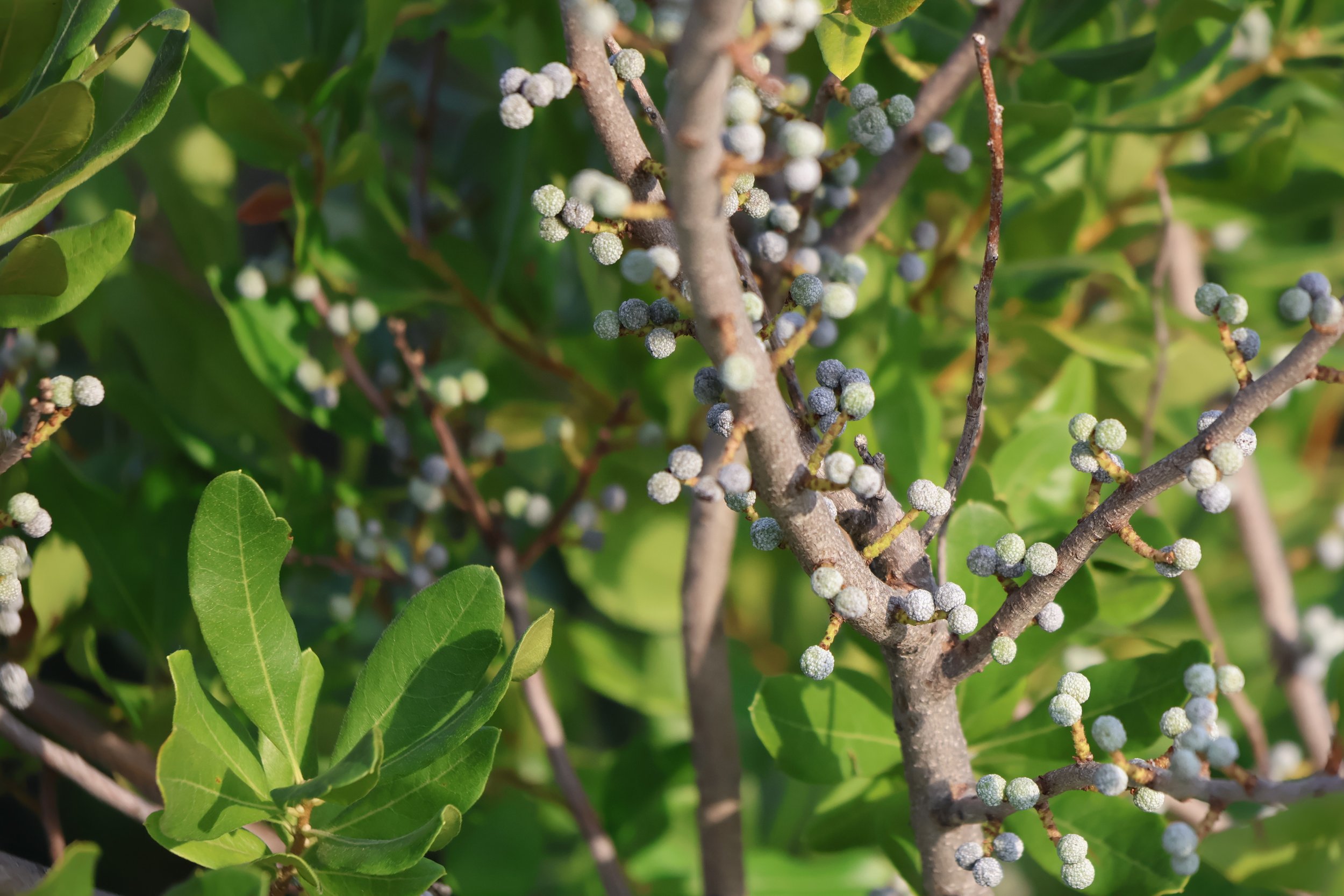
It grows 3 to 9 feet tall, often spreading into broad thickets through root sprouting. The leaves are leathery, aromatic, and semi-evergreen — staying on the branches well into winter in sheltered spots. In late spring, bayberry produces inconspicuous male and female flowers on separate plants (it is dioecious, meaning individual plants are either male or female). By late summer, fertilized female plants are studded with small, hard, blue-gray berries coated in a layer of pale, fragrant wax. These berries cluster tightly along the stems and persist through the winter and often into the following spring.
One of bayberry's most ecologically useful traits is invisible: its roots harbor colonies of nitrogen-fixing bacteria (Frankia spp.) in small nodules, allowing the shrub to extract usable nitrogen directly from the air. This lets bayberry colonize and thrive on the thin, acidic, nutrient-poor soils where most shrubs struggle — stabilizing shorelines, building soil fertility, and opening the way for other plants to follow.
Wabanaki Uses
For Wabanaki peoples, northern bayberry was both medicine chest and kitchen companion. The waxy berries were boiled and the aromatic wax skimmed from the surface of the cooling water — used as a salve for skin ailments, as a coating to help preserve stored foods, and as a material for small candles and torches. The fragrant leaves and bark were burned as incense and used in smudging, their scent carrying practical antibacterial properties alongside ceremonial significance.
The roots and inner bark were prepared as teas and decoctions for fevers, stomach ailments, and as an astringent for mouth and throat complaints. The aromatic leaves found use in flavoring food — a native equivalent of the bay leaf, used to season stews and preserved meats. Penobscot and Passamaquoddy peoples living along and near the St. George corridor understood bayberry as a plant that gave generously across seasons, asking very little of the soil it grew in.
Role in the St. George River Watershed
In the lower watershed and along the coast, northern bayberry thickets are important ecological anchors. Their dense structure provides nesting cover for gray catbirds, common yellowthroats, and towhees in summer. Come fall and winter, the waxy berries become critical food for a handful of bird species that have evolved the rare ability to digest bayberry wax — most notably the yellow-rumped warbler, which was long known as the "myrtle warbler" in honor of its relationship with this plant. Yellow-rumped warblers winter in remarkable numbers along the Maine coast precisely because bayberry allows them to survive when insects are unavailable. Tree swallows, hermit thrushes, and eastern bluebirds also rely on bayberry fruit through the colder months.
As a nitrogen fixer and shoreline stabilizer, bayberry performs soil-building services in the rocky, wind-exposed habitats of the peninsula that few other plants can provide. Old bayberry thickets often mark former clearings and pastures where the shrub was among the first to return — a record of land use history written in the landscape.
Seasonal Notes
Bayberry is a year-round presence in the lower watershed. Spring brings subtle catkin-like flowers, easy to miss but worth seeking out. Through summer, the berry clusters develop on female plants, and the thickets hum with nesting birds. Fall is when the gray-blue berries ripen and the first yellow-rumped warblers arrive from the north to find them. Winter finds the berries persisting on bare stems against gray skies — drab from a distance, but each one a small, waxy, fragrant package of stored energy for any bird that knows how to use it.
Fun Fact
Colonial settlers in New England learned to make bayberry candles from Indigenous peoples, and the practice spread widely through the 17th and 18th centuries. Bayberry candles burned cleaner and smelled far better than the tallow candles most households relied on — but the wax was costly to produce. It takes roughly four pounds of berries to yield a single pound of wax, meaning candle-making was a significant autumn labor. The tradition gave rise to a verse that some New England families still recite: "A bayberry candle burned to the socket puts luck in the home and gold in the pocket." Burning bayberry candles on Christmas Eve or New Year's Eve for good fortune is a custom that quietly persists along this coast to this day.
Want to Learn More?
- Native Plant Trust: Go Botany — Morella pensylvanica — Identification details, range maps, and habitat notes for New England.
- Maine Audubon — Yellow-rumped Warbler — More on the warbler most closely tied to bayberry and its remarkable winter ecology.
- USDA Plants Database — Morella pensylvanica — Range maps, taxonomy, and ecological data.
- Wabanaki Medicine and Moons Educators Guide — Maine Dept. of Education — Traditional Wabanaki knowledge of plant uses and seasonal relationships with the natural world.
The Living River blog series is published by St. George Consulting in support of the Georges River Land Trust and the Maine Council of Trout Unlimited. To explore the important work these organizations are doing to conserve and restore Maine's landscapes, visit georgesriver.org and tumaine.org.