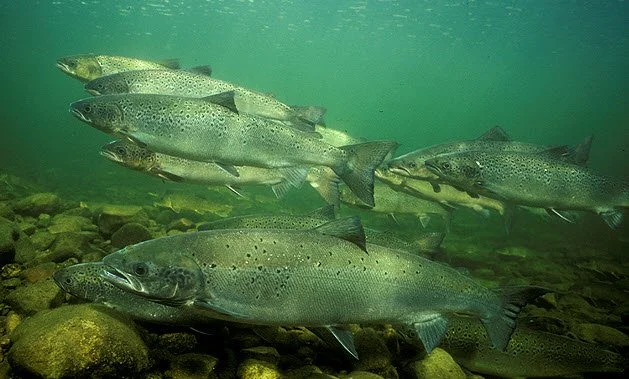
A Glacier's Gift: The Landlocked Salmon of Lake St. George
Georges River Land Trust — Living River Species Series
Introduction
At the headwaters of the St. George River watershed sits a cold, clear lake that holds one of Maine's most prized fish. Lake St. George, tucked into the hills of Liberty, is home to a population of landlocked salmon — sleek, powerful, cold-water predators that are, genetically speaking, Atlantic salmon that simply never got the memo about going to sea. They are a living relic of the last ice age, and they make our watershed a destination for anglers, naturalists, and anyone who finds wild things worth celebrating.
Natural History
Landlocked salmon (Salmo salar) are the same species as the Atlantic salmon that once ran up coastal rivers by the millions. When the glaciers retreated some 10,000 years ago, rising land cut certain inland lakes off from the sea, trapping salmon populations that adapted over millennia to life in freshwater year-round. In Maine, these fish are sometimes called Sebago salmon, after the lake where the strain was first formally described. In Quebec and among Wabanaki peoples, they are known as ouananiche — a name with deep roots in the Indigenous languages of the region.
Landlocked salmon require cold, well-oxygenated water throughout the year. In summer, they descend to the deepest, coldest layers of the lake where oxygen levels remain adequate. Their primary prey is the rainbow smelt — a small, silver forage fish without which landlocked salmon populations struggle. The relationship between salmon and smelt is one of the defining ecological partnerships in Maine's cold, deep lakes.
In fall, typically October and into November, landlocked salmon move into tributary streams to spawn on gravel beds. Males develop a slight hook to the jaw, called a kype, and both sexes deepen in color. After spawning, unlike Pacific salmon, they do not die — they return to the lake and can spawn multiple times over a lifespan of five to eight years. A large Lake St. George salmon might weigh four or five pounds, occasionally more.
Identification Tips
Landlocked salmon are sleek and silvery, with a deeply forked tail — unlike the nearly square tail of a brook trout — and small, irregular or X-shaped black spots scattered above the lateral line, never the red spots of a brook trout or the mixed black-and-orange spotting of a brown trout. The back runs steel-blue to olive, fading to bright silver sides and a white belly, giving the fish a distinctly metallic sheen even fresh from the water. Breeding males develop the hooked kype jaw and flush bronze-red along the flanks each fall. Because landlocked salmon are the same species as sea-run Atlantic salmon, the two look nearly identical; the surest way to separate a Lake St. George salmon from a brown trout sharing the same water is that deeply forked tail and the total absence of red spotting.
Wabanaki Uses
For Wabanaki peoples — particularly the Penobscot and Passamaquoddy nations — salmon were among the most important fish in the inland landscape. Known in Penobscot as plamu, salmon were harvested at falls, narrows, and spawning tributaries using weirs, dip nets, and spears. The fall spawning run made them especially accessible, and they were eaten fresh, smoked over alder and other hardwoods, and dried for winter storage. Salmon fat and flesh provided critical calories as the cold season set in. The fish held cultural and ceremonial significance as well — their return each season a marker of time and abundance in the Wabanaki year.
Maine IF&W and Lake St. George
Lake St. George supports one of Maine's most closely managed landlocked salmon fisheries. Maine Department of Inland Fisheries and Wildlife (IF&W) stocks the lake annually with hatchery-raised salmon, supplementing the wild population and sustaining a fishery that draws anglers from across the region. IF&W biologists monitor the lake regularly — tracking salmon growth, assessing smelt abundance, and adjusting stocking rates to keep the predator-prey relationship in balance.
This kind of active management matters. Landlocked salmon are sensitive to water quality, water temperature, and the health of the forage fish community. Maintaining a thriving salmon lake requires attention to the whole ecosystem — watershed health, shoreline integrity, water clarity, and the cold, deep-water habitat the fish depend on. In that sense, salmon are an indicator species: a healthy salmon population in Lake St. George is a sign that the larger watershed is functioning well.
Seasonal Notes
Winter brings ice anglers onto Lake St. George, where landlocked salmon are a prized quarry through the hard-water season. In early spring, as ice goes out, salmon move to shallower, warming water and feed aggressively — prime time for fly fishing and trolling. Summer finds them deep, following the cold layer below the thermocline and largely out of reach without specialized gear. Fall is the season of the spawn: watch for salmon rolling and finning in the mouths of inlet streams on cool October evenings, completing the cycle that has played out in this watershed for thousands of years.
Fun Fact
The landlocked salmon was designated Maine's official state fish in 1969 — a fitting tribute to a creature so closely tied to Maine's cold, clear lakes and the outdoor traditions built around them. It beat out the brook trout for the honor, though brook trout fans have never quite gotten over it.
Want to Learn More?
- Maine IF&W — Landlocked Salmon — Species biology, stocking reports, fishing regulations, and lake-specific data.
- Maine IF&W — Lake St. George Fish Stocking Records — Annual stocking data for lakes and ponds across Maine, including Lake St. George.
- Native Plant Trust: Go Botany — While focused on plants, an excellent companion resource for understanding the broader ecosystem salmon depend on.
- Wabanaki Medicine and Moons Educators Guide — Maine Dept. of Education — Traditional Wabanaki knowledge of seasonal relationships with fish, plants, and the natural world.
- Atlantic Salmon Federation — Landlocked Salmon — Conservation context and biology of Salmo salar across its range.
The Living River blog series is published by St. George Consulting in support of the Georges River Land Trust and the Maine Council of Trout Unlimited. To explore the important work these organizations are doing to conserve and restore Maine's landscapes, visit georgesriver.org and tumaine.org.