American Eel
The Long Way Home: The Remarkable Life of the American Eel
Georges River Land Trust — Living River Species Series
Introduction
There is a creature living in the St. George River right now that was born in the middle of the Atlantic Ocean, drifted thousands of miles on ocean currents as a transparent wisp of tissue, and then spent years — possibly decades — hunting in the dark beneath our riverbanks and lake bottoms. When its time finally comes, it will transform once more, find the sea again, and disappear into the deep to spawn and die without ever returning. The American eel (Anguilla rostrata) lives one of the most extraordinary lives of any animal on earth, and it does most of it quietly, invisibly, right here in our watershed.
Natural History
The American eel is the only catadromous fish in eastern North America — meaning it lives in freshwater but migrates to the ocean to reproduce, the reverse of salmon and alewives. Every American eel alive today was born in the Sargasso Sea, a warm, still region of the Atlantic east of Bermuda. After hatching, the leaf-shaped larvae drift on the Gulf Stream for months, slowly transforming into transparent "glass eels" as they approach the coast.
In spring, these tiny eels — now called elvers — pour into tidal rivers by the millions, pushing upstream with single-minded determination. They can even wriggle overland through wet grass on rainy nights to reach isolated ponds and streams. Once settled, they darken into the familiar yellow-brown "yellow eel" phase and begin years of nocturnal hunting — insects, worms, crayfish, small fish, and just about anything else they can find.
Females can grow to nearly four feet and live for twenty years or more. When the time finally comes to spawn, they transform one last time into "silver eels" — their eyes enlarge, their bellies turn silver, their digestive systems shut down — and they head downriver in autumn to begin the long journey back to the Sargasso Sea. They never return. Remarkably, no one has ever witnessed American eels actually spawning. We know where they go only because that's where the tiniest larvae are found.
Identification Tips
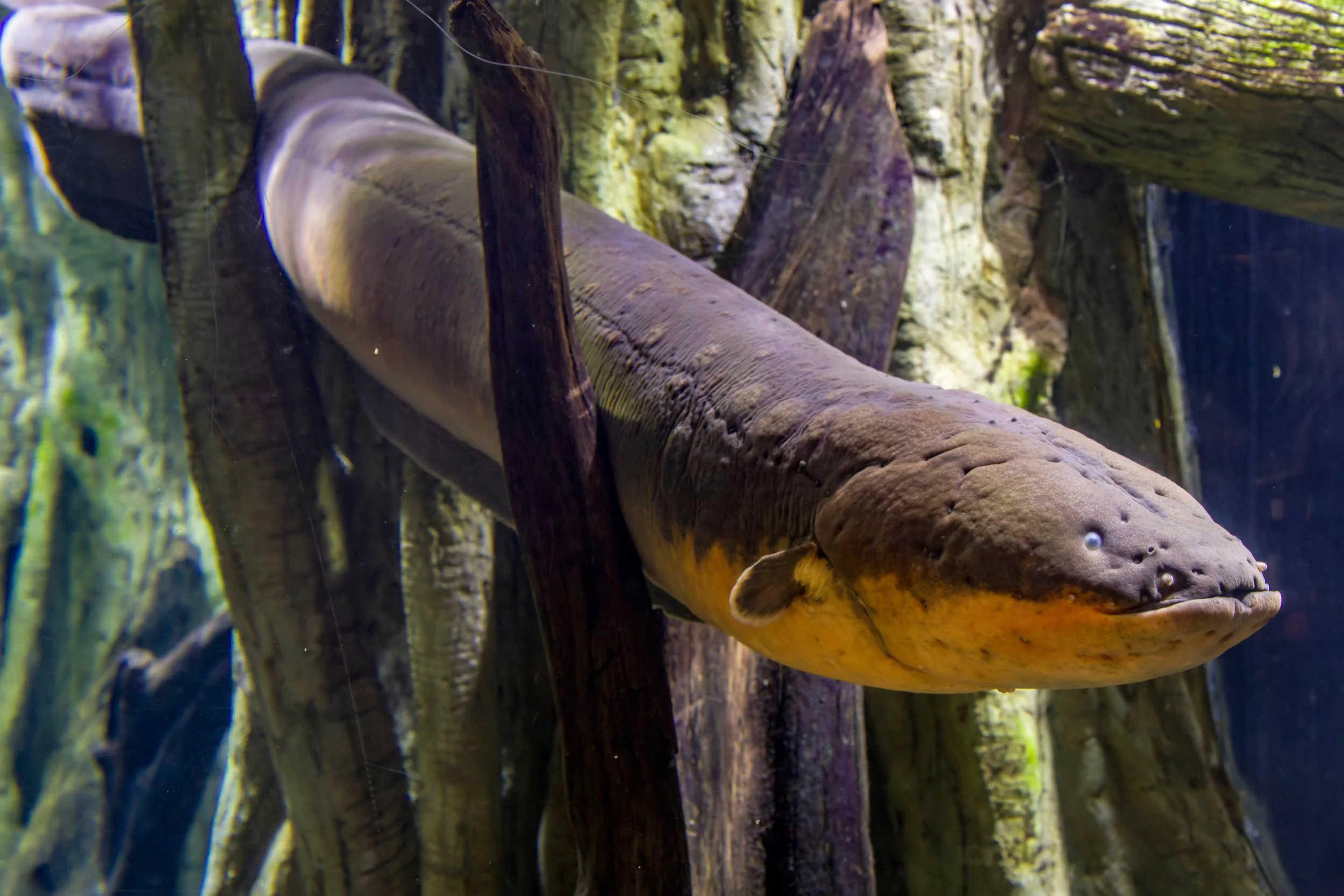
American eels are unmistakable once you know to look: a long, smooth, snake-like body with no pelvic fins and a single continuous fin running from midback around the tail to the vent, unlike any other fish in the watershed. The skin is slick and scaleless to the touch, colored olive-brown to yellow-green above and pale yellow below during the long resident "yellow eel" stage, shifting to a silver-bellied, bronze-backed sheen just before the adult's final migration to sea. Elvers — the tiny, nearly transparent young stage — are best looked for at dusk in April and May, wriggling upstream at the edges of culverts, dams, and fish ladders. Adult eels are almost entirely nocturnal, so a daytime sighting usually means one has been disturbed from a burrow in the mud or under a rock.
Role in the St. George River Watershed
Eels are active at every level of the St. George River's food web. As predators, they keep populations of invertebrates and small fish in balance. As prey, they are critically important to ospreys, great blue herons, river otters, striped bass, and other species. Their bodies, rich in fat and protein, transfer energy from river bottom to sky.
American eels are in serious decline across their range, and dams are a leading cause. Even modest barriers block the upstream migration of elvers. Efforts to restore eel passage — including eel ladders and dam removals — are part of the ongoing work to restore the ecological health of the St. George River and its tributaries. A river with a healthy eel population is a river with its connections intact.
Wabanaki Uses
For the Wabanaki peoples — Penobscot, Passamaquoddy, Maliseet, and Abenaki nations — the American eel was a prized and reliable food source throughout the seasons. Eels were harvested by spearing, by basket traps and weirs set at falls and narrows, and through the ice in winter, when eels buried in river sediment could be located and dug out. They were eaten fresh, smoked over fires, and dried for storage, providing important fat and protein through the long Maine winters.
Eel skin, strong and supple, was used for bindings and small leather goods. Eel oil was valued medicinally for its warming and lubricating properties. The relationship between Wabanaki communities and the eel stretched across generations and seasons — one of the most consistent threads in the food culture of this region long before European contact.
Seasonal Notes
In April and May, watch for elver runs at river mouths and fish ladders — the tiny eels are nearly invisible but can form dense, writhing aggregations. Through summer, adult eels are largely nocturnal and rarely seen, though they're active throughout the watershed. In September and October, "silver eels" move downstream on dark, rainy nights during their final migration — one of the most dramatic and least-watched wildlife events of the Maine autumn.
Fun Fact
Despite centuries of study, no one has ever seen American eels reproduce in the wild. Scientists have pieced together their life cycle largely through inference — tracking larvae, tagging adults, and reasoning backward from what washes up where. The full story of what happens in the deep, still waters of the Sargasso Sea remains one of the genuine unsolved mysteries of North American natural history.
Want to Learn More?
- Atlantic States Marine Fisheries Commission — American Eel — Stock assessments, management information, and life history overview from the primary regulatory body.
- Maine DMR: American Eel — Maine-specific information on eel biology, elver fisheries, and conservation efforts.
- NOAA Fisheries — American Eel Species Profile — Federal species profile with range maps, status, and habitat information.
- Wabanaki Medicine and Moons Educators Guide — Maine Dept. of Education — Traditional Wabanaki knowledge of plants, animals, and seasonal relationships, produced in partnership with tribal educators.
The Living River blog series is published by St. George Consulting in support of the Georges River Land Trust and the Maine Council of Trout Unlimited. To explore the important work these organizations are doing to conserve and restore Maine's landscapes, visit georgesriver.org and tumaine.org.