Horsetail
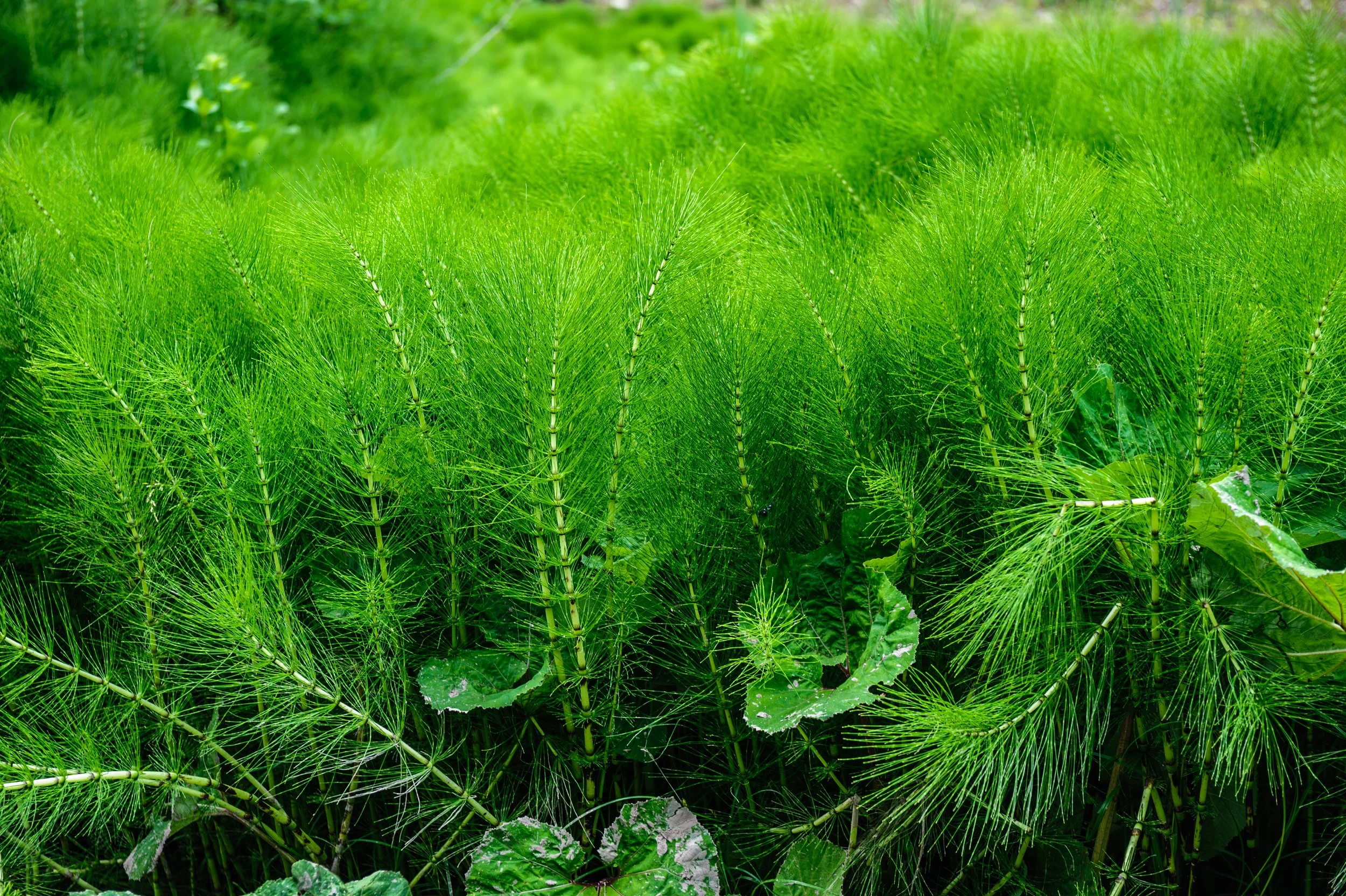
Before the Dinosaurs: Horsetail on the Banks of the St. George
Georges River Land Trust — Living River Species Series
Introduction
Pull on your rubber boots and walk the muddy margin where the St. George River meets a quiet marsh or wooded wetland edge, and you will almost certainly encounter a plant that was doing exactly this — standing in wet soil at water's edge — three hundred and fifty million years ago. Horsetail (Equisetum spp.) is one of the oldest living plant lineages on Earth. It watched the dinosaurs come and go. It is still here, jointed and green and quietly remarkable, looking much as it always has. For a plant that has seen so much, it is surprisingly easy to overlook.
Natural History
Equisetum is the sole surviving genus of an entire class of plants that once formed Carboniferous forests — some species growing forty feet tall, their compressed remains now part of the coal seams beneath our feet. Today's horsetails are modest by comparison, rarely exceeding three or four feet, but they carry the same essential architecture: hollow, jointed stems ringed at each node with whorls of slender branches. Run your finger along the stem and you feel a faint roughness — that is silica, deposited in the cell walls in quantities high enough that colonists once bundled the stems to scrub pots and smooth wood. Scouring rush (E. hyemale) earned its name honestly.
Several Equisetum species inhabit the St. George watershed. Water horsetail (E. fluviatile) grows directly in shallow water and marsh edges. Field horsetail (E. arvense) colonizes stream banks and disturbed wet soils. Scouring rush (E. hyemale) forms dense clumps in moist woods and stream margins, its unbranched stems persisting green well into winter.
These are not flowering plants. Equisetum reproduces by spores, released in spring from cone-like structures at the tips of fertile stems — a reproductive strategy unchanged since long before flowers existed. The spores are equipped with hygroscopic bands that coil and uncoil with changes in humidity, helping to disperse them on the wind.
Role in the St. George River Watershed
In the watershed's wetland margins, horsetails function as structural habitat — dense, persistent stands that provide cover, perching sites, and physical complexity in places where other vegetation is sparse or seasonally absent.
Dragonflies and damselflies use horsetail stems as emergence scaffolding in late spring and early summer, crawling up out of the water to split their nymphal cases and expand their wings. The stems are also favored perching sites for hunting adults — you are likely to find both species resting on horsetail on any warm July afternoon at the water's edge.
Wood frogs and spring peepers shelter in the dense base of horsetail stands during breeding season, and the stems provide cover for painted turtles navigating between basking sites and water. Muskrats feed on horsetail rhizomes through late summer and fall, digging through soft mud to reach the underground stems. Canada geese and wood ducks browse the tender young shoots in early spring.
Because horsetail rhizomes form deep, interconnected networks, the plants are effective bank stabilizers — holding saturated stream-margin soils in place during high water and protecting the clear, cool water conditions that brook trout, caddisfly larvae, and freshwater mussels depend on downstream.
Seasonal Notes
Equisetum is among the first plants to show green in the watershed, with fertile shoots of field horsetail emerging as early as late March — sometimes while frost still hardens the ground at night. Vegetative stems follow through April and May, deepening to rich green through summer. Scouring rush holds its color through November and into December, one of the few native plants still green at the river's edge after hard frost. A stand of horsetail in January, stiff and pale but upright, is worth a second look.
Fun Fact
The ancient forests dominated by giant horsetails collapsed and compressed over millions of years into the coal beds that fueled the Industrial Revolution. When you burn coal, you are, in a very literal sense, burning the compressed remains of Equisetum's ancestors. The plant standing at the edge of your favorite fishing pool is the last living branch of a lineage that once powered much of the modern world.
Want to Learn More?
- USDA Plants Database — Equisetum — Distribution maps and species profiles for all North American horsetail species.
- iNaturalist — Horsetails in Maine — Community sightings and photographs from New England observers.
- University of Maine Cooperative Extension — Wetland Plants — Identification and ecology of common Maine wetland plants.
- Paleobotany of Horsetails — University of California Museum of Paleontology — The deep history of the Equisetum lineage and its ancient relatives.
The Living River blog series is published by St. George Consulting in support of the Georges River Land Trust and the Maine Council of Trout Unlimited. To explore the important work these organizations are doing to conserve and restore Maine's landscapes, visit georgesriver.org and tumaine.org.