Blacknose Dace
Life in the Fast Lane: The Blacknose Dace
Georges River Land Trust — Living River Species Series
Introduction
If you want to find a blacknose dace (Rhinichthys atratulus), look where the water moves fastest. They are fish of the riffle — that tumbling, aerated, gravel-bottomed stretch of stream where the current breaks white over rocks and most other small fish find the going too difficult. Barely three inches long, marked with a bold dark stripe from snout to tail that gives them their name, blacknose dace are small enough to disappear against the streambed and tough enough to hold station in currents that would exhaust a much larger animal. They are among the most abundant native fish in the St. George watershed's tributary streams, and among the least celebrated. This is their moment.
Natural History
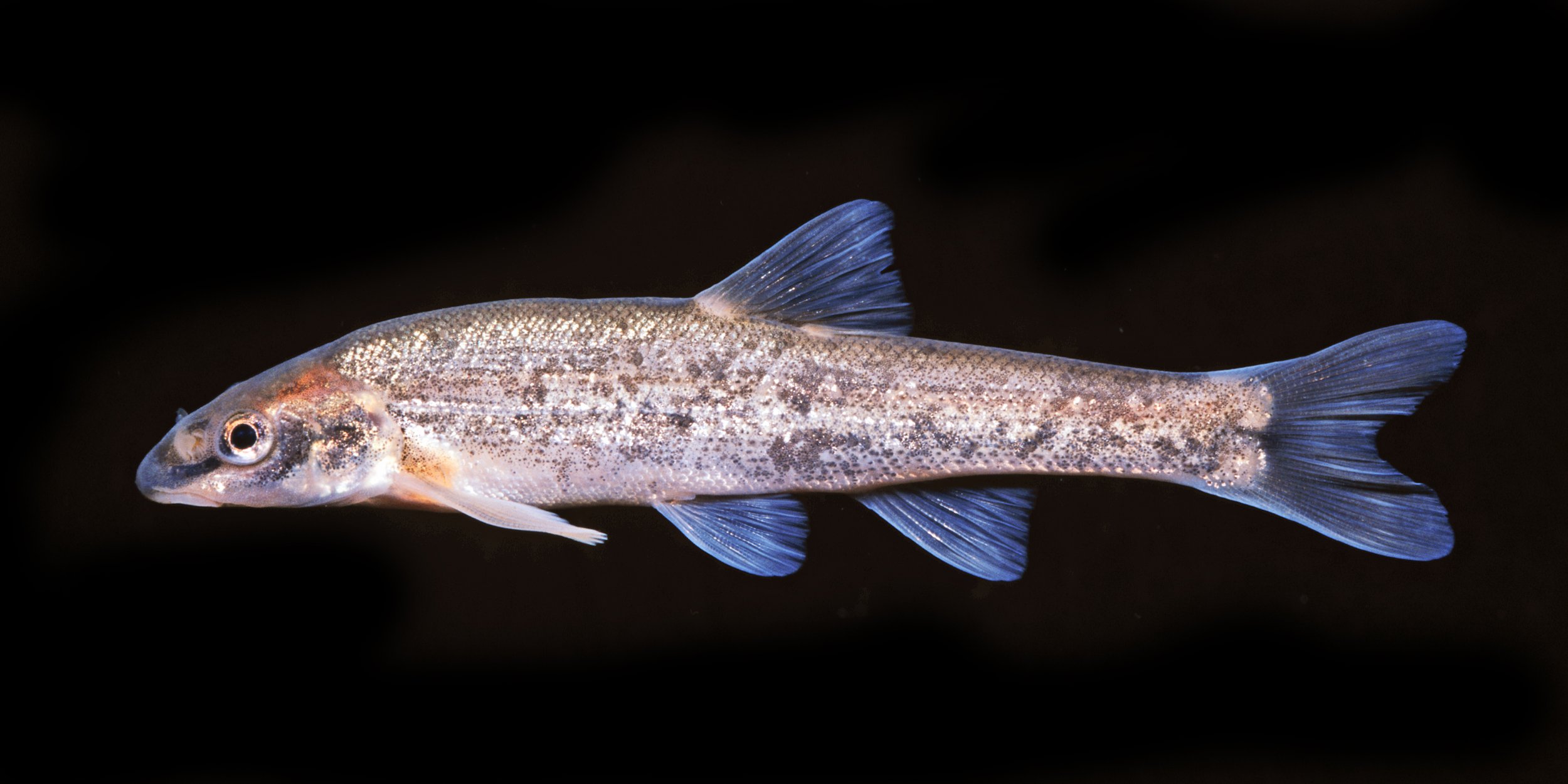
Blacknose dace are compact, fusiform fish built for fast water — slightly flattened on the underside, with a subterminal mouth positioned for feeding along the bottom. The signature dark lateral stripe runs from the tip of the snout through the eye all the way to the base of the tail, bold enough to identify the fish at a glance even through moving water. Adults typically reach two to three and a half inches; four inches is large for the species.
For most of the year they are quietly patterned in olive, brown, and silver. But in late spring and early summer, breeding males flush dramatically — their sides brightening with orange-red along the lateral stripe, their fins warming with color. It is a transformation easy to miss if you aren't looking, but striking once you know to watch for it, especially in a sunlit riffle where the males compete with one another in the shallows.
They feed primarily along the streambed, grazing on algae, diatoms, and the biofilm that coats submerged rocks, and supplementing this with midge larvae, blackfly larvae, mayfly nymphs, and other small invertebrates found in the gravel and cobble. This bottom-grazing habit distinguishes them ecologically from the common shiner, which feeds more in the water column — the two species often share the same stretch of stream while exploiting different parts of it.
Spawning occurs in late May and June in gravelly riffles. Unlike the common shiner, which borrows the nests of creek chubs, blacknose dace scatter eggs loosely over gravel without building or defending a nest. The eggs settle into the spaces between stones, where the well-oxygenated flow of the riffle keeps them clean and viable.
Identification Tips
Blacknose dace are small, thickset minnows — two to three and a half inches — with a bold, unmistakable dark stripe running from the snout through the eye to the base of the tail, the clearest field mark of any small fish in the watershed. The mouth sits low and slightly underneath the snout (subterminal), built for grazing algae off rocks rather than feeding at the surface, which also helps separate it from the common shiner's more upturned mouth. Look for them holding low in the fastest, most turbulent parts of riffles, often in loose aggregations behind cobble — a habitat few other small fish tolerate. In late spring, breeding males brighten with orange-red along the lateral stripe, a subtler flush than a shiner's but visible up close in a sunlit riffle.
Role in the St. George River Watershed
The blacknose dace holds two distinct ecological roles in the watershed — as a grazer of the streambed and as a critical forage fish for larger predators — and both matter.
As a grazer, it performs a function more commonly associated with invertebrates: regulating the growth of algae and periphyton (the complex community of algae, bacteria, and organic matter that coats stream rocks). By cropping this biofilm, dace help prevent the kind of algal overgrowth that can reduce oxygen levels and degrade stream habitat. In clean, fast-water streams, this grazing pressure is a quiet but meaningful part of what keeps the streambed healthy.
As forage, blacknose dace are absolutely central to the diet of brook trout in the smaller, upper tributaries of the St. George watershed. In streams too small or too fast for many other forage fish, dace are often the primary fish prey available to trout. Brown trout and landlocked salmon take them as well. Belted kingfishers and common mergansers hunt them in riffles, and great blue herons wade the shallower runs where dace concentrate.
The dace's preference for the fastest, most oxygenated water in the stream means it shares its habitat with stonefly and mayfly nymphs — the most sensitive of aquatic invertebrates, which require clean, cold, well-oxygenated conditions to survive. Finding healthy blacknose dace populations alongside diverse stonefly communities is a strong signal that a tributary's headwaters are genuinely pristine.
Mink and water shrews — the latter a surprisingly fierce and rarely seen mammal of the streambank — hunt dace and other small fish in the riffles, navigating swift current with startling agility. The presence of a healthy dace population supports these predators at the stream's edge the same way alewives and smelt support larger predators in the main river.
Seasonal Notes
Blacknose dace are active year-round, moving little even in winter — a small fish in a fast riffle loses less heat than one in slow water, and the streambed offers shelter from the current. Breeding color in males peaks in late May and June. Feeding activity increases through spring and summer as aquatic insect production rises. On warm summer afternoons, small aggregations of dace are often visible holding in the lee of larger rocks in riffles, darting out to intercept drifting invertebrates.
Fun Fact
Blacknose dace are one of the most widely used bioassessment indicator species in stream monitoring. Because they are sensitive to sedimentation, warming, and chemical pollution but abundant in clean water, biologists use their presence, abundance, and condition to grade stream health across thousands of monitoring sites in the northeastern United States. In a sense, the dace are doing water quality monitoring for us — constantly, for free.
Want to Learn More?
- Maine IF&W — Freshwater Fishes of Maine — Native fish species biology and distribution across Maine's watersheds.
- FishBase — Blacknose Dace — Species database with range maps, ecology, and biological detail.
- USGS — Nonindigenous Aquatic Species — Distribution and ecology of blacknose dace across North America.
- Maine Rivers — Advocacy and education around Maine's river health, including the tributary streams where dace thrive.
The Living River blog series is published by St. George Consulting in support of the Georges River Land Trust and the Maine Council of Trout Unlimited. To explore the important work these organizations are doing to conserve and restore Maine's landscapes, visit georgesriver.org and tumaine.org.