Freshwater Mussels
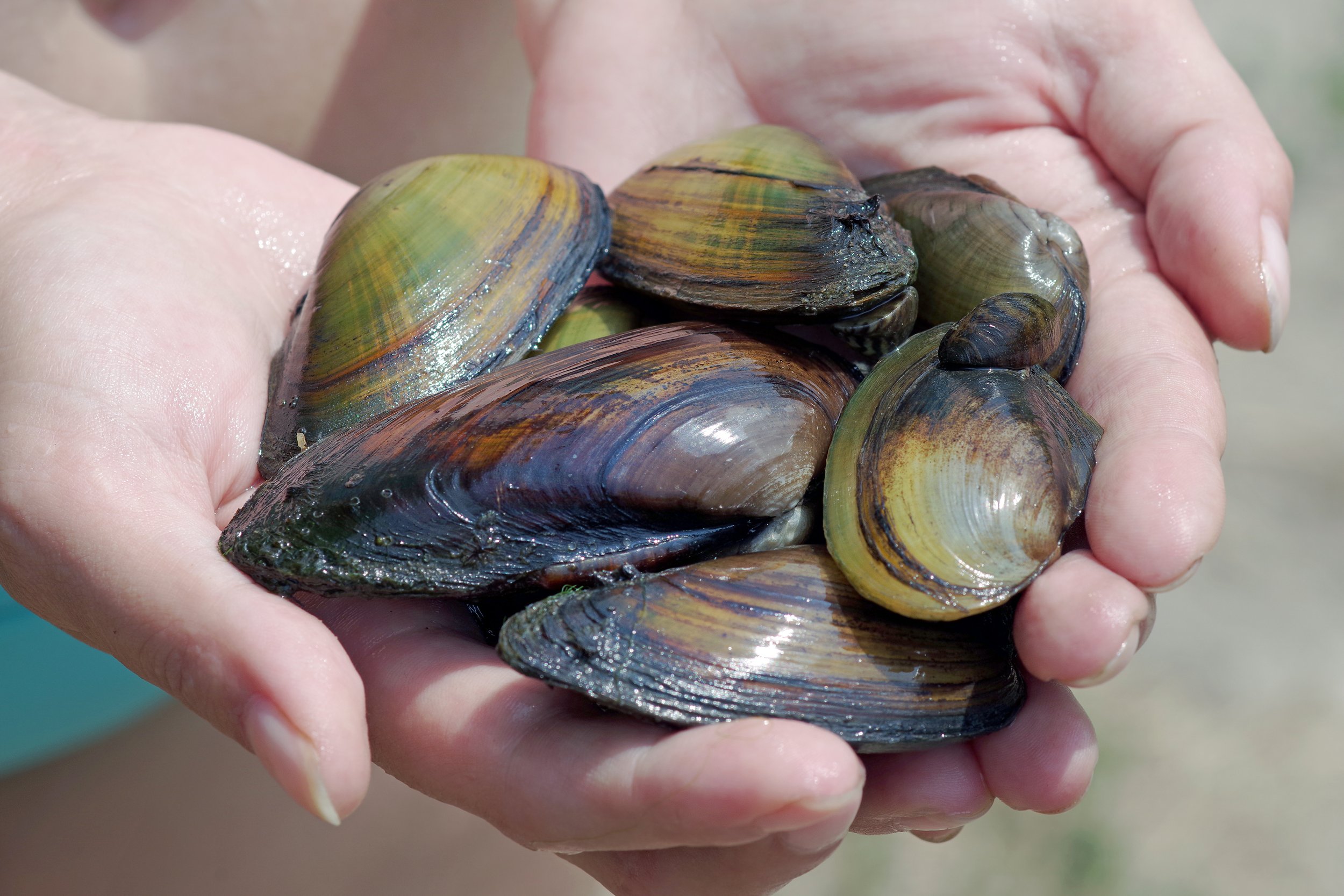
Hidden Gems of the River Bottom: Freshwater Mussels of the St. George
Georges River Land Trust — Living River Species Series
A Living Filter Beneath the Surface
They don't sing, sprint, or bloom, but freshwater mussels may be the St. George River's most quietly extraordinary residents. Tucked into sandy and gravelly streambeds, these ancient bivalves have been filtering our river water for millennia — and a few of the species living right here are among the rarest in the entire Northeast.
Maine is home to ten native species of freshwater mussels, and the St. George River watershed is one of the few places in the state where three threatened species share the same water. That makes this river genuinely special.
Natural History: Ancient and Ingenious
Freshwater mussels are bivalves — two-shelled mollusks related to clams and oysters — but they lead lives far stranger and more fascinating than their humble appearance suggests.
They are filter feeders, drawing water through their gills to extract algae, bacteria, and fine organic particles. A single mussel can filter several gallons of water per day. In a healthy river, a colony of mussels acts like a living water treatment plant, clarifying the flow and cycling nutrients back into the ecosystem.
But the truly astonishing part of their life story is reproduction. Mussel larvae, called glochidia, can't develop on their own — they must spend time as parasites on the gills or fins of a specific host fish. The Yellow Lampmussel has evolved a remarkable trick to get the job done: the fleshy edge of its mantle mimics a small fish, complete with a convincing eye-spot, to lure in a host. When a curious fish investigates, the mussel releases a cloud of larvae. It sounds dramatic, and it is.
Once the larvae drop off their host, they settle into the riverbed and begin their slow, quiet lives. Many freshwater mussels live for decades; some species reach 100 years or more.
Identification Tips
Freshwater mussels are elongated, oval-to-teardrop-shaped bivalves partly or fully buried in sand or gravel streambed, usually with just the shell's posterior edge visible or slightly gaping above the substrate. Shell color and shape help narrow down species: the yellow lampmussel shows a smooth, warm yellowish-brown shell, the tidewater mucket a similar size with a more bronze tone, and the brook floater a smaller, olive-brown shell with a somewhat irregular, sculpted surface. Live mussels typically sit at a slight angle with the hinge down and the growing edge up, unlike empty shells, which lie flat or are found scattered loose on the bottom or bank. Because Maine's rarest mussel species are protected and easily damaged by handling, the best identification approach is to look without touching or lifting them from the streambed.
The St. George's Rarest Residents
Three species found in the St. George River are listed as Threatened under the Maine Endangered Species Act:
Yellow Lampmussel (Lampsilis cariosa) — Up to five inches long with a warm yellowish shell. In Maine, it is found only in the Penobscot, St. George, and lower Kennebec River watersheds.
Tidewater Mucket (Leptodea ochracea) — Similar in size to the Yellow Lampmussel, with a more bronze-toned shell. It shares the same narrow Maine range.
Brook Floater (Alasmidonta varicosa) — Smaller, olive-brown, and considered one of the rarest freshwater mussels in the entire Northeast.
The fact that all three live here is a testament to the St. George's relative health — and a reminder of how much is at stake. Nationwide, more than a third of North America's nearly 300 freshwater mussel species have already disappeared or are at risk of extinction, largely due to dams, water pollution, and the loss of clean, free-flowing rivers.
The Wabanaki and the River's Mussels
Long before European settlement, the rivers of Midcoast Maine were home to the Wabanaki peoples — including the Penobscot, Passamaquoddy, Maliseet, and Mi'kmaq nations — who traveled, fished, and gathered throughout these watersheds across the seasons.
Freshwater mussels were part of that relationship with the river. Archaeological evidence from interior river sites shows mussel shells among food remains, and the sturdy shells were fashioned into practical tools — scrapers, small spoons, and other implements. Coastal shell middens also preserve a rich record of how deeply intertwined Wabanaki people were with the mollusks of their waters.
That long history of careful stewardship is part of why rivers like the St. George still support rare species today.
Seasonal Notes
Mussels are year-round residents, but late summer is when mussel-watching (or rather, mussel-finding) is easiest. Low water levels in July and August expose shallow riffles where mussels sometimes lie partially visible in the gravel. Look, but please don't disturb — these animals are slow to recover from disturbance, and some of those shells belong to animals that have been in that spot for decades.
Fun Fact
The Yellow Lampmussel's fish-luring mantle display is so convincing that it can fool even experienced naturalists at first glance. Evolution, it turns out, is a patient and brilliant artist.
Learn More
- Maine IFW — Rare Freshwater Mussels
- Maine IFW — Freshwater Mussels of Maine (poster/species guide)
- NRCM Creature Feature: Yellow Lampmussel
- Lakes of Maine — Freshwater Mussels
- St. Georges River Focus Area — Maine Natural Areas Program
- UMaine Hudson Museum — Maine's Shell Middens
The Living River blog series is published by St. George Consulting in support of the Georges River Land Trust and the Maine Council of Trout Unlimited. To explore the important work these organizations are doing to conserve and restore Maine's landscapes, visit georgesriver.org and tumaine.org.