Cattails
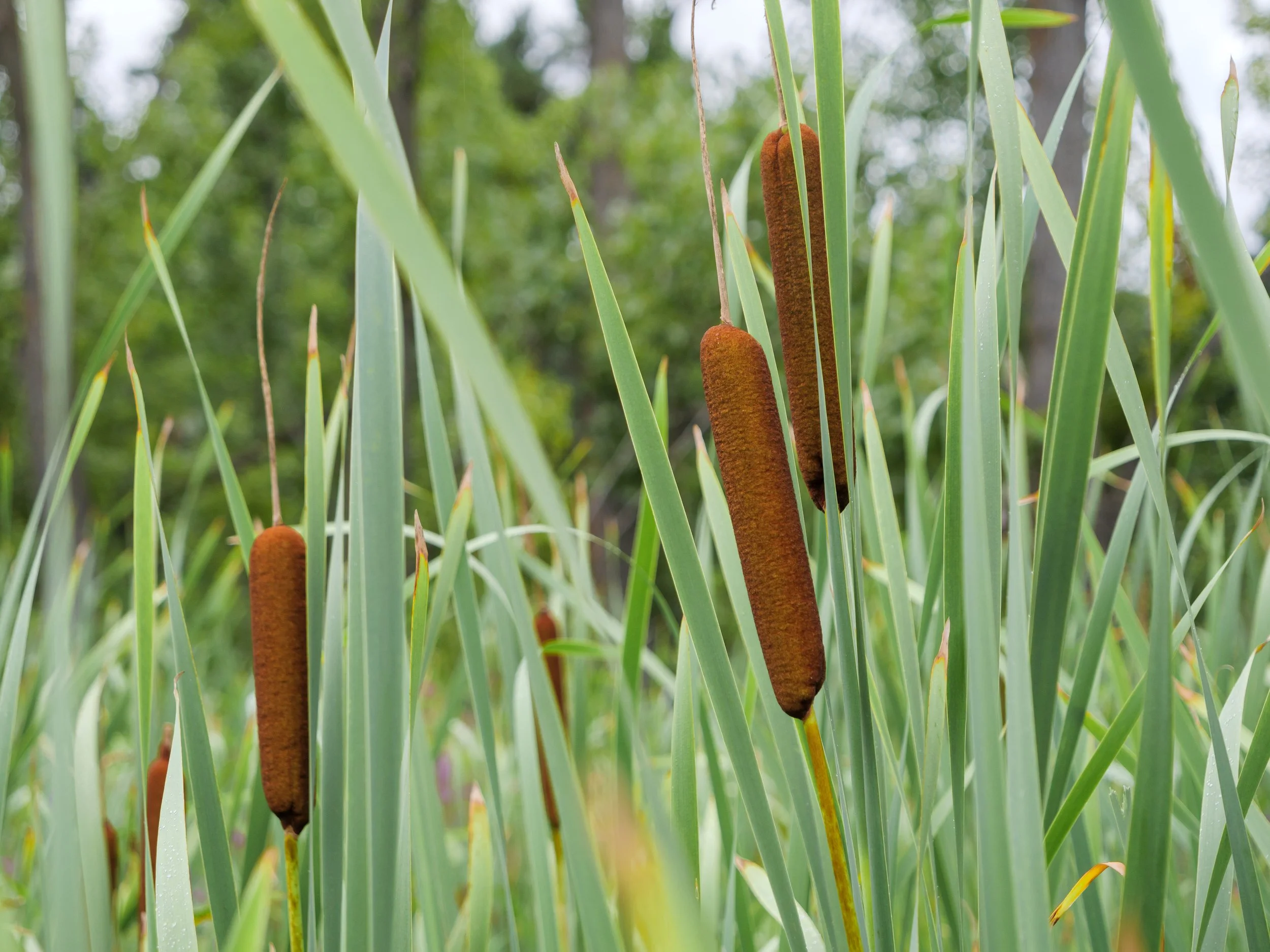
The Marsh's General Store: The Cattail
Georges River Land Trust — Living River Species Series
Introduction
There is no more recognizable wetland plant in Maine than the cattail. Those brown, velvety cylinders on stiff stalks — poker-straight above the waterline, rising from a dense stand of flat green leaves — are a universal shorthand for "marsh." Children poke them. Artists paint them. Most people have seen them their entire lives and never thought much about them. That's a shame, because the cattail is one of the most productive, useful, ecologically valuable, and genuinely fascinating plants in the entire watershed. Once you know what you're looking at, you'll never drive past a cattail marsh the same way again.
Natural History
Two cattail species grow in the St. George watershed, sometimes side by side. Broad-leaved cattail (Typha latifolia) is native and the more common of the two, with leaves up to an inch wide and a dense brown seed cylinder that sits flush against the male flower stalk above it. Narrow-leaved cattail (Typha angustifolia) has slender leaves and a small gap between its male and female flower portions. The two species hybridize freely, producing Typha × glauca, a highly vigorous hybrid that can spread aggressively and crowd out other wetland plants — a reminder that even familiar natives can become ecologically complicated.
The familiar brown "cattail" is actually a densely packed spike of thousands of tiny female flowers, each attached to a tuft of silky fiber. Above it, the thin bare stalk is where the male flowers once were — they produce clouds of bright yellow pollen in early summer, then wither and fall away. Each spike can carry up to 300,000 seeds, and when it finally breaks apart in fall and winter, the marsh erupts in slow-motion blizzards of fluff that drift for miles.
Cattails spread most aggressively not by seed but underground, through a dense network of thick rhizomes that can extend the colony several feet in a single season. A stand that fills a cove today may have started from a single plant not many years ago.
Identification Tips
Cattails are identified at a glance by their tall, straight stalks topped with a dense, velvety brown cylindrical seed head, rising above long, flat, sword-like leaves from the base. Broad-leaved cattail has leaves nearly an inch wide and a seed spike that sits flush against the thinner male flower spike directly above it; narrow-leaved cattail has slimmer leaves and a visible gap of bare stem between the male and female flower portions. In early summer, look for the male flower spike still intact above the brown female portion, dusted with yellow pollen, before it withers and falls away by midsummer. By fall and winter, the brown cylinder frays and releases cottony white seed fluff, a stage that makes cattail identifiable even at a distance across a frozen marsh.
Wabanaki Uses
Of all the plants in the watershed, few were as comprehensively useful to Wabanaki peoples as the cattail. It was, in a very real sense, a general store that was open in every season.
In spring, the young shoots emerging from the water were eaten like asparagus — crisp, mild, and nourishing after a long winter. As summer approached, the green, unripe female flower heads were roasted or boiled and eaten much like corn on the cob. When the male flowers opened and released their pollen, the bright yellow powder was collected in quantity and mixed into breads, porridges, and cakes, adding protein and a golden color. The starchy rhizomes were harvested year-round — dried, pounded into flour, or roasted whole — providing a reliable carbohydrate when other foods were scarce.
Beyond food: the broad leaves were woven into sleeping mats, baskets, and storage containers that were both flexible and waterproof when green. The silky seed down insulated clothing, lined cradle boards, and served as absorbent padding. The pale gel found between young leaves was applied directly to wounds, burns, and skin irritations, a soothing treatment that functions much like aloe. Among the Penobscot, Passamaquoddy, and Abenaki nations, the cattail was among the most versatile plants in the material and medicinal toolkit.
Role in the St. George River Watershed
Cattail marshes along the St. George River and its tributaries are among the most biologically productive habitats in the watershed. Their dense stands provide nesting cover for red-winged blackbirds, marsh wrens, and American bitterns — species that depend almost entirely on emergent marsh vegetation to breed. Common yellowthroats, swamp sparrows, and Virginia rails work the edges. Muskrats eat the rhizomes and leaves and weave entire lodges from cattail material; river otters and mink hunt the muskrats in turn.
Beneath the surface, cattail roots stabilize soft shoreline soils against erosion and filter nutrients and sediment from agricultural and residential runoff before it reaches open water. This filtering function makes cattail marshes a first line of defense for water quality in the watershed — natural infrastructure that no engineered system can fully replicate.
Seasonal Notes
Spring brings the new shoots, and early gatherers — human and wildlife alike — know to look for them. By early summer, the green, unripe seed heads are developing, and the male flowers at the top of the stalk dust everything nearby with yellow pollen. Through late summer, the familiar brown cylinders deepen and firm. Come fall and winter, the stalks dry and the seed heads begin to unravel in the wind, releasing their down across the marsh and beyond. The persistent brown stalks remain visible all winter, marking the marsh even under snow.
Fun Fact
During World War II, when Japanese forces controlled Southeast Asia and cut off the U.S. supply of kapok — the tropical fiber used to stuff life jackets and flight suits — the U.S. government turned to cattail down as an emergency substitute. American schoolchildren were organized into collection brigades, gathering cattail seed heads from marshes across the country. Millions of life jackets were stuffed with cattail fluff before the war's end. The marsh plant that lines the edges of the St. George River helped keep sailors and airmen afloat.
Want to Learn More?
- Native Plant Trust: Go Botany — Typha latifolia — Identification details, range maps, and habitat notes for New England.
- Maine DEP: Wetlands and Water Quality — The role of freshwater wetlands in Maine's landscape and regulatory protections.
- Wabanaki Medicine and Moons Educators Guide — Maine Dept. of Education — Traditional Wabanaki knowledge of seasonal plant use and relationships with the natural world.
- USDA Plants Database — Typha latifolia — Range maps, taxonomy, and ecological data for broad-leaved cattail.
The Living River blog series is published by St. George Consulting in support of the Georges River Land Trust and the Maine Council of Trout Unlimited. To explore the important work these organizations are doing to conserve and restore Maine's landscapes, visit georgesriver.org and tumaine.org.