Beaver
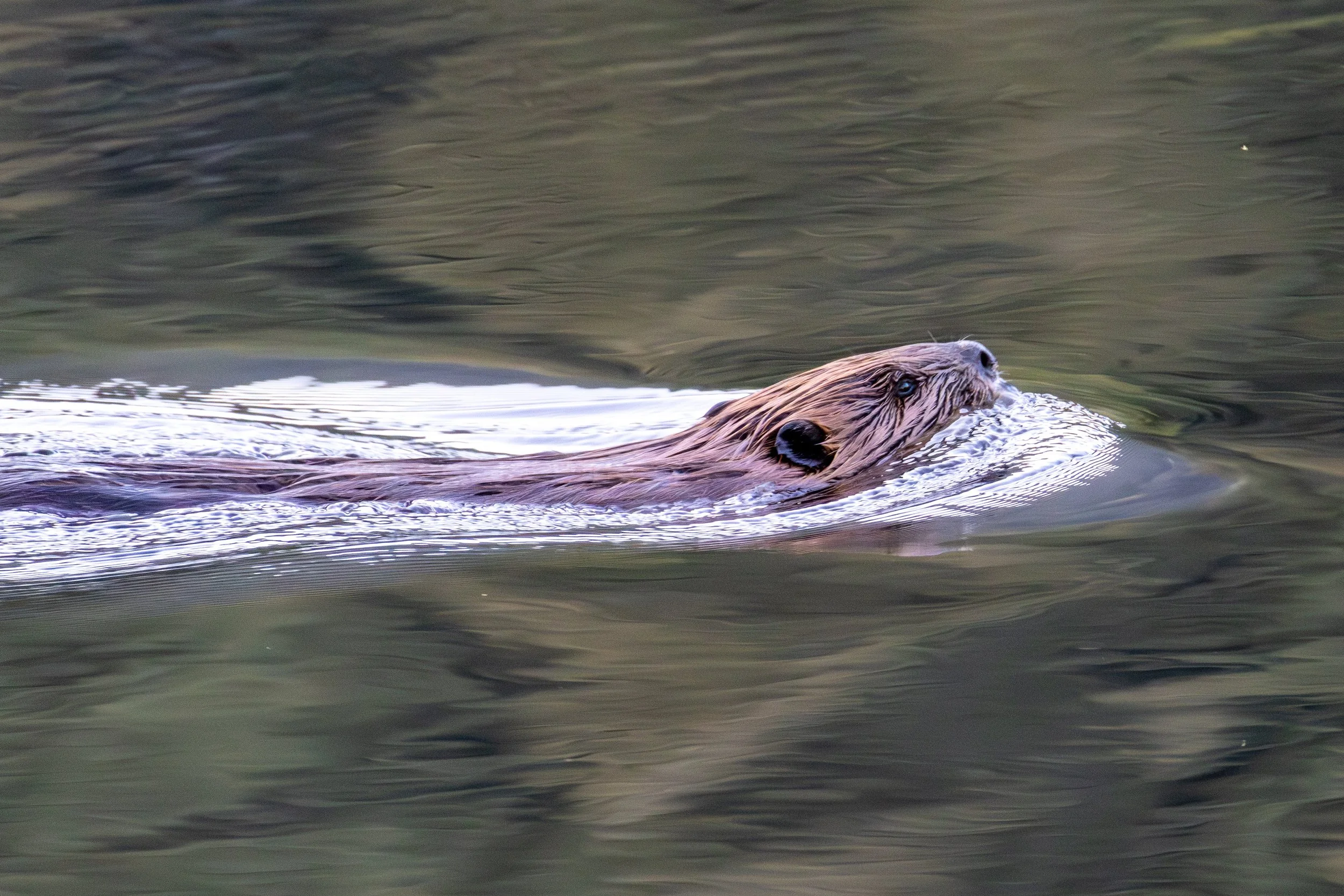
The Engineer Next Door: The American Beaver
Georges River Land Trust — Living River Species Series
Introduction
No wild animal reshapes the landscape of the St. George River watershed quite like the American beaver (Castor canadensis). Where a beaver colony moves in, a stream becomes a pond, a pond becomes a wetland, and a wetland becomes one of the richest habitats in the entire watershed — alive with ducks, herons, frogs, dragonflies, otters, and dozens of other species that had nowhere to live before a family of large rodents decided to build a dam. The beaver is what ecologists call a keystone species: remove it, and the whole arch of the ecosystem it supports comes down. Leave it alone, and it does more for the health of a river than almost anything else.
Natural History
The American beaver is the largest rodent in North America, with adults typically weighing between 35 and 60 pounds and occasionally exceeding 70. They are built for a life divided between land and water: dense, waterproof fur; a broad, flat tail that acts as a rudder while swimming and a prop while sitting upright to gnaw; large webbed hind feet; and front paws nimble enough to manipulate sticks and pack mud with surprising precision. They can stay submerged for up to 15 minutes and swim at speeds that make them nearly uncatchable in the water, even by otters.
Their most recognizable feature is the teeth. A beaver's incisors are bright orange — the color comes from iron compounds in the enamel, which make the cutting edge exceptionally hard. The back of each tooth is softer and wears away faster, creating a self-sharpening chisel that never stops growing throughout the animal's life. A beaver can fell a 5-inch-diameter tree in minutes and will tackle much larger ones when motivated.
Despite all that wood-cutting, beavers don't eat wood — they eat the soft inner bark and cambium layer beneath it, along with aquatic plants, grasses, and leaves. Aspen, alder, birch, and willow are favorites. In fall, they cut and cache branches underwater near the lodge entrance, creating a submerged food supply they can access all winter without ever leaving the water.
Beavers mate for life and live in family groups — a breeding pair, the current year's kits (usually two to four, born in May or June), and often the yearlings from the previous litter who stay on to help raise the new arrivals. The family maintains a lodge of sticks and mud with underwater entrances, rendering it nearly impenetrable to predators.
Identification Tips
American beavers are large, thickset rodents easily told apart from muskrats by size and tail: a beaver's tail is broad, flat, and paddle-shaped, while a muskrat's is thin, ratlike, and whips side to side when swimming. Adult beavers commonly weigh 35 to 60 pounds, dwarfing a muskrat's two to four. Fur is a rich chestnut to blackish-brown, dense and glossy when dry. Look for bright orange incisors, visible when a beaver is feeding or grooming, and for the unmistakable signs of their presence on the landscape — dams, lodges of piled sticks and mud, conical-cut stumps with visible tooth marks, and cached branches poking above a pond's surface near the lodge. A beaver swimming low in the water with only the head and back visible, and a loud tail-slap on the surface when startled, are both reliable field cues.
Role in the St. George River Watershed
Beaver activity is woven throughout the St. George watershed, and its effects are overwhelmingly positive for biodiversity and watershed function. When beavers dam a stream, the resulting pond slows water flow, raising the water table in surrounding soils and creating wetland habitat that the landscape would otherwise lack. Beaver wetlands trap sediment, filter nutrients, and reduce the flashiness of streams during heavy rain — natural flood control built one stick at a time.
The habitat complexity a beaver pond creates is remarkable. Open water, emergent marsh, shrubby edges, and standing dead timber (drowned trees killed by flooding) provide niches for wood ducks, great blue herons, river otters, mink, painted turtles, wood frogs, countless invertebrates, and cavity-nesting birds like woodpeckers that depend on the snags. When a beaver colony eventually abandons a site, the drained pond becomes a rich, flat meadow — "beaver meadows" that are among the most botanically diverse spots in the northeastern forest.
For a land trust focused on watershed health, active beaver colonies are, in a very real sense, partners.
Seasonal Notes
Beavers are active year-round in Maine and do not hibernate. Fall is their busiest season — through September and October, colonies work intensively to reinforce dams and lodges and build up their underwater food cache before freeze-up. This is when fresh gnawing stumps and new dam work are easiest to spot. Winter finds them moving beneath the ice between lodge and food pile, rarely visible but very much present. Spring brings kits and, often, new dam construction as families expand. Summer evenings — the hour before dark along a quiet beaver pond — are among the best times to watch them working the surface in the fading light.
Fun Fact
By the early 1800s, the American beaver had been almost completely wiped out from Maine and much of New England, trapped to near-extinction for the European fur trade. At the peak of the fur trade era, millions of beaver pelts were shipped across the Atlantic each year, primarily to be felted into fashionable hats. The recovery of beaver populations over the past century — driven by trapping regulations, reintroduction programs, and the regrowth of eastern forests — is one of the great conservation success stories of North America. The wetlands being created in the St. George watershed right now are in many ways a second chance, centuries in the making.
Want to Learn More?
- Maine IF&W — American Beaver — Species biology, habitat management, and coexistence resources from Maine's wildlife agency.
- Rethink the Myth: Beavers as Restoration Tools — National Wildlife Federation — An accessible look at how beaver reintroduction is being used for watershed restoration across the country.
- Beaver Institute — A nonprofit dedicated to beaver coexistence, with practical resources for managing beaver activity near roads and culverts.
- Maine Audubon — Wetlands and Wildlife — Broader context on the role of wetlands in Maine's landscape and the wildlife that depends on them.
The Living River blog series is published by St. George Consulting in support of the Georges River Land Trust and the Maine Council of Trout Unlimited. To explore the important work these organizations are doing to conserve and restore Maine's landscapes, visit georgesriver.org and tumaine.org.