Double-crested Cormorant
The River's Black Diver: Double-crested Cormorant of the St. George
St. George Consulting — Living River Series
A Bird That Looks Like It Means Business
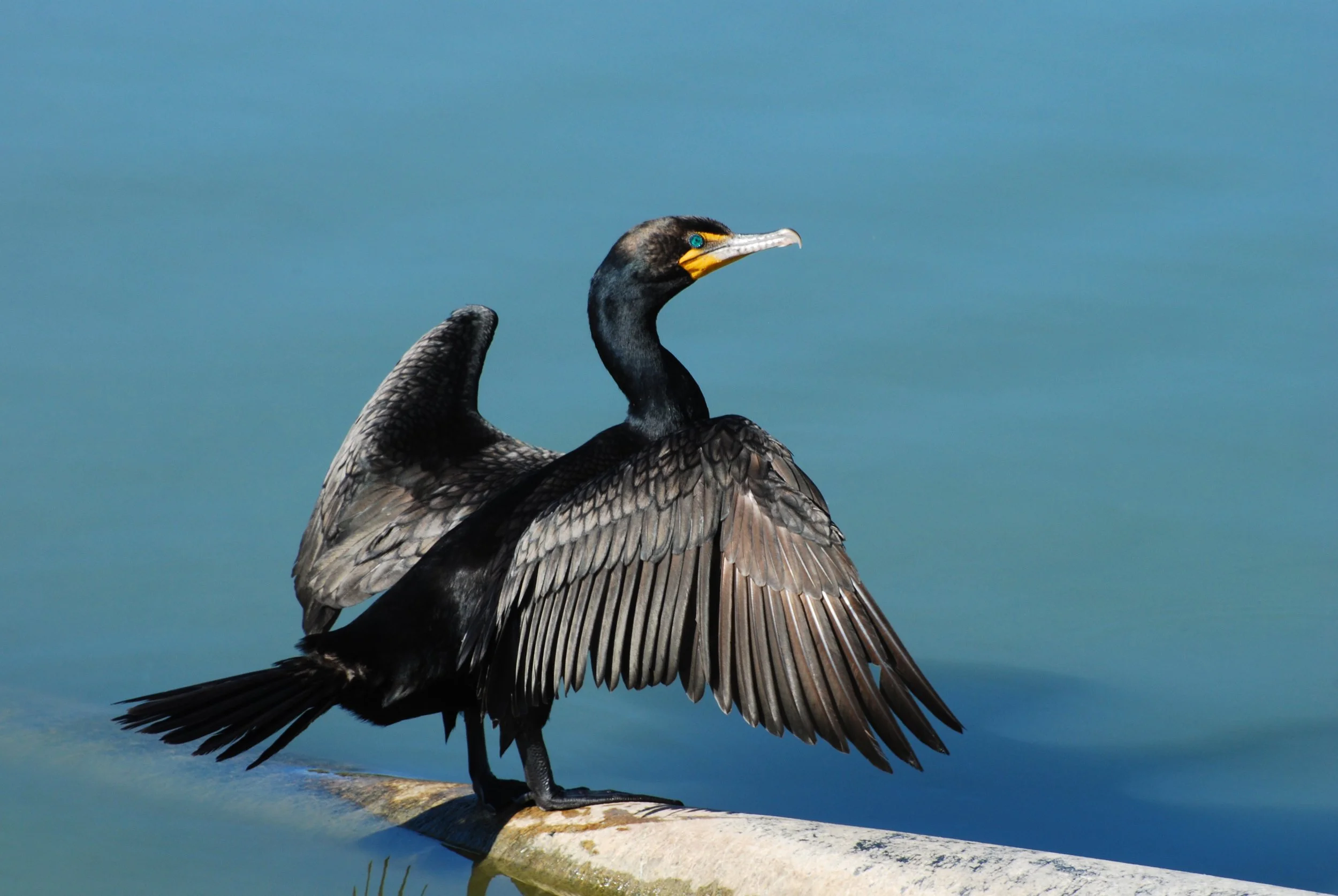
There's something almost prehistoric about a cormorant. Standing upright on a rocky ledge or a snag jutting from the river, wings spread wide to dry in the sun, it looks like a creature that has been doing this for a very long time — and it has. The double-crested cormorant (Nannopterum auritum) is one of North America's most successful waterbirds, and along the St. George River and its tidal reaches, it is a familiar and quietly impressive presence.
Not everyone loves the cormorant. It has a reputation for eating a lot of fish, which puts it at odds with some anglers. But spend a little time watching one — watching it surface dive with improbable grace, shake the water from its feathers, and tilt its bright orange-throated face toward the sky — and it's hard not to come around.
Natural History: Designed to Go Deep
The double-crested cormorant is a large, dark waterbird — roughly the size of a small goose — with black plumage that shimmers greenish in good light, a long neck built for chasing fish, and that distinctive orange-yellow throat pouch that's always visible. The "double crests" of the name are small tufts of white or dark feathers that appear briefly on adults during breeding season and are rarely conspicuous in the field.
Unlike ducks, cormorants have only partially waterproof feathers. This sounds like a design flaw, but it's actually an advantage: reduced buoyancy makes diving easier, and cormorants can pursue fish at depths that most diving birds can't reach. The trade-off is that they have to dry their feathers afterward — which explains that iconic spread-winged posture. When you see a cormorant standing like a small, dark gargoyle with its wings held out, it's doing exactly what it needs to do.
Underwater, cormorants are remarkably agile. They propel themselves with powerful webbed feet (their wings stay folded), using their hooked bill to snatch fish with precision. They can dive to 25 feet or more and stay submerged for up to a minute. Alewives, smelt, perch, minnows, and other small schooling fish make up the bulk of their diet.
Role in the St. George River Watershed
The cormorant's connection to the St. George watershed is especially vivid during the alewife run — one of the great annual wildlife events in Midcoast Maine. Each spring, hundreds of thousands of alewives (Alosa pseudoharengus) push up from saltwater into the river's tributaries and ponds to spawn. For the cormorant, this is a feast.
Cormorants congregate at river mouths, fish passages, and tidal pools precisely when the alewives are running, diving repeatedly into the dense, silver schools. This isn't freeloading — it's an ancient ecological relationship. Cormorant predation on alewives helps thin the most abundant individuals from the run, reducing pressure on the forage fish population and keeping the school healthy. The nutrients cormorants deposit along riverbanks — in the form of guano — enrich the riparian soils, benefiting the streamside plants that in turn hold the banks together and shade the water.
Alewives also connect cormorants to larger predators. Osprey, bald eagles, striped bass, and river otters all converge on the same runs — the cormorant is one player in a whole community drawn together by the seasonal abundance of a single small fish. What happens to the alewife run matters to all of them.
Beyond fish, cormorants nest colonially on islands and rocky outcroppings in coastal areas, often in the company of great blue herons and black-crowned night herons. Their nesting activity enriches island soils dramatically, supporting distinctive plant communities adapted to high-nutrient conditions.
Seasonal Notes
Cormorants begin appearing on the lower St. George and along the Penobscot Bay coastline in April, often before the alewife run is underway. Numbers build through May and June as birds spread to feeding areas along tidal rivers and estuaries. By midsummer, post-breeding birds and young-of-the-year join adults in mixed groups that work the river's lower reaches and nearby bays.
Most cormorants have departed for the coast and points south by October, though small numbers linger into November along open saltwater. The peak window for watching cormorants on the St. George is May through August — and the best show is almost always during the alewife run.
Fun Fact
Cormorants are remarkably sociable hunters. They've been observed working together in loose groups to herd schools of fish into tighter formations — essentially collaborating to make the catch easier for everyone. It's not the kind of sophisticated cooperative hunting you'd see in dolphins, but it's a step in that direction. The next time you see a raft of cormorants all diving in the same patch of river, they may be doing exactly this.
Learn More
- All About Birds — Double-crested Cormorant (Cornell Lab of Ornithology)
- Audubon Society — Double-crested Cormorant
- Maine Audubon — Cormorants in Maine
- NOAA Fisheries — Alewife
- Georges River Land Trust — Alewife Restoration
The Living River blog series is published by St. George Consulting in support of the Georges River Land Trust and the Maine Council of Trout Unlimited. To explore the important work these organizations are doing to conserve and restore Maine's landscapes, visit georgesriver.org and tumaine.org.