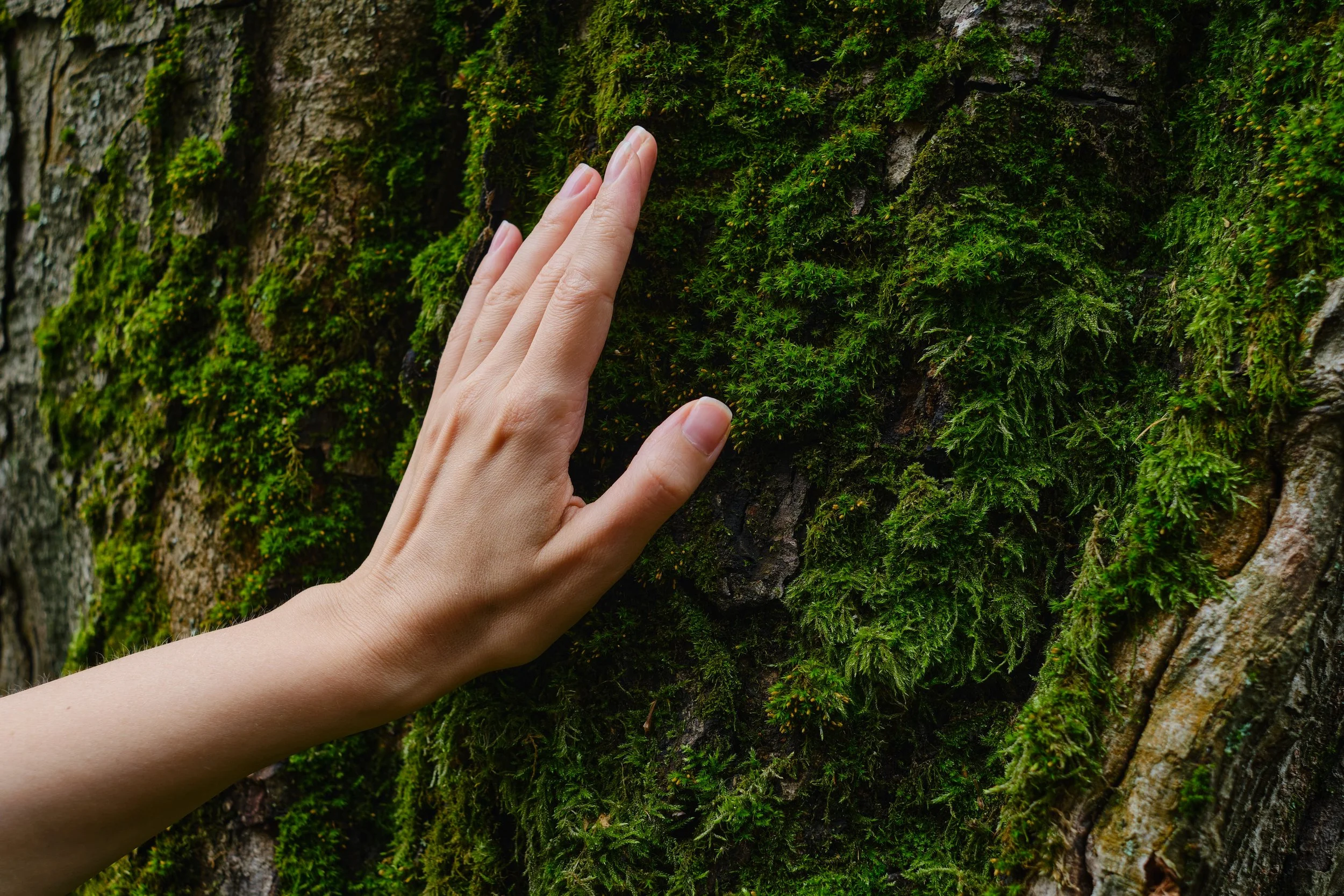
How Did That Moss Get Way Up There?
Moss has no legs, no wings, and no roots. So how does it end up growing high on a maple branch? On our walk this week, we talked about the relationship between moss and maple trees.
Meet the Maples
Maine's forests are home to several kinds of maple, including red maple and sugar maple. Sugar maples can reach 60 to 70 feet, and their sap gives us maple syrup. Red maples are a bit shorter, at around 50 to 60 feet.
As maples grow older, their smooth young bark becomes ridged and furrowed. Those cracks matter to moss! You may also know maples by their winged "helicopter" seeds.
Meet the Mosses
"Moss" isn't just one species. There are more than 10,000 kinds, and they do things differently from a maple:
- No roots: Thin threads called rhizoids anchor moss in place, but they don't soak up water the way roots do.
- Whole-body drinking: Moss takes in water and nutrients through its outer surfaces.
- Amazing comebacks: When moss dries out, it goes inactive and wakes up again when water returns.
Because moss doesn't need soil, a branch can make a good home. A plant that grows on another plant this way is called an epiphyte (EP-ih-fite).
How Moss Reproduces
Moss has no flowers, seeds, or pollen. Instead, its life has two stages that take turns:
- The green stage: The soft, leafy moss you know makes eggs and sperm, often on separate male and female plants.
- A swim in the rain: Moss sperm must swim! Raindrops splash sperm from male plants to female plants, where they swim to the eggs. That's one reason moss needs moisture.
- The stalk stage: A fertilized egg grows into a thin stalk with a tiny capsule on top. If you've seen little "hairs" rising from a moss patch, you've probably seen these.
- Spore launch: The capsule's lid falls off, and spores come out. Many mosses have tiny "teeth" around the opening that open and close with the humidity, and wind helps pull the spores out.
- A new start: If a spore lands somewhere suitable, it grows into a green thread, then buds into new leafy moss.
So How Does Moss Get So High?
Moss doesn't start on the ground and climb to the top of the tree. Most likely, it arrives by air.
Many moss spores are so tiny that wind carries them easily, sometimes for long distances. Picture specks drifting through the forest like invisible dust. Most land somewhere moss can't grow. But one might settle in a damp crack in a maple branch, and that's all it takes to start a new patch.
Moss has a backup plan, too. Pieces that break off can grow into new plants. Storms and animals can break moss apart, and wind or water can carry small pieces. These pieces usually travel only short distances, but that could help a patch spread along a branch.
How the Relationship Works
When one species benefits and the other isn't really affected, scientists call it commensalism, and moss and maple fit that idea pretty well. The moss gets a place to live, high in the light and rain, while it makes its own food by photosynthesis. Unlike a parasite, it doesn't reach into the tree to steal food.
Maples may be especially good hosts. A study of sugar maples in New York found that big trees had thicker bark that held more water and dried more slowly. Rain running down the trunks also picked up minerals. Moss cover was higher on bigger trees, possibly for these reasons.
But nature is rarely that simple! Moss soaks up rain like a sponge, so less water may reach the soil, while evaporation may help cool the forest. Scientists are still working out how much these effects matter.
Be a Moss Detective!
On our next walk, let's investigate:
- Where does moss grow on a maple: in the cracks, on the branches, or at the base?
- Do bigger maples have more moss than smaller ones?
- Can you find any tiny stalks and capsules? A hand lens will help!
Something to think about: If you were a tiny moss spore looking for a home, what would you want from a tree?
Want to Learn More?
- Do Lichens and Mosses Drink From Tree Bark?, a science article written for young readers
- Grow Moss in a Terrarium, an activity from Science Friday
- Red or Sugar Maple?, how to tell these two trees apart