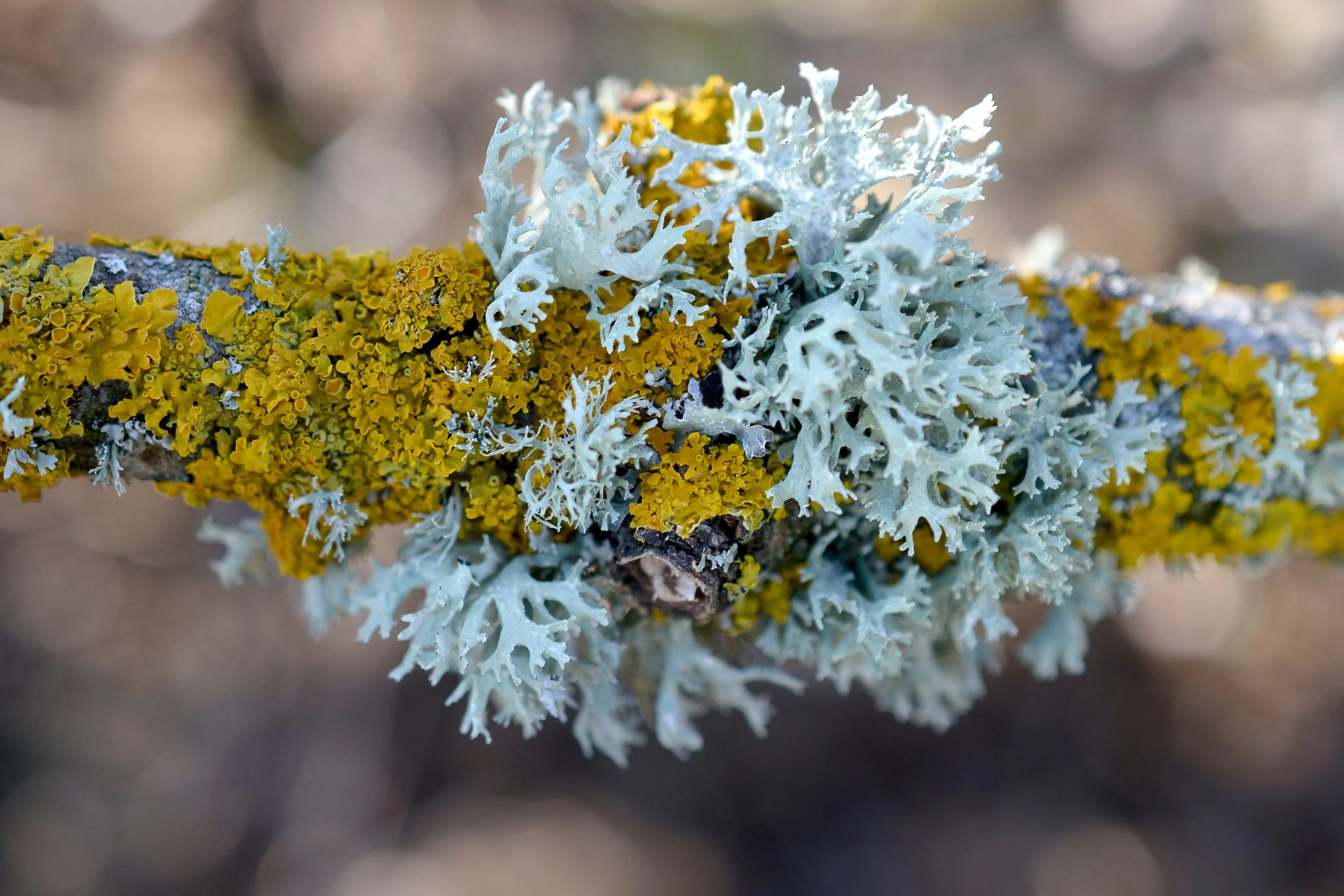
Lichen and Red Spruce: Roommates in the Branches
Monday Woods Walk — Week of October 26, 2026
Walk into a spruce grove near the coast and look up. Hanging from the branches you'll see pale, greenish-gray strands, like a wizard's beard caught in the tree. Look closer at the trunk and you'll find flat crusty patches in gray, green, even orange. That's lichen, and our red spruce trees are covered in it.
A lot of people think lichen is a disease that's killing the tree. It isn't. This week we figured out what's really going on.
Meet the Red Spruce
The red spruce (Picea rubens) is one of the most common evergreens in Maine, and it loves our foggy, rocky coast.
How to know one:
- Needles: Short (about half an inch), shiny, dark green, stiff, and sharp. Grab a branch and it feels prickly. Roll a needle between your fingers: it's four-sided, so it rolls easily. (A fir needle is flat and won't roll.)
- Cones: About 1½ to 2 inches long, shiny reddish-brown, hanging down from the branches.
- Bark: Reddish-brown and flaky, breaking into thin scales on older trees.
- Shape: A narrow, pointed crown when young, like a classic Christmas tree.
Red spruce can grow 60 to 80 feet tall. People have used it for building lumber, paper, and even the soundboards of guitars and violins, because the wood rings so clearly. Its sap was once chewed as spruce gum, Maine's original chewing gum.
Learn more: Red Spruce — Forest Trees of Maine (Maine Forest Service)
Meet Lichen
Here's the weird part: a lichen isn't one living thing. It's two (or more) living together as a team.
- A fungus builds the body of the lichen. It holds onto surfaces, soaks up water, and protects its partner from drying out or getting too much sun.
- An alga (or sometimes a cyanobacterium) lives inside the fungus. It uses sunlight to make food through photosynthesis, and shares that food with the fungus.
Neither partner could live in a dry, windy spot like a tree branch on its own. Together they can. That kind of partnership, where both sides benefit, is called mutualism. A lichen is a relationship you can hold in your hand!
On our spruces you'll find three main shapes:
- Crusty (crustose): Flat patches painted onto the bark.
- Leafy (foliose): Wrinkly, leaf-like flaps.
- Hairy (fruticose): Hanging strands, like old man's beard (Usnea), the "wizard's beard" on our spruces.
Learn more: Lichen — Britannica Kids
The Relationship: A Good Place to Live
So what's the connection between lichen and red spruce?
What the lichen gets. A home. Lichens don't have roots, and they don't take food or water from the tree. They make their own food from sunlight and drink water straight from rain and fog. What they need is something solid to hang onto, high enough to catch light and moisture. A red spruce branch on the foggy Maine coast is perfect: always damp, lots of fog drifting through, and bark rough enough to grip.
What the spruce gets. Not much, but it isn't harmed either. Lichens aren't parasites. When one living thing benefits from another and the other isn't helped or hurt, scientists call it commensalism. That's the main relationship here.
Why lichen shows up on dead branches. You may notice the lower branches of a spruce, the dead ones, are often the most covered in lichen. That's because dead branches have no needles to block the sun, so the lichen gets more light. The lichen didn't kill the branch. It moved in after.
A small bonus for the forest. When lichen falls to the forest floor, it breaks down and adds nutrients to the soil. Some lichens can even pull nitrogen out of the air and turn it into plant food. Deer and flying squirrels eat lichen, and birds use old man's beard to line their nests.
Learn more: Is That Lichen Killing Those Trees? — Ontario Parks
Lichens Are Air Detectives
Lichens soak up everything from the air and rain, including pollution. Many lichens, especially the hairy kind like old man's beard, can't survive where the air is dirty. So when you see a spruce draped in beard lichen, it's a clue that the air in St. George is clean.
Watch For on Our Next Walk
- Roll a needle. Spruce or fir?
- Find all three lichen shapes: crusty, leafy, and hairy.
- Compare branches. Is there more lichen on live branches or dead ones?
- Check the side. Is there more lichen on one side of the trunk than the other? Why might that be?
Big Idea
Red spruce and lichen are roommates. The spruce gives lichen a place to live, and the lichen doesn't take anything in return. And the lichen itself is a partnership between a fungus and an alga. So every time you look at a lichen-covered spruce, you're looking at a relationship inside a relationship.
See you Monday.