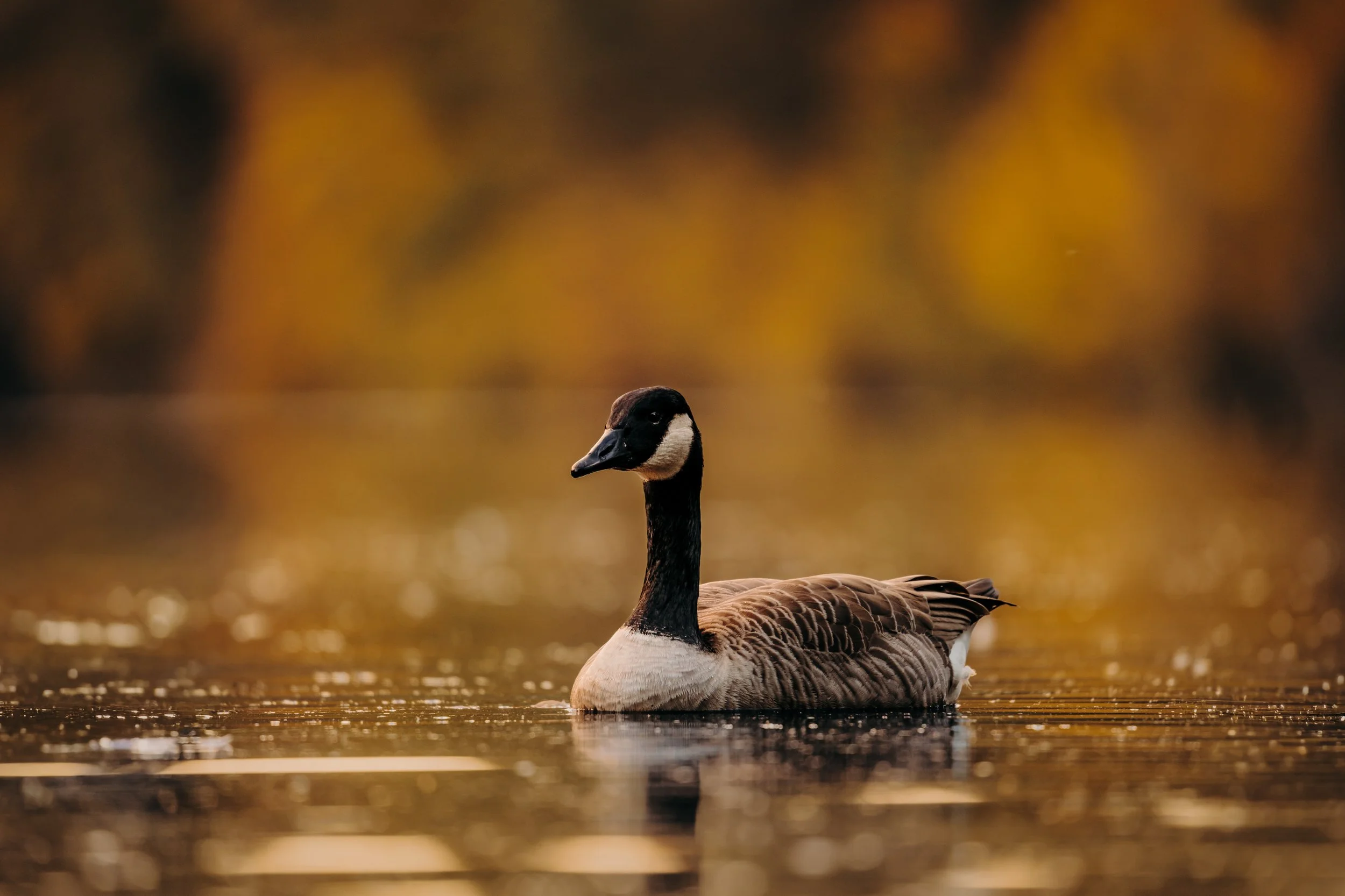
Canada Geese and Waterweed: Tipping Up for Lunch
Monday Woods Walk — Week of October 26, 2026
You've probably heard them before you saw them: a loud HONK-HONK from a V of big birds flying overhead. Canada geese are some of the easiest birds in Maine to spot. But this week we watched them doing something odd on the pond: sticking their heads underwater with their tails pointed straight up at the sky.
What were they after? A plant most people never notice: waterweed. Let's meet both.
Meet the Canada Goose
The Canada goose (Branta canadensis) is a big bird. A grown-up one can weigh as much as a gallon of milk and has wings that stretch nearly five feet from tip to tip. (Fun fact: it's Canada goose, not Canadian goose, even though most people say it the second way.)
How to know one:
- Look: Brown body, black neck and head, and a white "chinstrap" patch under the chin.
- Sound: A loud, honking call. That's why people call them "honkers."
- Flight: Long V shapes in the sky. Flying in a V saves energy, because each goose catches a little lift from the air coming off the wings of the goose ahead of it.
Many Canada geese migrate, flying north in spring and south for winter, and fall is a great time to watch them pass through Maine. Some now stay all year on ponds, golf courses, and town fields.
Geese are herbivores. They eat grass, seeds, and grain on land, and underwater plants in ponds. To reach those plants, they "tip up": dunking their head and neck with their tail in the air, just like we saw.
Learn more: Canada Goose — All About Birds (Cornell Lab of Ornithology)
Meet Waterweed
Common waterweed (Elodea canadensis) lives completely underwater in ponds, lakes, and slow streams. Notice its scientific name has canadensis in it, just like the goose. Both are native to North America and belong right here in Maine.
How to know it:
- Leaves: Small, narrow, bright green leaves growing in little rings of three around a skinny stem. Up close, a strand looks a bit like a green bottle brush.
- Where: Underwater, often in thick, tangled beds. Pull up a strand on a stick and you'll probably find snails or tiny bugs hitchhiking on it.
- A strange trick: Waterweed rarely makes seeds. Instead, it spreads by fragments. If a piece of stem breaks off and floats away, it can grow roots and become a whole new plant.
Waterweed is a big deal in a pond. It makes oxygen for fish to breathe, gives small fish and insects a place to hide, and feeds ducks, muskrats, beavers, and geese.
Learn more: Common Waterweed — Chesapeake Bay Program Field Guide and Elodea canadensis — Go Botany (Native Plant Trust)
The Relationship: Eater and Eaten… and a Little More
What the goose gets. Food. Waterweed is soft, leafy, and easy to pull up. For a big bird that eats a lot of plants every day, a thick bed of waterweed is a salad bar. Migrating geese need extra energy in fall, so ponds full of underwater plants make great rest stops.
What the waterweed gets. At first this looks one-sided: the goose eats, the plant gets eaten. But remember waterweed's strange trick? It spreads by broken pieces.
When geese tear at waterweed, they break off lots of fragments, and many drift off to start new plants elsewhere in the pond. Scientists think waterbirds can also carry bits of water plants tangled on their feet and feathers from one pond to another. And goose droppings add nutrients that plants use to grow.
So the goose eats some waterweed, but it can also help the plant spread — a little like how mowing a lawn doesn't kill the grass.
Too much of a good thing. Balance matters. A few geese nibbling a pond is fine. But a big flock staying in one small pond all year can eat plants faster than they grow back, and their droppings can add so many nutrients that the water turns green and cloudy with algae. That's bad news for the waterweed, the fish, and the pond.
Watch For on Our Next Walk
- Count the tip-ups. How long does a goose keep its head underwater?
- Find waterweed. Use a stick to pull up a strand from the shallows. Can you see the rings of three leaves?
- Look for hitchhikers. What's living on the waterweed you pulled up?
- Listen and look up. Are geese flying over? Which direction are they headed?
Big Idea
Canada geese and waterweed are linked by food, but it's not as simple as "eater wins, plant loses." The geese get a meal, and by breaking the plant apart and carrying pieces around, they can help it spread. Just like the rest of nature, it works best in balance.
See you Monday.