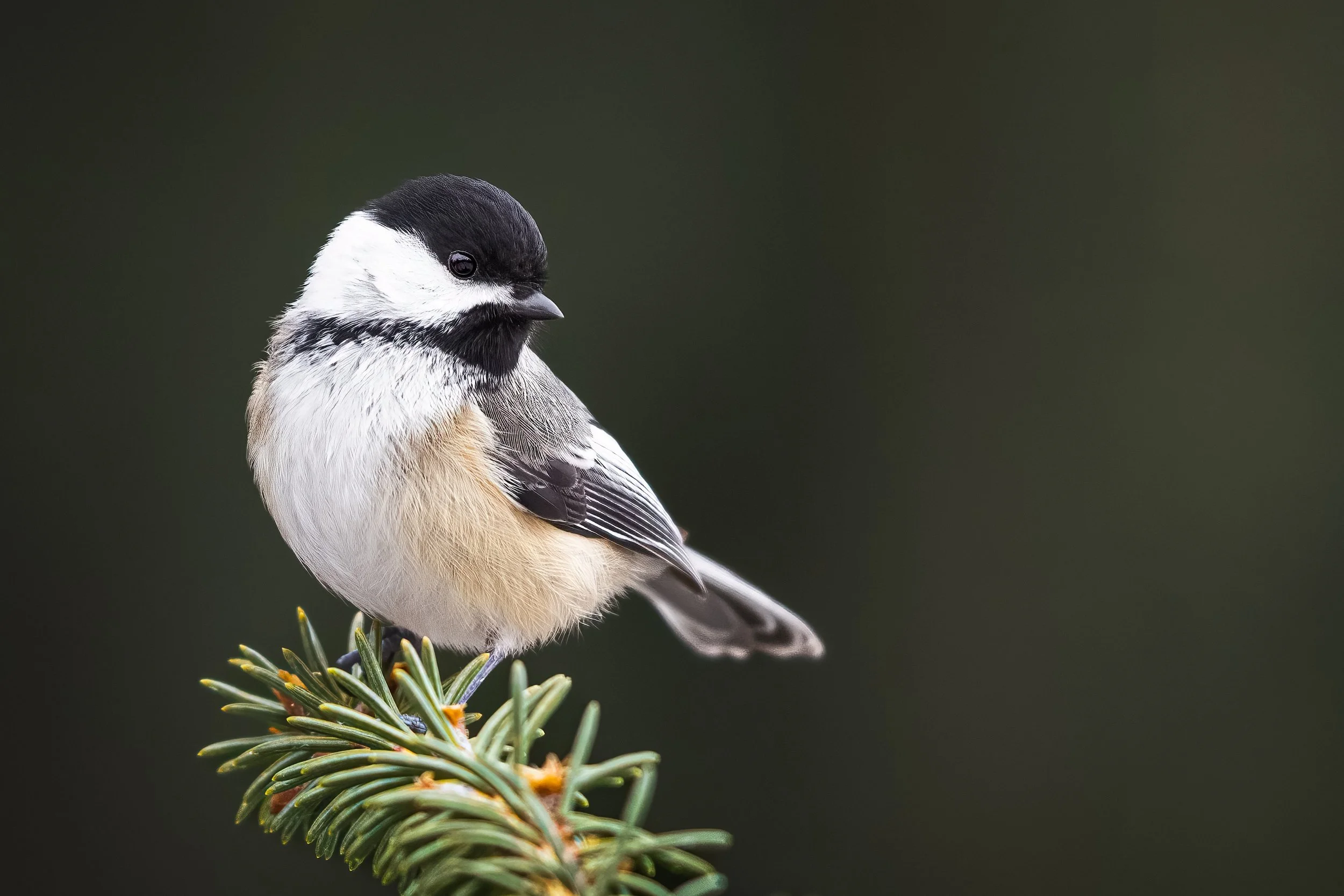
Tiny Bird, Tall Tree: Chickadees and Red Spruce
On our walk this week, we talked about two neighbors you can find almost anywhere in the woods around St. George: a small, cheerful bird and a tall, prickly tree. It turns out the black-capped chickadee and the red spruce have a lot to offer each other, especially as winter comes to Maine.
Meet the Black-capped Chickadee
You probably know this bird: black cap, black bib under its chin, white cheeks. It's also Maine's state bird, chosen in 1927.
Chickadees are tiny: just over five inches long and lighter than five pennies. Most birds that small fly south for winter, but chickadees stay in Maine all year.
How does such a small bird survive? It has some amazing tricks:
- It's a champion food hider. In fall, a chickadee hides seeds and other food in thousands of different spots, then remembers where they are when food gets scarce. The part of its brain that remembers places, the hippocampus, grows bigger in fall, when it's busy hiding food.
- It shivers all night. By day it eats as much as it can and stores the extra as fat. At night it burns that fat by shivering to stay warm.
- It turns down its own thermostat. On cold nights, a chickadee can lower its body temperature by about 12 to 15 degrees Fahrenheit, which saves energy until morning.
Maine also has a cousin, the boreal chickadee, which has a brown cap and lives mostly in northern Maine.
Meet the Red Spruce
Red spruce is a conifer, a tree with needles and cones that stays green all year. It is the signature tree of the Acadian forest, the forest that covers much of northern New England and Canada's Maritime Provinces.
Here's how to recognize it:
- Needles: about half an inch long, shiny dark green, stiff and prickly. They point toward the tip of the branch.
- Bark: on older trees, broken into thin, reddish-brown scales.
- Cones: about one and a half to two inches long, reddish-brown and shiny when ripe. They hang down from the branches.
Red spruce likes cool, damp air, which is one reason it grows well along the Maine coast. It grows slowly and can live for more than 400 years.
People use red spruce wood for building lumber and even for the soundboards of guitars and violins.
How They Help Each Other
What the chickadee gets from the spruce:
- Food. Red spruce cones ripen in early fall, and their winged seeds are a great snack. Chickadees do not just eat spruce seeds, they hide them too. At one study site, chickadees hid between 50,000 and 80,000 spruce seeds in a single fall. They tuck them into cracks in bark, clusters of needles, and even snow.
- Shelter. On winter nights, birds often roost in conifers, close to the trunk. The thick needles block the wind, and the trunk gives off a little warmth.
What the spruce might get from the chickadee:
Chickadees search the cracks in tree bark for insect eggs, caterpillars and pupae. One of the biggest enemies of spruce and fir trees is the spruce budworm, a caterpillar that eats their needles. In a study in Quebec, in an area where spruce budworm was present, the budworm's family of caterpillars made up more than a third of the caterpillars chickadees ate. Every caterpillar a chickadee eats is one fewer chewing on needles.
What Kind of Relationship Is This?
When both partners get something good, scientists call it mutualism. The chickadee clearly gets a lot: food, hiding places and a warm place to sleep. The spruce gets some help with pests, but it can live without chickadees, and chickadees could find food and shelter in other trees. So this is a looser partnership than some we'll explore this year. You could call them "good neighbors."
What do you think? Is it fair to call this mutualism, or does the chickadee get a better deal?
Look Closer on Our Next Walk
- Watch a chickadee for one full minute. Does it go into the needle clusters? Does it fly off with something in its beak to hide?
- Look for cones. Spruce cones fall in autumn and early winter. Are there any on the ground? Are any chewed apart?
- After a snowfall, check the base of a big tree. The warmth a trunk gives off can melt a ring in the snow around it. That's the same warmth that helps roosting birds.
I wonder: A chickadee hides thousands of seeds, but does it find every single one? What do you think happens to the seeds it forgets?
Want to Learn More?
- Chickadee: Maine Atlas: The story of Maine's state bird, and why lawmakers argued about which chickadee it should be.
- Black-capped Chickadee Life History: All About Birds: What chickadees eat, where they nest and how they live in flocks.
- How Do Birds Survive the Winter?: All About Birds: Why chickadee feet don't freeze, and other cold-weather tricks.
- Black-Capped Chickadees Are Masters of Memory: Smithsonian Magazine: How scientists are learning what goes on inside a chickadee's brain.
- Red Spruce: Maine Forest Service: The official guide to identifying red spruce in Maine.