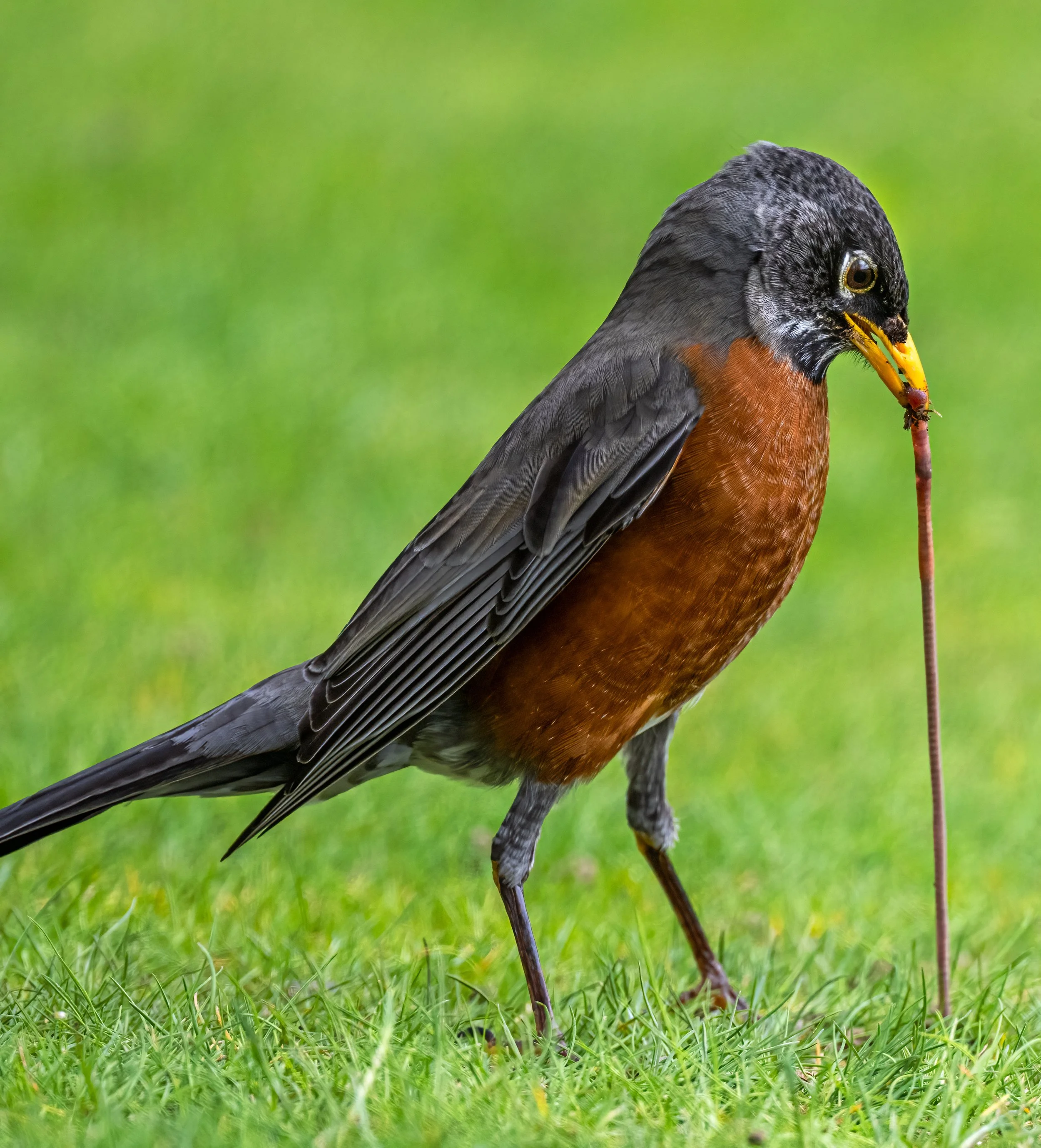
The Bird, the Worm, and a Trip Across the Ocean: American Robins and Earthworms
You've probably heard "the early bird gets the worm." On our walk this week we talked about the American robin and one of its favorite foods, the earthworm. But this story has a surprise in it. The earthworms in Maine are newcomers. They came here from Europe!
Meet the American Robin
You know this bird: gray wings and back, a reddish breast and a yellow beak. In the Abenaki language, the robin is called kwikweskas, a name that copies the sound of its sputtering call.
Robins live almost everywhere: lawns, fields, city parks, woods and even mountains. The female builds a cup-shaped nest of grass and twigs, glues it together with mud, and lines it with soft, dry grass. She lays three to five sky-blue eggs.
Many people think robins are a sign of spring, but Maine Audubon says robins have no trouble spending the winter here. In fall and winter, they gather in large flocks and wander around looking for fruit. Staghorn sumac, the shrub with fuzzy red clusters of berries, is a favorite winter food.
Meet the Earthworm
An earthworm doesn't have eyes, ears or lungs, but it gets along just fine:
- It breathes through its skin. Oxygen passes through its moist skin. That's why a worm has to stay damp, and why it can die if it dries out.
- It senses light without eyes. A worm can tell light from dark and moves away from light.
- It feels vibrations. Worms have no ears, but they are very sensitive to movement in the ground.
- It's built in rings. A worm's body is made of segments, up to about 150 in the common nightcrawler.
Earthworms eat dead leaves and other decaying material, swallowing a lot of soil along the way.
Here's the Surprise: Maine's Worms Came From Europe
Thousands of years ago, giant glaciers covered Maine. They scraped away the soil and everything in it. According to the State of Maine, because of these glaciers there are no native earthworms in Maine. (Native means a living thing that was here before people brought it.)
So where did our worms come from? When European settlers sailed to North America, their ships carried soil and rocks as ballast, extra weight that kept the tall ships from tipping over. Earthworms hid in that soil, and in the roots of plants the settlers brought. Once they arrived, the worms spread across the Northeast. The nightcrawler you find after a rainstorm has ancestors from Europe.
Earthworms help gardens, but they can cause problems in forests, which grew for thousands of years without them. When worms move into a forest, they can eat up the thick layer of fallen leaves on the forest floor that many plants and animals depend on.
Who Gets What?
What the robin gets: dinner! In spring and summer, robins eat lots of earthworms, plus insects and some snails. A robin often stands very still, tilts its head to one side, then stabs the ground and pulls out a worm.
How does it know where the worm is? Scientists have argued about this for a long time. A study in 1965 decided robins find worms by sight. About 30 years later, another study found robins could find worms they couldn't see, by listening! Today, many scientists think robins use both their eyes and their ears.
Here's one more connection. When a robin glues its nest together with mud, it often uses mud made from worm castings, which is a polite name for worm poop.
What the earthworm gets: not much. Getting eaten is bad news for a worm.
What Kind of Relationship Is This?
When one animal hunts and eats another, scientists call it a predator and prey relationship. The robin is the predator, the hunter. The earthworm is the prey, the one that gets eaten.
There's a twist, though. Because worms are newcomers to Maine, the robins here have only been eating them for a few hundred years. What do you think robins in Maine ate before the worms arrived?
Look Closer on Our Next Walk
- Look for robins in flocks. Are they on the ground or up in trees and shrubs? Can you spot any eating berries or sumac?
- Check under a log or a flat rock. If you find a worm, notice how it moves away from the light. Put it back gently, and keep it moist!
- Look at the forest floor. Is there a thick layer of old leaves, or is it bare soil?
I wonder: When the ground freezes solid in winter, where do the earthworms go?
Want to Learn More?
- How Do Robins Find Worms?: Ask Dr. Universe: A Washington State University scientist explains how robins use their eyes and ears to hunt.
- American Robin Life History: All About Birds: What robins eat, how they build nests and where they spend the winter.
- Earthworms: The Good, the Bad, and the Bizarre: KidsGardening: How earthworms breathe, sense the world and grow.
- Invasive Worms: Maine Department of Agriculture: Why Maine has no native earthworms, and how worms from far away got here.
- Earthworms Are Invading Our Forests: Cary Institute: A scientist explains what happens when worms move into a northern forest.