Snapping Turtle
Ancient and Unhurried: The Snapping Turtle
Georges River Land Trust — Living River Species Series
Introduction
If the painted turtle is the watershed's sun-worshipping neighbor, easy to spot and pleasant to observe, the snapping turtle (Chelydra serpentina) is something altogether different — older-feeling, more secretive, with a reputation that precedes it. People who grew up near Maine ponds know the snapper mostly as a warning: don't put your hand near that one. And while the snapping turtle's defensive bite is real and not to be trifled with, there is a great deal more to this animal than its temperament on land. The snapping turtle is one of the watershed's most important ecological players — a long-lived, wide-ranging omnivore that has been keeping these waters clean and balanced for millions of years.
Natural History
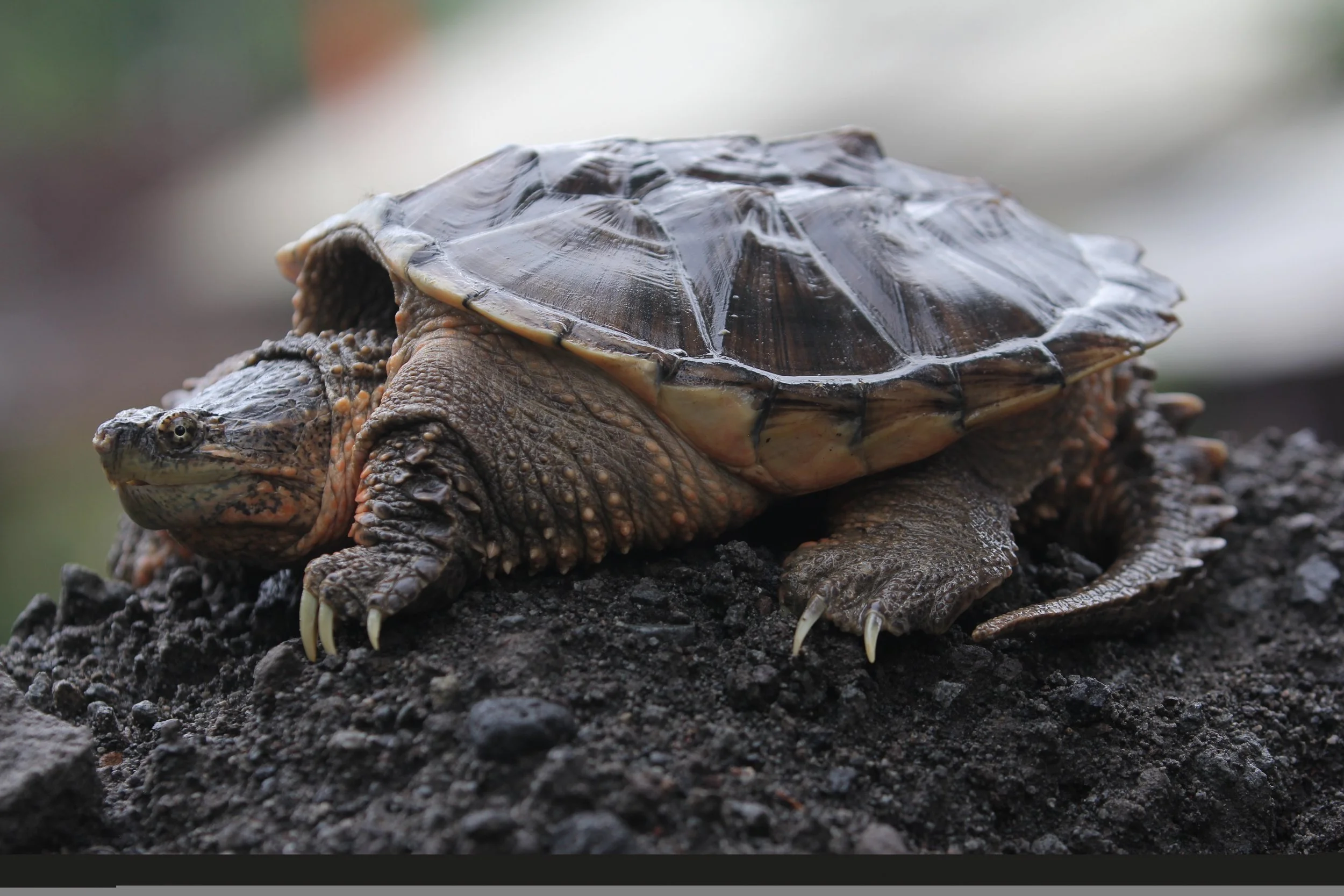
Snapping turtles are large, prehistoric-looking animals with rough, dark shells often blanketed in algae, powerful hooked beaks, long necks, and tails ridged like a small dinosaur's. Adults commonly weigh 10 to 35 pounds, with some individuals reaching 40 pounds or more after decades of steady growth. They are among the largest freshwater turtles in the Northeast.
Unlike the painted turtle, snappers are highly aquatic and rarely haul out to bask. They spend most of their lives submerged in the muddy bottoms of ponds, lakes, slow rivers, and marshy wetlands, buried in silt with little more than their eyes and nostrils exposed. In the water they are surprisingly docile — a swimmer who accidentally brushes one is far more alarmed than the turtle. On land, however, a snapper feels exposed and vulnerable, and reacts accordingly.
They are true omnivores of remarkable flexibility: fish, frogs, crayfish, aquatic insects, snails, waterfowl, small mammals, aquatic vegetation, algae, and carrion all end up on the menu. This dietary breadth is part of what makes them so ecologically important — and so effective as survivors.
Snappers mature slowly, typically reaching breeding age at 15 to 20 years. They can live well past 40, and possibly much longer. A large snapping turtle in the St. George watershed may be older than many of the people who share its shoreline.
Identification Tips
Snapping turtles are large and unmistakable: a rough, often algae-covered dark shell that looks almost too small for the body, a long, saw-toothed tail nearly as long as the shell, a thick neck, and a hooked, beak-like jaw. Unlike painted turtles, snappers rarely bask in the open — look instead for just the eyes and nostrils breaking the surface, or a wake moving through duckweed. The plastron, or belly shell, is small and cross-shaped, leaving the legs and tail exposed, a useful mark if you see one out of water. Hatchlings, barely the size of a quarter, already show the ridged tail and hooked beak in miniature. Size alone is a strong clue too — a freshwater turtle in the St. George watershed over a foot long and 10 or more pounds is almost certainly a snapper.
Role in the St. George River Watershed
Few animals in the watershed hold as many ecological roles simultaneously as the snapping turtle.
As scavengers, they consume dead fish, waterfowl, and other carrion, performing a quiet sanitation function in ponds and slow-moving water that is easy to overlook but genuinely important. A wetland with healthy snapper populations is one with fewer rotting carcasses accumulating in the shallows.
As predators, they regulate populations of fish, frogs, and aquatic invertebrates. They are one of the few freshwater predators capable of taking adult painted turtles and their eggs — a relationship we noted in our painted turtle post. Ducklings and goslings are vulnerable in areas with large snappers, which creates predictable tension with people who feed waterfowl, but this predation is a natural and ancient dynamic. Muskrats occasionally fall prey to large adults as well.
As prey, snapping turtles contribute most during their early life. Raccoons, skunks, foxes, crows, and herons raid snapper nests with high success — nest predation rates can exceed 80 percent in some populations. Hatchlings face additional predation from large fish, herons, and hawks during their scramble from nest to water. The small fraction that survive to adulthood enjoy relative safety: a full-grown snapper has few natural predators in Maine.
The algae that colonizes their shells provides microhabitat for aquatic invertebrates, and the burrows snappers create in muddy pond bottoms are occasionally used by other species. Their movement between wetlands also aids in dispersal of aquatic plant seeds and invertebrate eggs carried on their bodies — a small but real contribution to the connectivity of wetland habitats across the watershed.
Road mortality during the June nesting season is one of the most significant human-caused threats. Females travel surprising distances from water to find nesting sites, often crossing roads, and their slow pace and late-to-reproduce biology make vehicle strikes a serious population concern.
Seasonal Notes
Snappers emerge from hibernation in the muddy pond bottom in April and May. June is nesting season — the time when females are most likely to be seen on land and on roads, sometimes far from water. Eggs incubate through summer, hatching in August and September. Hatchlings may overwinter in the nest in some years, emerging in spring. By October, adults return to the pond bottom to hibernate, buried in mud where they absorb enough oxygen through their skin to sustain their minimal winter metabolism.
Fun Fact
Snapping turtles can absorb oxygen directly through specialized tissue around their tail and cloaca — effectively breathing through their backside while hibernating underwater all winter. This adaptation, called cloacal bursae respiration, allows them to remain submerged for months without surfacing, even under ice.
Want to Learn More?
- Maine IF&W — Reptiles and Amphibians — Maine species accounts and conservation status for native turtles.
- Maine Audubon — Turtles and Road Safety — How to safely help a snapping turtle across a road without injuring yourself or the turtle.
- Maine Turtle Research, Outreach and Conservation (ME-TROC) — University of Maine program studying turtle populations and road mortality across the state.
- iNaturalist — Snapping Turtle — Track sightings across the region and contribute your own observations.
The Living River blog series is published by St. George Consulting in support of the Georges River Land Trust and the Maine Council of Trout Unlimited. To explore the important work these organizations are doing to conserve and restore Maine's landscapes, visit georgesriver.org and tumaine.org.