Common Shiner
The Stream's Silver Currency: The Common Shiner
Georges River Land Trust — Living River Species Series
Introduction
Wade into any clean, clear tributary of the St. George River on a summer morning and look down. If the water is healthy, you will almost certainly see them — flashes of silver darting through the current, small fish moving in loose schools that catch the light and scatter like thrown coins. These are almost certainly common shiners (Luxilus cornutus), and they are easy to overlook precisely because they are so reliably, abundantly there. But the common shiner is anything but ordinary. It is one of the watershed's most ecologically important fish — a living link between the aquatic insects in the streambed and the larger predators above — and in late spring, the males transform into something genuinely beautiful.
Natural History
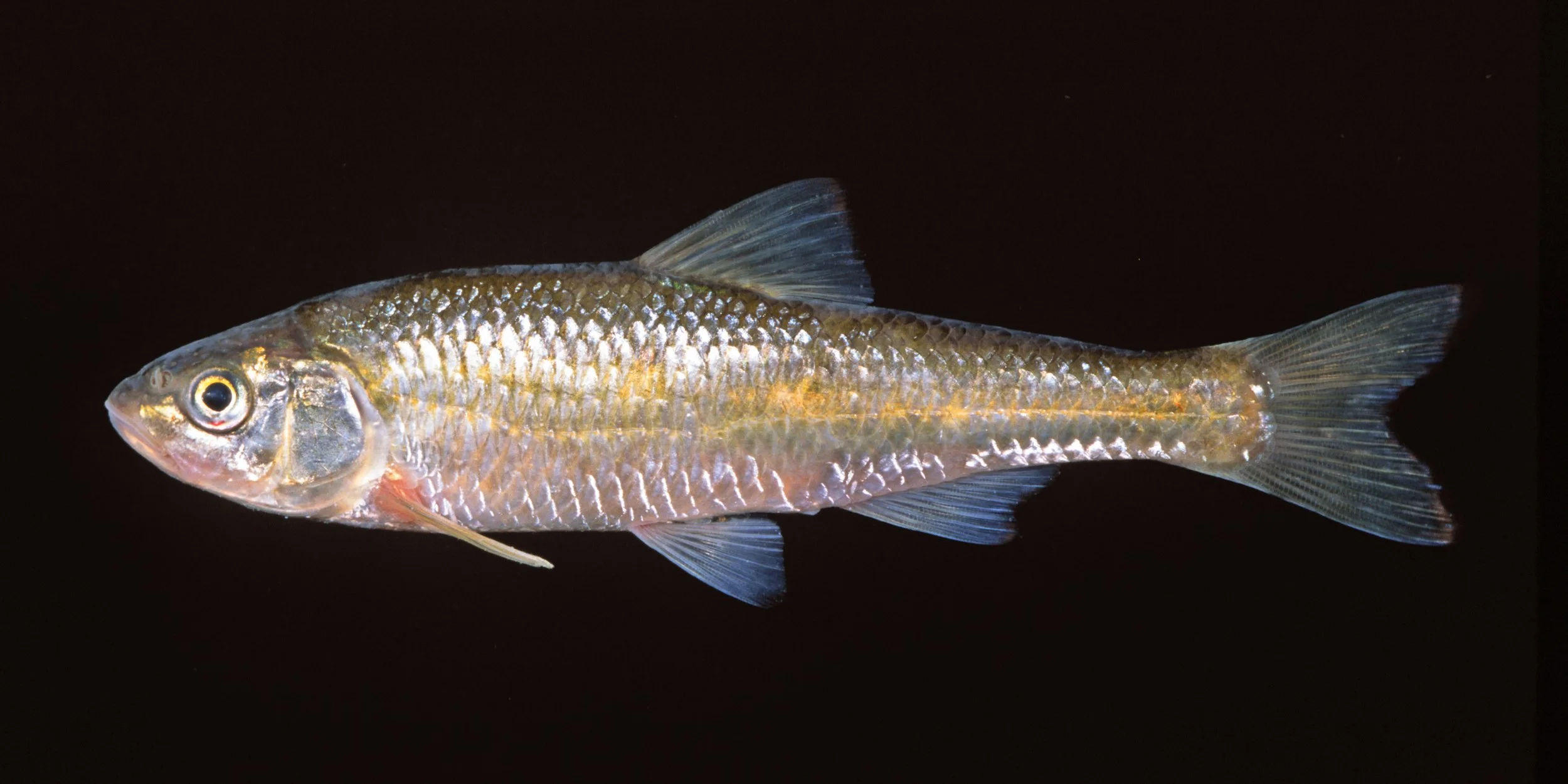
Common shiners are small, streamlined fish, typically three to five inches long, with the bright silvery sides that give them their name. For most of the year they are modestly handsome — silver flanks, olive-toned backs, a dark lateral stripe running from snout to tail. But come late May and June, the males change. Their sides flush with rose and pink, their fins warm to orange-red, and their heads develop small, hard bumps called nuptial tubercles that play a role in spawning competition. For a few weeks, the common shiner of the St. George's gravel runs is a genuinely striking animal.
They are native to eastern North America and strongly associated with clean, well-oxygenated streams and rivers — the kind of cool, clear water that defines the upper tributaries of the St. George watershed. They school readily, moving in loose groups through riffles and pools, feeding opportunistically on whatever the current delivers: aquatic insects, terrestrial insects that fall onto the water surface, algae, zooplankton, and small invertebrates. Their position as generalist feeders in the middle of the food web makes them indispensable connectors in the stream ecosystem.
One of the common shiner's most remarkable traits is its spawning behavior — or more accurately, its relationship with another fish while spawning.
Identification Tips
Common shiners are slim, silvery minnows three to five inches long, with an olive-toned back and a subtle dark lateral stripe that fades toward the tail — much fainter than the bold, continuous stripe of a blacknose dace. A useful technical mark: the dorsal fin sits slightly behind the pelvic fins, distinguishing shiners from several similar minnows. Outside the breeding season, look for loose, flashing schools of small silver fish holding in riffles and pool edges of clean, clear tributary streams. In late May and June, breeding males are unmistakable — rose-pink flanks, orange-red fins, and small hard bumps (nuptial tubercles) on the head.
Role in the St. George River Watershed
The common shiner occupies a central position in the watershed's stream food web, functioning simultaneously as predator and prey in ways that support nearly every other species in the river.
Looking upward in the food web: common shiners are primary forage for brook trout, brown trout, and landlocked salmon — all of which depend heavily on small forage fish through the warmer months when aquatic insect hatches are less predictable. Smallmouth bass and chain pickerel take them in slower pools and lake margins. Above the surface, belted kingfishers plunge-dive for shiners with precision, and great blue herons and common mergansers wade and dive among schools. The shiner's abundance is what makes these predators' success possible.
Looking downward: common shiners consume enormous quantities of mayflies, caddisflies, stoneflies, and midges — both as larvae in the streambed and as adults on the surface during hatches. In doing so, they transfer the energy stored in aquatic insects upward through the food chain to trout, birds, and beyond. They also consume terrestrial insects — ants, beetles, grasshoppers — that fall from overhanging streamside vegetation, creating a direct link between the riparian forest and the river.
One of the most fascinating ecological relationships in the watershed involves spawning. Common shiners frequently spawn in or immediately adjacent to nests built by creek chubs, a slightly larger minnow that constructs gravel mounds in stream riffles. The creek chub males defend these nests aggressively, but common shiners dart in to deposit eggs among the gravel — effectively borrowing the chub's carefully tended real estate. Both species end up spawning in the same nest at times, a relationship that benefits the shiner while the chub tolerates it with varying degrees of success.
As a water quality indicator, the common shiner is genuinely useful. It requires clean, well-oxygenated water to thrive. A healthy shiner population in a St. George tributary is meaningful evidence that the stream's basic conditions — temperature, dissolved oxygen, sedimentation, and chemical quality — are reasonably intact.
Seasonal Notes
Common shiners are active throughout the open-water season, from ice-out in April through late October. Feeding activity peaks in May and June as aquatic insect hatches intensify. Spawning occurs from late May through June in gravelly riffles and shallows, when males are at their most colorful. Schools are most visible in clear, shallow water on calm summer mornings. By November, shiners move to deeper, slower water as temperatures drop, remaining sluggish through winter beneath the ice.
Fun Fact
Common shiners can detect the chemical alarm signals released by injured members of their own school — a substance called schreckstoff (German for "fright substance") — and respond instantly with an evasive schooling response. This chemical warning system, shared by many minnow species, means that a predator's first strike alerts the entire school before it can strike again.
Want to Learn More?
- Maine IF&W — Freshwater Fishes of Maine — Maine's native and naturalized fish species, with biology and distribution.
- FishBase — Common Shiner — Global species database with range maps, ecology, and biological detail.
- Maine Rivers — Stream Health — Advocacy and education around Maine's river ecosystems and the species that depend on them.
- iNaturalist — Common Shiner — Regional sightings and photos from community naturalists across New England.
The Living River blog series is published by St. George Consulting in support of the Georges River Land Trust and the Maine Council of Trout Unlimited. To explore the important work these organizations are doing to conserve and restore Maine's landscapes, visit georgesriver.org and tumaine.org.