Jewels at the Water's Edge: Damselflies
Georges River Land Trust — Living River Species Series
Introduction
On a warm July afternoon along a shaded reach of the St. George River, if you watch the water where sunlight breaks through the canopy in shifting pools, you may see something that stops you mid-step: a small, iridescent creature with dark wings flickering in a slow, almost butterfly-like flight just above the surface, its body catching the light in flashes of metallic blue-green. This is the ebony jewelwing (Calopteryx maculata), one of the most beautiful insects in the watershed — and one of the more visible members of a group that most people have seen without quite registering: the damselflies. Cousins to the dragonfly, slender and jewel-bright and tied to clean water their entire lives, damselflies are as much a part of the living river as the current itself.
Natural History
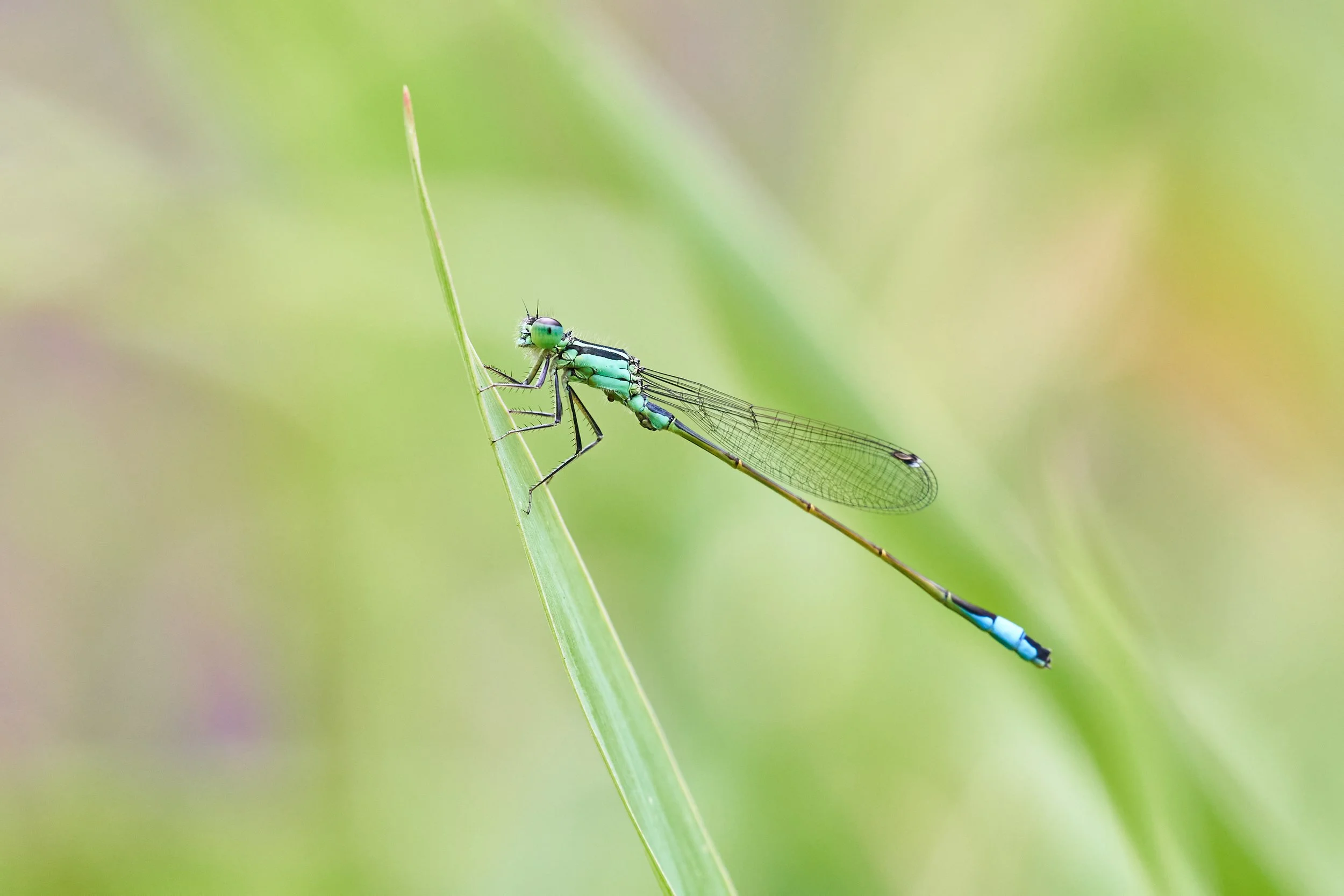
Damselflies belong to the Order Odonata — the same ancient lineage as dragonflies — but occupy their own distinct suborder, Zygoptera. The difference is worth knowing. Where dragonflies hold their wings flat and out to the sides at rest, damselflies fold theirs back along the body, like a small aircraft parked with folded wings. Damselflies are also more slender and delicate, and their large compound eyes are set to the sides of the head rather than wrapping nearly all the way around as in dragonflies.
Maine hosts a wonderful variety of species. The ebony jewelwing haunts the shaded banks of clean, flowing streams — the male's dark, iridescent wings and metallic green body making him unmistakable. The bluets (Enallagma spp.) are far more numerous but easily overlooked: tiny, vivid blue damselflies that emerge in clouds from ponds and lake margins through summer. Spreadwings (Lestes spp.) hold their wings slightly open at rest, an intermediate posture between the dragonfly and the typical damselfly. American rubyspots glow with red wing patches along faster stream reaches.
All damselflies are aquatic as nymphs, living in ponds, slow streams, and wetland vegetation for one to three years before emerging as adults. The nymph breathes through three leaf-like gills that project from the tip of its abdomen — a feature that immediately distinguishes it from a dragonfly nymph, which breathes through internal rectal gills. Adults are aerial hunters, catching small flying insects with precise, basket-like legs while in flight.
Identification Tips
Damselflies are easiest to separate from their dragonfly cousins by wing posture: damselflies fold their wings back along the body at rest, while dragonflies hold theirs flat out to the sides. Damselflies are also more slender overall, with a thinner abdomen and eyes set apart on the sides of the head rather than nearly meeting on top. The ebony jewelwing is unmistakable — inky black wings and a metallic green-blue body, fluttering low over shaded stream banks. Bluets are tiny and, true to the name, vivid blue with black markings, usually seen in loose swarms over pond and lake edges. Spreadwings hold their wings at a partial angle, neither fully open nor fully closed — a useful in-between clue when you're unsure which group you're looking at.
Role in the St. George River Watershed
Damselflies connect the watershed's aquatic and terrestrial worlds in both directions — feeding below the surface as nymphs and above it as adults, and being fed upon by creatures of both realms.
Nymphs are active predators of small aquatic invertebrates — midge larvae, tiny mayfly nymphs, water fleas, and small crustaceans — in the pond margins and slow backwaters of the watershed. They are in turn consumed by brook trout, yellow perch, and bass, which take them from the vegetation and streambed. Painted turtles eat them along pond edges, and great blue herons and kingfishers take both nymphs and adults near the water's surface.
Adults hunt midges, gnats, small flies, and other tiny insects on the wing, contributing to the regulation of flying insect populations in the riparian zone through summer. They are eaten by tree swallows and barn swallows in flight, by cedar waxwings and flycatchers from perches, and by little brown bats in the evening — the same bats that hunt caddisfly adults over the water after dark, as we described in that post.
Damselfly eggs are laid directly into aquatic plant tissue — species like the jewelwing insert eggs into the stems of submerged and emergent vegetation, including water lilies, pondweeds, and aquatic sedges. The health of the watershed's aquatic plant communities is therefore directly tied to damselfly reproductive success.
The ebony jewelwing's dependence on clean, cool, well-shaded streams with silt-free bottoms makes it a meaningful water quality indicator in the tributaries of the St. George. Like the stonefly and the blacknose dace, its presence signals something real and good about the water it inhabits. Degraded, silted, or warmed streams lose jewelwings quickly — their absence is as informative as their presence.
The sphagnum bogs of the upper watershed — another subject in this series — support specialized spreadwing and bluet species adapted to the cool, acidic, low-nutrient conditions of bog pools, adding yet another layer to the damselfly's ecological range across the watershed.
Seasonal Notes
The first damselflies appear in late May and early June, with bluets and spreadwings often the earliest to emerge from ponds and lake margins. Ebony jewelwings are most abundant along streams in June and July, when the male's courtship display — slow, fluttering flight with those dark wings catching the light — is at its peak. Peak diversity across species runs from late June through August. Most damselflies are gone by mid-September, though warm autumns can push stragglers into early October. Nymphs are present in the streambed and pond vegetation year-round, growing slowly through winter and spring before emerging the following summer.
Fun Fact
When a damselfly nymph is grabbed by a fish or other predator, it can shed its three tail gills — dropping them the way a lizard drops its tail — and escape while the predator is momentarily distracted by the detached, still-wriggling appendages. The gills do not regenerate fully, which means a nymph that has lost them breathes less efficiently for the remainder of its aquatic life. It is a costly but sometimes life-saving sacrifice.
Want to Learn More?
- Maine Damselfly and Dragonfly Survey — Maine Odonata, the citizen science effort tracking dragonfly and damselfly distribution across the state; you can contribute sightings.
- Cornell Lab — Odonata Central — The leading North American database for dragonfly and damselfly observations, with range maps and species accounts.
- Bug Guide — Zygoptera — Photographic identification guide to North American damselfly species and life stages.
- iNaturalist — Damselflies — Regional sightings and community photos; an excellent tool for learning to identify species in the field.
The Living River blog series is published by St. George Consulting in support of the Georges River Land Trust and the Maine Council of Trout Unlimited. To explore the important work these organizations are doing to conserve and restore Maine's landscapes, visit georgesriver.org and tumaine.org.