Caddisflies
Architects of the Streambed: Caddisflies
Georges River Land Trust — Living River Species Series
Introduction
Turn over a smooth rock in any clean riffle of the St. George River and look at what clings to the underside. Among the algae and mayfly nymphs you will almost certainly find something that at first glance looks like a small piece of the streambed itself — a tidy cylinder of sand grains, or a bundle of tiny twigs, or a mosaic of pebbles, all fitted together with uncanny precision and moving with quiet determination across the rock face. Inside is a caddisfly larva (Order Trichoptera), going about its business in a house it built entirely by itself, grain by grain, from materials it found on the bottom of the stream. Caddisflies are among the most ecologically vital and biologically extraordinary insects in the watershed, and most people have never given them a second look.
Natural History
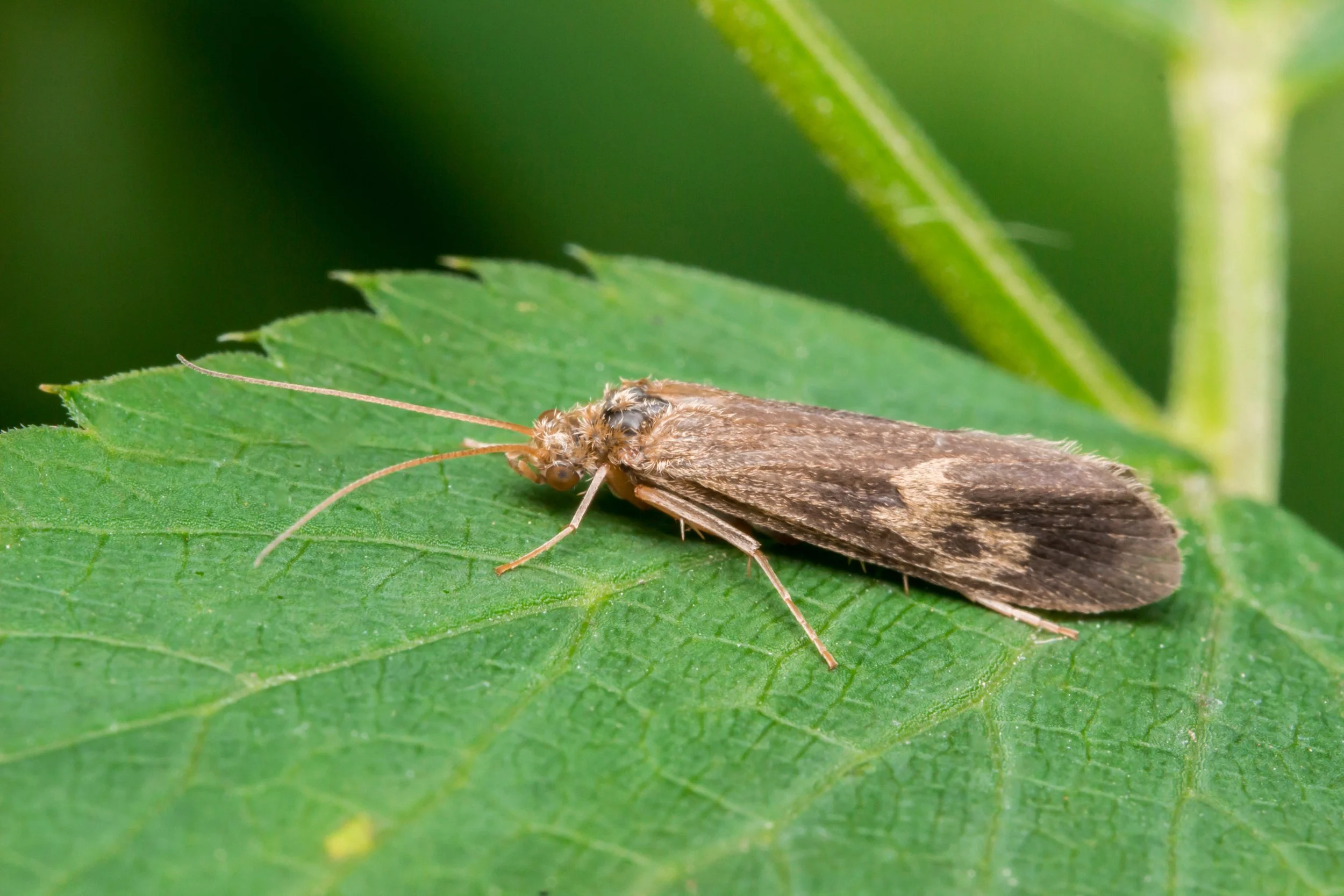
Caddisflies are closely related to moths and butterflies — so closely that entomologists consider them sister groups. As adults they are moth-like in appearance: soft-bodied, long-antennae'd, and holding their wings in a tent-like fold over their bodies when at rest. The difference is in the wings themselves, which bear tiny hairs rather than scales, giving the order its name: Trichoptera means "hair wings." Adults are short-lived, eating little or nothing, their purpose concentrated entirely into finding a mate and returning to the water to lay eggs.
It is the larval stage where caddisflies reveal their full character, and where the diversity of the order becomes apparent. Maine hosts hundreds of caddisfly species, each adapted to a slightly different niche in the stream ecosystem. Most larvae are architects. Using silk produced from glands near their mouths — true silk, chemically similar to that of silkworms — they construct protective cases from whatever material the local stream offers: sand grains arranged in precise spirals, leaf fragments cut and assembled like shingles, small pebbles stacked in careful rows, or fine mineral particles smoothed into a seamless tube. Each species builds a recognizable design, as consistent as a fingerprint.
Some caddisflies forgo the portable case and instead spin silk nets anchored between rocks in the current — fixed filters that intercept fine organic particles drifting downstream, which the larva then harvests. Others are free-living predators that roam the streambed without a case at all. The order spans the full range of aquatic feeding strategies, from leaf-shredder to algae-grazer to active predator, making caddisflies collectively one of the most functionally diverse insect groups in any freshwater system.
Identification Tips
The larvae are the easiest life stage to identify: look for a small, cylindrical case — built from sand grains, tiny pebbles, leaf fragments, or bits of twig, each species with its own signature pattern — inching across submerged rocks with only the head and legs protruding from the open end. Net-spinning species instead leave a small silk net strung between rocks or debris in the current. Adult caddisflies look moth-like at rest, holding their wings tent-fashion over the body, but lack the powdery scales of a true moth — the wings look dull and slightly hairy rather than patterned. The surest way to separate a caddisfly from a similar-looking small moth resting near water is habitat and posture: caddisflies stay close to the stream, wings folded low and roof-like, antennae held forward.
Role in the St. George River Watershed
The caddisfly's ecological importance in the watershed operates at every level of the stream food web simultaneously.
As shredders, case-building species that feed on leaf litter work alongside stonefly nymphs — as we described last week — to process the annual leaf fall from the riparian forest. Alder, birch, and red maple leaves are broken down by shredding larvae into fine particles that drift downstream and feed the net-spinning filterers waiting to intercept them. It is an assembly line of decomposition, with caddisflies occupying multiple stations.
As scrapers, other species graze the algae and diatom biofilm from rock surfaces in the same riffles where blacknose dace forage — the two sharing the same food resource from opposite biological kingdoms, the fish working the water column, the insect working the rock face.
As prey, caddisfly larvae are indispensable to brook trout, brown trout, and landlocked salmon throughout the year. The larva in its case is consumed whole, case and all. Fly anglers have imitated caddis larvae, pupae, and adults for centuries; the elk hair caddis and similar patterns rank among the most effective trout flies ever devised, which is not coincidence — it reflects the centrality of caddisflies to a trout's diet across every season.
When caddisflies hatch in numbers — emerging from the water as winged adults in the evening — the event reorganizes the immediate food web around it. Trout rise. Tree swallows and barn swallows course over the water's surface snapping adults in flight. After dark, little brown bats take over, hunting by echolocation in the same airspace the swallows abandoned. The hatch is brief, sometimes lasting less than an hour, and during it the boundary between the aquatic and terrestrial worlds briefly dissolves.
The silk nets of net-spinning caddisflies also stabilize streambed gravel — their threads bind particles together and reduce the scouring effect of high flows, providing a subtle but real benefit to the stability of the habitat they inhabit.
Seasonal Notes
Caddisfly larvae are present in the streambed year-round, growing through one to two years before pupating. Spring hatches begin in April and May and are often spectacular on the St. George's cleaner tributaries. Summer hatches continue through June and July, typically in the evening. Fall species emerge in September and October, sometimes on warm afternoons, providing late-season feeding opportunities for trout before winter. In winter, larvae remain active in the gravel of fast, cold runs, one of the few invertebrate groups still feeding and growing under the ice.
Fun Fact
In the 1980s, French artist Hubert Duprat began providing caddisfly larvae with gold flakes, turquoise, opals, and tiny pearls instead of the usual sand and pebbles. The larvae, utterly indifferent to the material's monetary value, incorporated the precious stones into their cases using the same precise silk-spinning technique they would use on gravel. The resulting structures — tiny jeweled tubes of remarkable elegance — have been exhibited in museums as art objects. The caddisfly is the only non-human animal whose unmodified natural behavior has produced work displayed in fine art galleries.
Want to Learn More?
- Maine DEP — Biological Monitoring — How Maine uses aquatic invertebrates including caddisflies to assess stream health.
- Bug Guide — Trichoptera — Photographic guide to North American caddisfly species, larvae, cases, and adults.
- Xerces Society — Freshwater Invertebrates — Conservation context for aquatic insects and the clean-water habitats they require.
- Hubert Duprat — Caddisfly Art — For those intrigued by the fun fact: search "Hubert Duprat caddisfly" for images of the jeweled cases.
The Living River blog series is published by St. George Consulting in support of the Georges River Land Trust and the Maine Council of Trout Unlimited. To explore the important work these organizations are doing to conserve and restore Maine's landscapes, visit georgesriver.org and tumaine.org.