Smooth Gray Giant Under Siege: American Beech
Georges River Land Trust — Living River Species Series
Introduction
Walk through a Maine hardwood forest in late fall and you'll notice that one tree hasn't let go of its leaves. While its neighbors stand bare, the American beech (Fagus grandifolia) holds onto pale, papery tan leaves that rustle in the wind well into winter. With its smooth, elephant-gray bark and its rich crop of nuts, the beech is one of the most important wildlife trees in our woods. Today it also faces serious threats.
Natural History
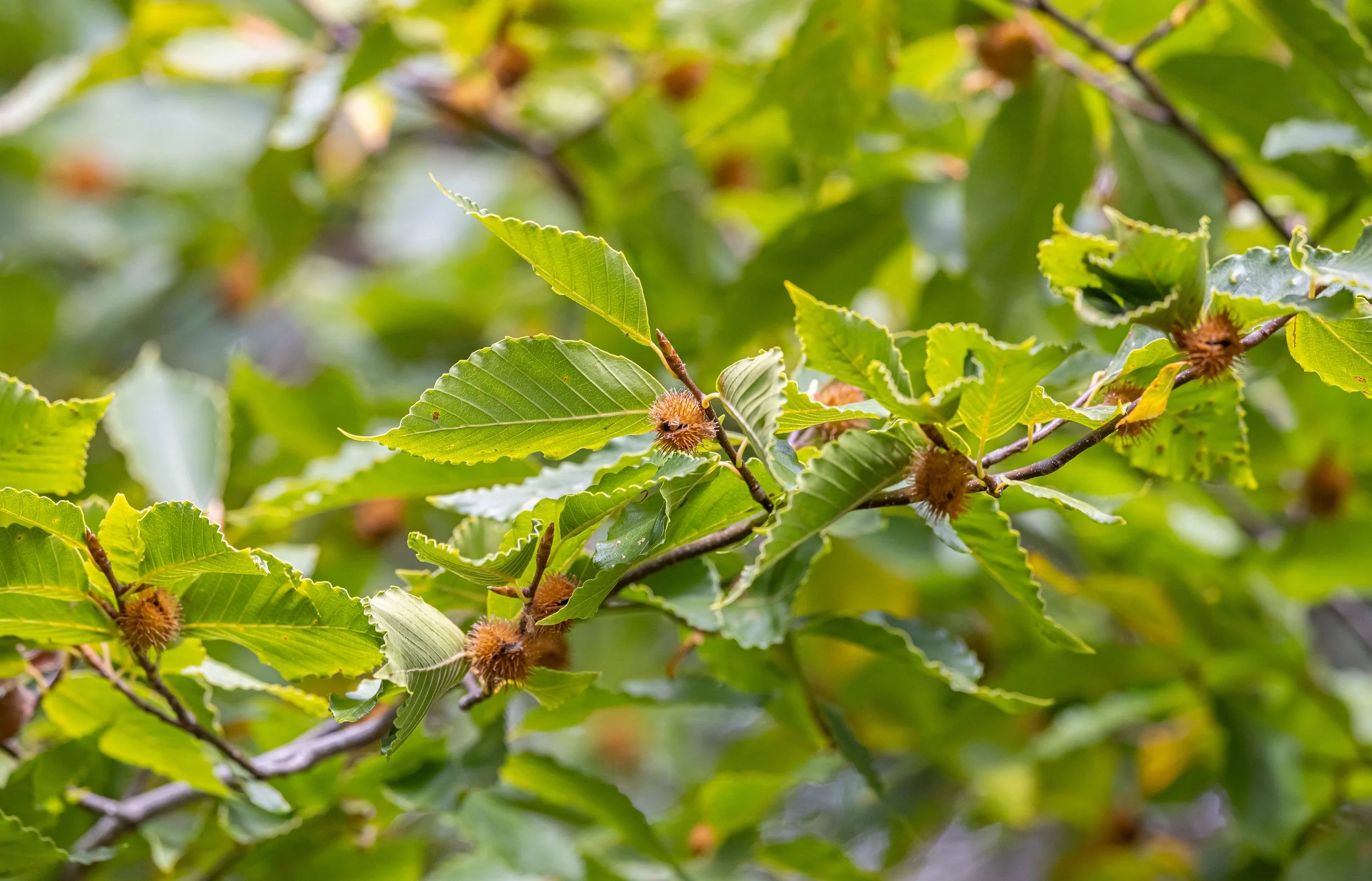
American beech grows up to about 70 feet tall in Maine. Its most famous feature is its smooth, light gray bark, which stays smooth unless disease attacks it. Its leaves are 3 to 5 inches long, sharply pointed, with coarse, hooked teeth, and its buds are long, slender and sharp-pointed. Each bur usually holds two triangular, sweet nuts.
Beech is a slow-growing climax species that can grow up under the shade of other trees and live more than 300 years. It also has a habit of sprouting from its roots. Trees begin producing nuts around age 40, and heavy crops come every two to eight years.
Maine's champion beech, in Hallowell, was listed in 2008 at 87 feet tall.
Role in the St. George River Watershed
Beech grows statewide in Maine, best on rich upland soil, and sometimes forms nearly pure stands. Its nuts, called beech mast, are one of the forest's most important wildlife foods. In cold northern spruce-hardwood forests, beech is the only tree producing hard mast, making it a key fall food for black bears fattening up for winter.
But beech faces two serious threats. Beech bark disease, which arrived in North America around 1920 on imported European beech seedlings, now causes significant mortality in Maine. And beech leaf disease, associated with a non-native microscopic roundworm, was first found in Maine in Lincolnville, in Waldo County, in 2021. It has since spread to every county in the state.
A Web of Relationships
- Plants: Beechdrops (Epifagus virginiana) is a brown plant with tiny leaves and no chlorophyll that lives as a parasite on beech roots, getting all its nutrients from the tree.
- Birds: Ruffed grouse, blue jays and ducks eat beechnuts.
- Mammals: Black bears climb beeches to feed on the nuts, leaving claw marks on the trunk and sometimes piles of broken branches called "bear nests." Deer, foxes, squirrels, chipmunks and mice eat the nuts too.
- Insects: The beech scale, an insect accidentally brought from Europe, feeds on the bark and opens the door to beech bark disease.
- Fungi: Beech bark disease is a partnership between that scale insect and Neonectria fungi. As the scale feeds, it weakens the bark, and fungal spores carried by wind and rain enter through the wounds. Cankers form under the bark, leaving it pockmarked and deformed, and branches die back until the tree dies. Look for clusters of tiny red fruiting bodies, each less than a millimeter wide, the fungus's spore-producing stage. After the disease sweeps through, beech often resprouts from roots into dense thickets of small trees that rarely live long enough to bear nuts.
Wabanaki Connections
The Mi'kmaq name for beech is Su'omusi, and beechnuts are su'mann. A trail guide from Nova Scotia's Bras d'Or Lake Biosphere Reserve describes Mi'kmaq uses of the tree: beechnuts as food, beech leaves for tea and for flavoring game meat, and beech wood as long-burning firewood. This knowledge belongs to living Wabanaki communities, and readers who want to learn more are encouraged to seek out Wabanaki voices and Wabanaki-led organizations.
Seasonal Notes
Right now (late October and November): Look for beeches by their light tan leaves, which often stay on the tree into winter. Check the bark for black bear claw marks.
Winter: Long, slender, sharp-pointed buds help identify beech. Watch for white streaks or blotches on the bark, the colonies of beech scale.
Summer: Check leaves for dark bands between the veins, the telltale sign of beech leaf disease. Leaves may also be cupped, shrunken or leathery. You can report suspected cases to the Maine Forest Service.
Fun Fact
Not every beech gets sick. Some trees resist the beech scale, likely thanks to the physical or chemical makeup of their bark. That's why the Maine Forest Service advises landowners to preserve resistant beeches rather than cut them.
Want to Learn More?
- Maine Forest Service: American Beech: Identification, uses and Maine's champion tree.
- Maine Forest Service: Beech Bark Disease: How the scale and fungus team up.
- Maine Forest Service: Beech Leaf Disease in Maine: Symptoms, spread and how to report it.
- University of Vermont: American Beech Bark and Black Bears: Why bears depend on beechnuts.
- Go Botany: Beechdrops: The parasitic plant that lives on beech roots.
The Living River blog series is published by St. George Consulting in support of the Georges River Land Trust and the Maine Council of Trout Unlimited. To explore the important work these organizations are doing to conserve and restore Maine's landscapes, visit georgesriver.org and tumaine.org.